
Leave a patch of ground alone long enough and something will grow there. It probably won’t be what you wanted, either. Your mind works the same way because whatever you keep thinking about, watching, worrying over, or giving your attention to starts taking up more space, and that’s where learning how to build mental discipline really begins.
Now picture this. Megan checks her phone before she even gets out of bed. By breakfast, she’s already seen bad news, somebody else’s vacation, a business owner celebrating a huge win, and one comment that irritated her enough to keep replaying it. Nothing catastrophic happened, but her mind already feels crowded before the day even starts.
That crowded mental garden is exactly what James Allen was warning about more than a century ago. In his 1903 classic As a Man Thinketh, he compared the mind to a garden: you can tend it on purpose or let it grow wild, but either way, something is going to grow.
That idea is one reason Allen’s book earned a place in our guide to forgotten books for self-discipline. And no, this isn’t another lesson about pretending everything is wonderful and thinking happy thoughts all day.
Mental discipline is about paying attention to what you keep feeding so your mind starts working with you instead of against you.
Your Mind Doesn’t Stay Empty
It’s easy to think that if you aren’t deliberately working on your mindset, nothing much is happening up there. But your mind doesn’t sit empty waiting for you to come back.
Something is always getting your attention. If you aren’t choosing it, whatever is loudest around you will usually make the choice for you.
That can look like:
- Comparison: Watching everybody else long enough that your own progress starts looking small.
- Resentment: Replaying something somebody said months ago as if the argument happened yesterday.
- Distraction: Checking one notification and somehow losing the next 40 minutes.
- Fear: Taking something that might happen and mentally turning it into something that definitely will.
The problem is that none of this feels dramatic while it’s happening. It just feels like another scroll, another thought, another argument you replay, or another hour you somehow lost.
But stack enough of those little moments together and they start eating into your focus, your energy, and the work you actually care about.
Think about how careful you are with your house. You wouldn’t let strangers walk through the front door all day and dump whatever they wanted in your living room.
Yet that’s basically what happens when every headline, opinion, argument, and piece of online nonsense gets unlimited access to your attention. If you’ve ever wondered how to protect your mental energy, start by looking at what gets access to you before you’ve even had breakfast.
Your attention is going somewhere either way. Mental discipline means deciding where it goes instead of handing it over to whatever happens to be loudest.

Thoughts Aren’t Harmless Background Noise
One weird or negative thought isn’t going to ruin your life. Everybody has thoughts they’d rather not have, and trying to control every single one would drive you crazy.
If you’ve ever wondered how to control your thoughts, this is the part people often get wrong. Control doesn’t mean preventing every unwanted thought from showing up; it means being more careful about which ones you keep returning to.
Think “I’m probably not good at this” once, and it may just be frustration. Keep repeating it, however, and eventually you start making decisions around it.
That’s where Allen’s garden idea starts making sense. A thought you keep watering has a much better chance of growing, and after a while, it starts showing up in the choices you make.
Maybe you stop applying for opportunities because you’ve decided you’re under-qualified. Maybe you quit something you were capable of learning because you’ve spent six months telling yourself you’re bad at it. Or maybe you avoid a hard conversation because you’ve already decided how badly it’s going to go.
That’s how thoughts affect your actions. The thought doesn’t magically create the outcome, but it can absolutely steer the choices that get you there.
Leave that pattern alone long enough, and you can start passing on opportunities, avoiding things that would help you grow, or settling for less simply because you’ve repeated the same story so many times that it feels true.
Mental Discipline Isn’t Fake Positivity
Mental discipline gets confused with positive thinking all the time. If something is going badly, telling yourself “Everything is amazing” doesn’t fix it.
Sometimes the most useful thought you can have is, “I screwed this up, and now I need to fix it.” That’s still mental discipline because you’re facing the problem instead of hiding from it.
Learning how to improve your mindset isn’t about swapping every uncomfortable thought for something cheerful. It’s about seeing the situation clearly without making it worse in your own head.
Something may have failed, somebody may have disappointed you, or you may have made the wrong call. You can acknowledge all of that without turning one bad situation into “Everything is ruined.”
Mental discipline gives you enough space between what happened and how you respond to it. You deal with what’s real without piling fear, drama, or false optimism on top of
What Are You Watering Every Day?
Allen’s garden metaphor gets practical when you look at what gets your attention every day. Whether you mean to or not, you’re watering something.
I know this firsthand. Last Christmas, someone stiffed me, and for weeks I kept replaying the whole situation in my head. I thought about what happened, what I should’ve said, how angry I was, and how unfair it felt.
Thinking about it for the hundredth time didn’t change anything. It just let that person keep taking up space in my head long after the situation was over.
It’s been nine months and it still pops into my mind sometimes. When it does, I can feel myself getting worked up enough that focusing on anything else is hard. But I’m steadily working on catching myself, reminding myself that replaying it won’t fix it, and pulling my attention back to what’s in front of me. I’m a work in progress.
That’s what watering a thought looks like. Comparison, fear, resentment, and old mistakes all get stronger when you keep going back to them. Before long, they can take up way more space in your head than they deserve.
The good news is that the same principle works in the other direction:
- Learn a skill and you become more capable.
- Work on your goals and they get clearer.
- Read things that make you think instead of react.
- Give your attention to work that actually matters.
The weeds may still pop up. But they don’t get nearly as strong when you stop watering them every time they appear.
So, ask yourself: What am I feeding every day, and is it growing the life I actually want?

How To Pull The Weeds Before They Take Over
If you’re trying to figure out how to stop negative thinking, the real problem usually isn’t the first thought. It’s getting trapped in the same mental loop and giving it more and more of your attention. The answer isn’t forcing yourself to think happy thoughts.
It starts with noticing when your mind has grabbed onto something and won’t let go. Maybe you’re replaying an argument, worrying about something you can’t solve tonight, or telling yourself the same tired story about why something won’t work.
That’s the moment to interrupt it.
- Notice what keeps repeating. Catch the thought before it gets another hour of your attention. If you’ve replayed the same thing five times today, that’s your signal.
- Ask whether it’s helping. There’s a difference between thinking through a problem and chewing on it until you’re miserable.
- Decide whether there’s an action to take. If there is, take it. Send the email, make the call, write it down, or handle the next step.
- If there’s no action, change the channel. Take a walk, clean something, work on a task, or give your attention to something you can actually do something about.
- Expect the thought to come back. You may have to redirect yourself more than once. That isn’t failure; it’s part of the practice.
That’s also a practical answer to how to stop overthinking. You don’t have to solve every thought; sometimes you just have to stop giving it unlimited airtime.
The goal isn’t to never have another negative thought. It’s to get better at noticing when one has taken over and choosing where your attention goes next.
If you want a little structure while you practice this, the 30-Day Discipline Reset gives you a daily place to track your actions, reset your focus, and keep following through.
How To Change Your Thought Patterns
Thought patterns usually change slowly because they were built slowly. If you’ve spent years assuming the worst, comparing yourself, replaying old mistakes, or questioning every move you make, one good morning isn’t going to erase all of that.
What helps is catching the old thought sooner and deliberately giving yourself a better one to work with. You’re not trying to lie to yourself. You’re trying to stop treating your first reaction like the final answer.
For example, “I always screw this up” can become “I screwed this one up. What needs fixing?” The first thought shuts the door. The second one gives you something to do.
The same thing works with comparison. Instead of “They’re so far ahead of me,” ask, “What are they doing that I could learn from?” Instead of “I’m terrible at this,” try, “What part of this do I need to get better at?”
That little shift matters because you’re training yourself to look for a next move instead of another reason to stay stuck.
Over time, those better responses become easier to reach. You may still have the old thought first, but you don’t have to build the rest of your day around it.
That’s how you begin to train your mind. You stop accepting every automatic thought as fact and start choosing which ones deserve to stay.
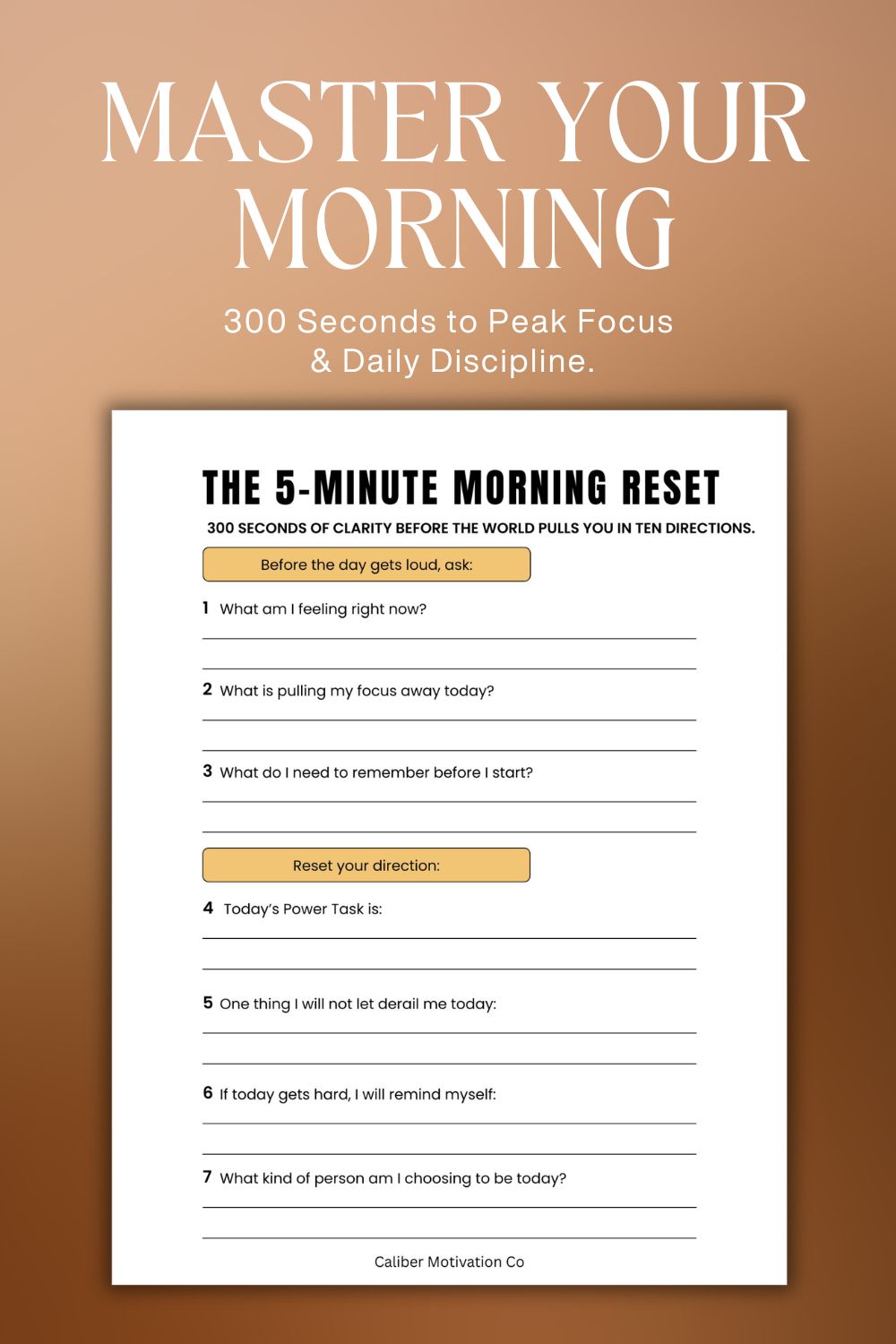
Want a simple way to reset your focus before the day gets away from you? Grab the Morning Reset and start your morning with a clearer head and a more intentional plan.
Free 5-Minute Morning Reset
Build stronger discipline, focus, and consistency with the free 5-Minute Morning Reset guide from Caliber Motivation Co. Get new blog posts, mindset strategies, and practical systems for long-term growth delivered straight to your inbox.
Plant Something Worth Growing
Pulling weeds is only half the job. Once you stop feeding the stuff that drains you, you need something better to take its place.
Start putting more of your attention toward things that actually build you. Read books that make you think, learn a skill that makes you more capable, work on a problem that matters, or spend time creating something instead of endlessly consuming what everybody else created.
Pay attention to the people around you too. Some conversations leave you clearer, sharper, and ready to move. Others leave you irritated, distracted, or carrying somebody else’s drama around for the rest of the day.
This doesn’t mean turning every waking minute into a self-improvement project. It just means being more selective about what gets repeated access to your mind.
Over time, that starts to change things. You recover faster when something gets under your skin. You spend less time stuck in your own head. Your decisions get clearer because every random thought, opinion, or distraction isn’t fighting for control.
That’s part of how to build a stronger mindset. You make the things you want to grow easier to reach and stop giving everything else unlimited room in your head.
You Still Have To Tend The Garden Tomorrow
You’re not going to get every thought right. Neither am I.
Some things take longer to let go of than we wish they would. Some thoughts come back even after we thought we were done with them, and some days we’ll handle that better than others.
What matters is that we keep trying.
We keep noticing what deserves our energy and what doesn’t. We keep choosing what kind of thoughts we want to carry forward, even when that choice takes effort.
There’s something hopeful about Allen’s garden metaphor because a garden can change. What grew there yesterday doesn’t have to be what grows there next season.
Neither does your mind.
You can plant something different. You can give better things more room. And little by little, you can build a mind that feels more like a place you want to live in.
If you’re ready to put that kind of discipline into practice, visit the Caliber Motivation Co. shop for tools designed to help you keep growing.
Join The Standard
Get practical articles on discipline, mindset, structure, and execution delivered straight to your inbox.
No hype. No fluff. Just real-world strategies to help you stay focused and keep building.
No spam. Unsubscribe anytime.