
There were so many times in my life when I wanted to do something but was completely stuck in the trap of saying “I can’t.” I didn’t test those limits; I just assumed they were there. As a result, I wasted years staying stuck. I didn’t reach places I might have reached sooner because I accepted limits I had never tested.
For nearly five years, one of those shelved goals was starting a YouTube channel.
I knew I wanted to do it. But I wanted a completely faceless channel, which meant I had to build highly professional, Motiversity-style compilation videos. Because I didn’t know how to do any of it, I just decided I couldn’t. In addition, I had no idea how to research and identify all the different speakers, find where to source raw footage, or download videos to clip them up. I was completely in the dark about copyright laws, licensing, and how “fair use” actually worked.
On top of the legal stuff, I didn’t know how to edit—sourcing the right b-roll, aligning the audio, and lining up the visuals perfectly to match the rhythm of a powerful speech felt impossible. I treated my lack of knowledge as proof that the goal was simply beyond my capacity.
Flipping the Switch From “Can’t” to “How”
In 2022, after my 18-year-old son died, I started watching motivational videos to get through the grief. In that dark place, something finally clicked. I remember thinking, “Thank God for these videos helping me get through. I want to make a channel to help other people.” Once it clicked, I was like, why didn’t I think of this sooner? That was the moment I started searching how.
My search history suddenly turned into a mountain of questions:
HOW TO:
- Build a motivational YouTube channel.
- Edit videos from scratch.
- Source and add video clips.
- Learn copyright, licensing, and fair use worked.
It was just how, how, how.
I didn’t suddenly gain all those technical and legal skills overnight. But I stopped saying I can’t and started asking how. I watched tutorials and learned one basic task at a time.
One of the hardest skills was learning how to blend several songs into one video. I watched tutorial after tutorial, tested different transitions, and kept adjusting the timing. The final result wasn’t perfect, but I created one video using three or four songs that came together better than I once believed I could manage.
I didn’t need to master the entire system first. I needed to stop treating “I don’t know how” as “I can’t.”
That experience taught me a hard truth: sometimes “I can’t” doesn’t describe your actual ability. It describes the exact moment you decided to stop looking for a way.

The Real Reason You Think You “Can’t”
Sometimes the problem is not the goal. It is the way your current life drains the energy needed to pursue it.
Maybe you are telling yourself “I can’t” build that business, learn that skill, or make that change because you are simply drained. You keep pushing in a job, a relationship, or a role you have outgrown, and the resulting fatigue makes every new goal feel completely impossible.
However, more willpower cannot fix a path that needs a new direction.
When you say “I can’t” to new opportunities, it does not mean you lack the talent. It means you may need to change how you are living, working, or managing your energy first.
Ask yourself one hard question: Am I telling myself “I can’t” because the goal is actually impossible, or because I am too exhausted to try?
Sometimes “I can’t” really means: “I am too tired to do it the old way.”
How “I Can’t” Shuts Down Your Mind
The moment you accept those words as fact; your brain stops searching for alternatives. It closes the file, shuts down the search engine, and goes on standby. Why look for a way over the wall when you’ve already declared the wall unclimbable?
“I can’t” is a full stop placed before the problem has even been examined. It acts as instant permission to stay powerless.
In a powerful speech on mental toughness, David Goggins describes exactly how the mind tries to trick you into giving up when things get heavy:
“Your brain is talking to you in all kind of ways and it wants to control you and pull you in these different pockets. If you can’t control your own brain and your brain controls you… it’s over… I gave myself no way out and my mind realized that. They said, ‘Okay, we’re gonna adapt and overcome.'”
If you want to solve harder problems—and build a life on your own terms—you have to force yourself to look past the word “can’t.” You have to tell your brain where you want to go, give yourself no way out, and say what you actually mean.
Watch the Full David Goggins Speech:
Disclosure: This post may contain affiliate links. If you purchase through these links, Caliber Motivation Co. may earn a small commission at no extra cost to you.
Want to go deeper? Can’t Hurt Me by David Goggins is a great book about challenging self-imposed limits, building resilience, and refusing to let excuses dictate your future.
The Real Cost of Saying “I Can’t”
Every time you say “I can’t” without testing the limit, you pay a price:
- First, you stop trying. You accept defeat before gathering evidence.
- Soon, you stop learning. You avoid skills you’ve already labeled impossible.
- Eventually, you stop noticing options. Your mind looks for proof that you’re stuck.
- Finally, you surrender decisions to fear. Discomfort begins setting your boundaries.
That price does not begin with the final failure. It begins with the story you tell yourself before you ever test what is possible.
What We Really Mean When We Say “I Can’t”
When you dig under the hood of a flat refusal, “I can’t” is often a placeholder for a much more honest truth. Here is what you are actually telling yourself when you use those words:
- “I don’t know how.” The truth is, you just haven’t learned how yet.
- “I don’t want the cost.” You simply aren’t willing to trade the time, effort, comfort, or money this requires.
- “I’m afraid of failing.” You are just scared of what will happen if you try and it doesn’t work.
- “I need help.” You don’t believe you can move forward without someone doing it right alongside you.
- “I don’t have time.” You haven’t decided what you’re willing to give up or change to make the space.
- “It feels impossible.” You are just overwhelmed because you’re looking at the whole mountain instead of the first step.
- “I’m choosing something else.” This project just isn’t important enough to you right now to make the required trade.
During those five years when I thought I couldn’t start a YouTube channel, the biggest barrier was believing I needed help. For years, I kept thinking, “I can’t do this alone.” After searching for someone to build the channel with me, I eventually gave up looking and put the dream off even longer. Instead, I treated the lack of a partner as proof that I couldn’t do it. That belief became a major part of my “I can’t.”
Spotting the excuse is awareness. Challenging it is growth. The table below takes the seven most common “I can’t” statements and turns each one into a question that puts you back in control.
Replace “I Can’t” With a Better Question
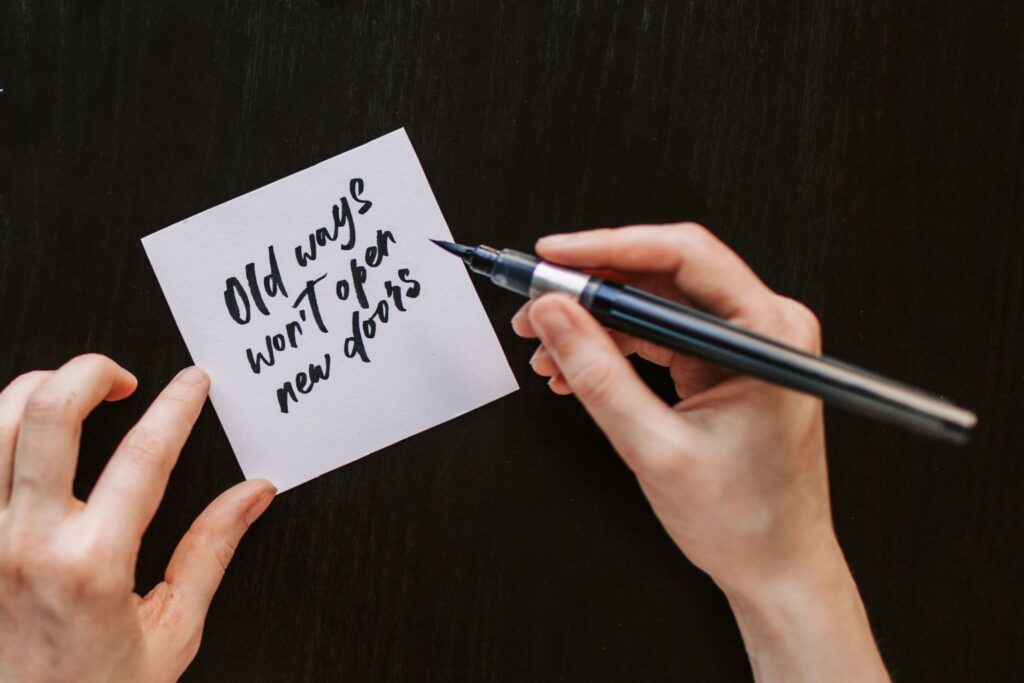
If you catch yourself saying one of these negative statements, use one of the examples below to reframe your thinking and shift from avoidance to action.
| Instead of saying… | Ask yourself… | What this changes |
| “I don’t know how.” | “How can I learn this? Where can I find the right resources?” | You turn confusion into a research plan. |
| “I don’t want the cost.” | “What am I willing to trade to make this possible?” | You face the real price in time, effort, money, or comfort. |
| “I’m afraid of failing.” | “What can I learn even if this doesn’t work the first time?” | You stop treating failure like the end and start treating it like information. |
| “I need help.” | “Who can teach me, guide me, or point me in the right direction?” | You move from waiting for a partner to actively finding support. |
| “I don’t have time.” | “What can I reduce, stop, or do differently to make room?” | You examine your routine and create space for the work. |
| “It feels impossible.” | “What is the smallest part I can handle first?” | You stop staring at the whole mountain and focus on one step. |
| “I’m choosing something else.” | “Is this still important enough for me to make the trade?” | You get honest about whether the goal is still a real priority. |
Changing your thinking is a habit, not a one-time decision. For the next 30 days, track every single time you catch yourself using one of these negative excuses. Watching that number shrink is real proof that your mindset is shifting. If you want a zero-excuses tool to keep you honest, grab the 90-Day Habit Tracker to stay locked in and measure your daily consistency.
What to Do After You Replace “I Can’t”
Changing the sentence is not enough. Therefore, you have to use the new question to make a real decision.
To begin, start with these five moves:
- Choose one problem. Do not attack your whole life at once. Pick the one area where “I can’t” has kept you stuck the longest.
- Name the real barrier. Decide whether the problem is knowledge, fear, time, money, support, or willingness.
- Ask the better question. Use the table above to replace the dead-end statement with a question that points toward action.
- Choose the smallest useful step. Find one move you can make now. Research the skill, send the email, watch the tutorial, make the call, or block out the time.
- Repeat before doubt returns. Once you complete the first step, ask the next question. Keep moving until the problem becomes smaller than your excuses.
You do not need a complete plan. You need one honest question and one clear action.
The Battle I Am Still Fighting
I’m not preaching to you from the finish line.
I’ve spent the last 20 years working by myself in landscaping—mowing yards, weeding, planting, and hauling mulch. To this day, I still work six or seven days a week to keep the bills paid. It’s hard, physical labor, and it takes a toll.
I come home exhausted, sit down at my computer, and try to build an online business. As a single mom, I don’t have the money to drop on expensive business courses or high-priced gurus. There isn’t a team or a mentor to turn to. Instead, I rely on free videos, articles, and AI tools. I use them to teach myself SEO, WordPress, product design, and marketing from the ground up.
And on some days, when the results aren’t matching the massive effort yet, I fall right back into the trap myself. The fatigue creeps in, and I think: “I can’t ever make this business profitable enough to stop working seven days a week.”
However, that thought is not a proven fact. It’s fear trying to turn an unfinished process into a final verdict.
The honest, accurate truth is this: I haven’t figured out how to make it profitable yet. Honestly, I sometimes wonder if all this work will ever pay off.
That fear is completely real. But it still isn’t proof that I can’t do it. It’s just proof that I’m in the middle of the process, not at the final verdict. The real danger is letting “this is taking longer than I hoped” turn into “this will never work.”
Take Control of Your Progress
Caliber Motivation Co. creates practical tools for people who are tired of standing still. Visit the shop and choose a system that helps you build discipline, track your progress, and keep moving before doubt makes the decision for you.
Join The Standard
Get practical articles on discipline, mindset, structure, and execution delivered straight to your inbox.
No hype. No fluff. Just real-world strategies to help you stay focused and keep building.
No spam. Unsubscribe anytime.