
Disclosure: This post may contain affiliate links. If you purchase through these links, Caliber Motivation Co. may earn a small commission at no extra cost to you.
You know you should start, and you know the next step your goal, project, or business requires. But if you want to stop making excuses, you have to recognize how quickly chaos, tight money, low energy, and unfinished details can become reasons to delay action.
Other people may have had more time, better connections, or more money to start with. Every one of those reasons can feel completely valid.
Stack enough of them together, however, and five or ten years can quietly disappear.
Author David Schwartz gave this trap a name in his 1959 classic The Magic of Thinking Big: Excusitis. Schwartz treated chronic excuse-making like a disease of the mind that slowly paralyzes capable people.
His framework remains one of the sharpest ways to diagnose self-sabotage. It’s also one reason his work earned a spot in our guide to forgotten books for self-discipline.
However, breaking free takes more than positive-thinking clichés. You have to understand how excuses actually work.
An Explanation Isn’t the Same as an Excuse
If you want to stop making excuses, you have to get honest about the difference between a real problem and the story you build around it. Maybe you’re tired, money is tight, or you’ve got too much on your plate. That stuff is real, and pretending otherwise doesn’t help anybody.
The difference is what you do next. You can say, “I’ve only got 30 minutes tonight, so I’ll do what I can,” or you can say, “I’ve only got 30 minutes tonight, so there’s no point.” Same 30 minutes, same tired person, same problem, but a completely different decision.
That’s what an excuse does. It takes something real and turns it into a reason to stay where you are. One rough week becomes “I’m always too busy.” One setback becomes “Nothing ever works for me.” Something you haven’t learned yet becomes “I’m just not good at this.”
Repeat those thoughts long enough and they start sounding like facts. That’s when excusitis really gets hold of you, because now you’re not just dealing with a temporary problem. You’re starting to build your identity around it.
And if “I’ll do it later” keeps becoming your answer, Tomorrow Is Not an Option: The Cost of Waiting goes deeper into what all that waiting can eventually cost you.
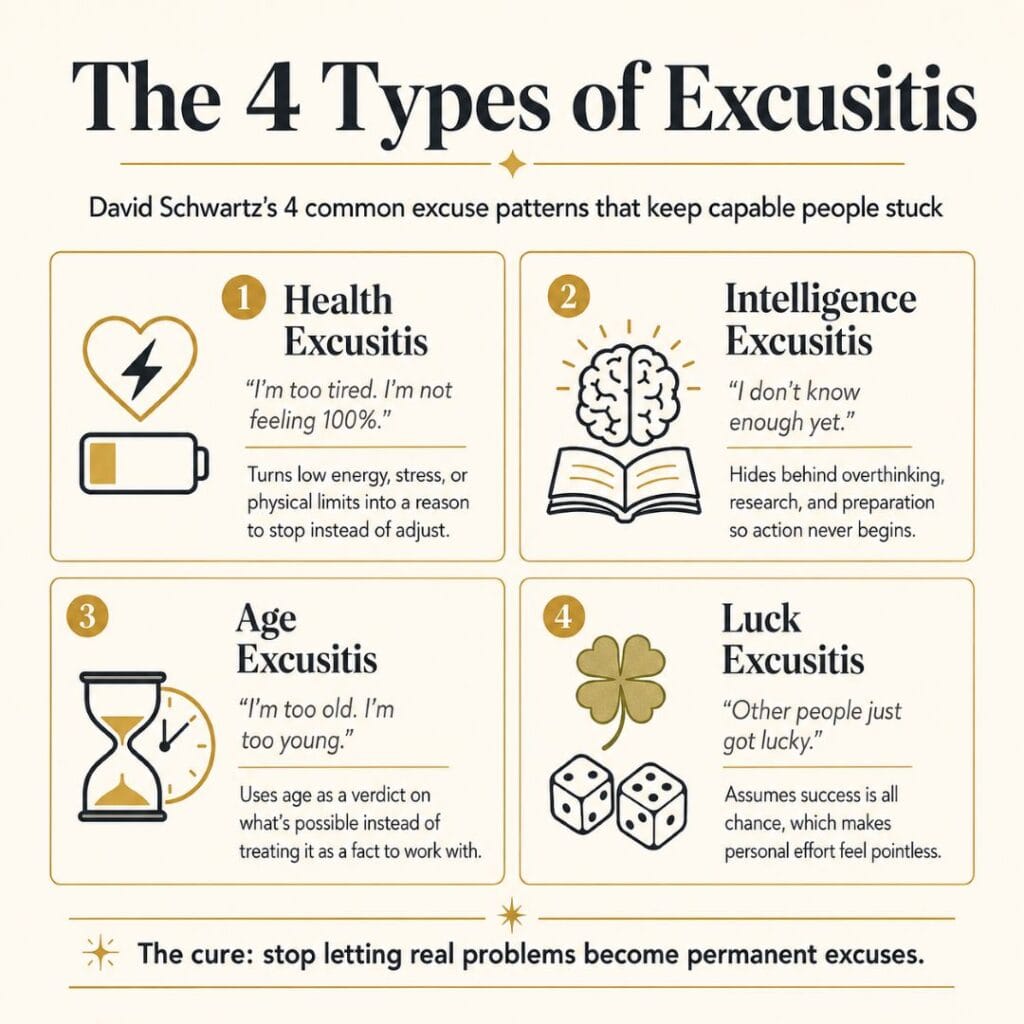
The 4 Types of Excusitis
Schwartz identified four major areas where people often give themselves permission to stay stuck.
1. Health Excusitis
“I don’t have the energy.” “I’m not feeling 100%.” “I’m under too much stress.”
Sometimes you really are tired. Sometimes your body hurts, your week has been brutal, or you’ve got more on your plate than usual. That’s real.
The problem starts when every rough day becomes a reason to shut everything down. If you only take action when you feel rested, focused, and stress-free, you’re going to spend a lot of time waiting.
Maybe an hour isn’t happening today. Fine. What about 15 minutes? What about one small task that keeps you moving instead of losing the whole day?
That’s the difference. You work with the energy you have instead of using low energy as a reason to disappear from your own goals.
If this is the excuse you fall into most often, How to Build Discipline When You’re Exhausted: The 13-Day Grind goes deeper into how to keep moving when your tank isn’t full.
2. Intelligence Excusitis
“I don’t know enough yet.” “I’m not built for business.” “I’m not sharp enough.”
This one sounds smart because it usually hides behind learning. You tell yourself you need one more book, one more course, one more tutorial, or a little more time to figure everything out.
Meanwhile, you’re still standing in the same spot.
Most people don’t need to know everything before they start. They need to know enough to take the next step, then learn what the next step teaches them.
That’s where intelligence excusitis gets sneaky. Research feels productive, so it’s easy to convince yourself you’re moving when you’re really avoiding the part that makes you uncomfortable.
At some point, you have to stop studying the water and get in.
And if the real problem is feeling like everyone else knows more than you, How to Overcome Imposter Syndrome Without Waiting for Confidence goes deeper into why confidence usually comes after you start, not before.
3. Age Excusitis
“I’m too old to pivot.” “I’m too young to be taken seriously.” “I missed my window.”
Age is one of those excuses people can make sound airtight. If you’re younger, you tell yourself nobody will take you seriously. If you’re older, you start wondering whether you waited too long.
But age by itself doesn’t decide what’s still possible. It may change how you approach something, how fast you move, or what resources you have, but that’s different from deciding the door is closed.
The danger is when “I’m 25” or “I’m 55” turns into a verdict instead of a fact. You start using your age to explain why now isn’t the right time, and before long, another few years are gone.
There’s no perfect age to get serious about your life. You work with the season you’re in, make the smartest move you can from there, and keep going.
4. Luck Excusitis
“Must be nice.” “They just got lucky.” “The deck is stacked against me.”
Sometimes people really do get better breaks. They may have more money, better timing, the right connection, or somebody opening a door for them. Pretending that never happens would be ridiculous.
The problem starts when you use somebody else’s advantage as proof that your own effort doesn’t matter. Once you start believing success is mostly luck, it gets real easy to sit still and explain why trying probably won’t make a difference anyway.
That mindset can keep you stuck longer than bad luck ever could. You spend more time studying what somebody else had than figuring out what you can do with what’s already in front of you.
That’s also the lesson behind The Candle Problem: How to Stop Feeling Stuck in Life. Sometimes the answer isn’t getting better circumstances. It’s seeing the resources you already have differently.
A better question is: What can I build with what I have right now? You may not control the breaks you get, but you still control whether you make anything out of the ones you do.

When Your Excuses Become Your Identity
This is where excusitis gets more serious. At first, you’re just describing a rough week, a skill you haven’t learned yet, or something you’re struggling with.
Then the language starts to change. “I haven’t figured this out yet” becomes “I’m just not good at this.” “I’m worn out this week” becomes “I don’t have what it takes to keep up.”
Once you start talking that way, the excuse isn’t just about the situation anymore. It starts becoming part of how you see yourself, and that’s a much harder thing to shake.
You may even catch yourself defending it. Instead of looking for a way forward, you start collecting proof that confirms the story you’ve already told yourself.
That’s why phrases like “I can’t” carry more weight than they seem to. If you’ve fallen into that pattern, How to Overcome The Trap of Saying “I Can’t” goes deeper into how repeated language can quietly turn into a personal limit.
The good news is that identity can change too. You don’t have to keep carrying a label just because you’ve repeated it for a long time.
How to Stop Making Excuses and Build Real Momentum
Breaking the excusitis cycle usually doesn’t come down to some huge breakthrough. Most of the time, it comes down to what you do in the five minutes after your brain starts giving you reasons to put something off.
Start by making the problem smaller and more specific. “I have too much to do” feels impossible, but “I need to answer three emails and make one phone call” gives you somewhere to start.
- State the problem without making it bigger. If the garage is a disaster, you don’t have to clean the whole thing tonight. Pick one shelf and start there.
- Ask what’s still under your control. Maybe a client hasn’t answered you yet. You can’t control that, but you can send the follow-up, work on another lead, or finish something else while you wait.
- Shrink the next move. If organizing your finances feels overwhelming, don’t build a whole budget system tonight. Pull up the last month of transactions and sort one category.
- Stop waiting for the perfect setup. Maybe you want better equipment, more space, or a cleaner schedule. Start with the setup you have and improve it as you go.
- Judge the day by movement. You may not finish the whole project, but if you made the call, submitted the form, cleaned the shelf, or handled the next task, you moved something forward.
That’s really what momentum looks like in real life. It usually isn’t dramatic. It’s a bunch of small decisions where you stop giving the excuse the last word.
Your Circumstances Don’t Get the Final Vote
Setbacks are going to happen. Some seasons will be harder than others, and there will be days when everything feels like it’s working against you.
That doesn’t mean the whole thing is over.
You may have to slow down, change the plan, ask for help, learn something new, or take a smaller step than you wanted. None of that means you’ve failed. It just means you’re working with the life that’s actually in front of you.
That’s the part people forget.
You don’t need perfect timing to move forward. You don’t need to feel completely ready. And you definitely don’t need every obstacle out of the way before you take the next step.
Sometimes progress looks big. Sometimes it looks like one call, one page, one decision, or one hour you could’ve easily talked yourself out of.
Keep making those moves.
Your circumstances can shape the road, but they don’t have to decide where you end up.
If you’re ready to raise your standard and build stronger discipline, visit the Caliber Motivation Co. shop for tools designed to help you follow through.
Join The Standard
Get practical articles on discipline, mindset, structure, and execution delivered straight to your inbox.
No hype. No fluff. Just real-world strategies to help you stay focused and keep building.
No spam. Unsubscribe anytime.