You can know exactly what you need to do and still struggle to do it consistently. The problem is rarely a lack of information. Usually, the hard part is following through when you’re tired, distracted, overwhelmed, or simply not in the mood. That’s where AI prompts for discipline can become surprisingly useful.
Instead of using AI only to write emails, brainstorm ideas, or answer questions, you can use it to examine your habits, plan your day, challenge your excuses, and keep important goals from getting pushed aside.
AI cannot make you disciplined. However, it can help you see where your routine keeps breaking down and decide what to do next. A well-written prompt can turn a vague goal like “I need to be more consistent” into a specific action you can take today.
In this guide, you’ll find practical AI prompts for discipline that help with focus, procrastination, daily planning, accountability, habit building, and following through when motivation disappears.
If you’re not sure which AI tool to use for these prompts, I also broke down the best AI platforms for entrepreneurs and what each one does best.
The Real Problem: Lack of Clarity, Not Effort
You can put in plenty of effort and still feel like you are getting nowhere. That usually happens when you keep working without stopping to look at what is actually breaking down.
Maybe you start strong, lose focus after a few days, and then try to restart. The problem is not always laziness or a lack of discipline. Sometimes you simply do not have a clear system showing you where things keep going off track.
That is where AI prompts for discipline can help. They give you a way to step outside your own head and look at your habits more clearly.
For example, you can ask AI to help you identify:
- where your routine keeps falling apart
- what distractions are costing you the most time
- which goals are too vague to act on
- what pattern keeps causing you to stop
- what one change would make the biggest difference
Without that kind of feedback, it is easy to repeat the same cycle: start strong, lose focus, fall off, and try again.
However, once you can see the pattern, you can start fixing the right problem instead of simply trying harder.
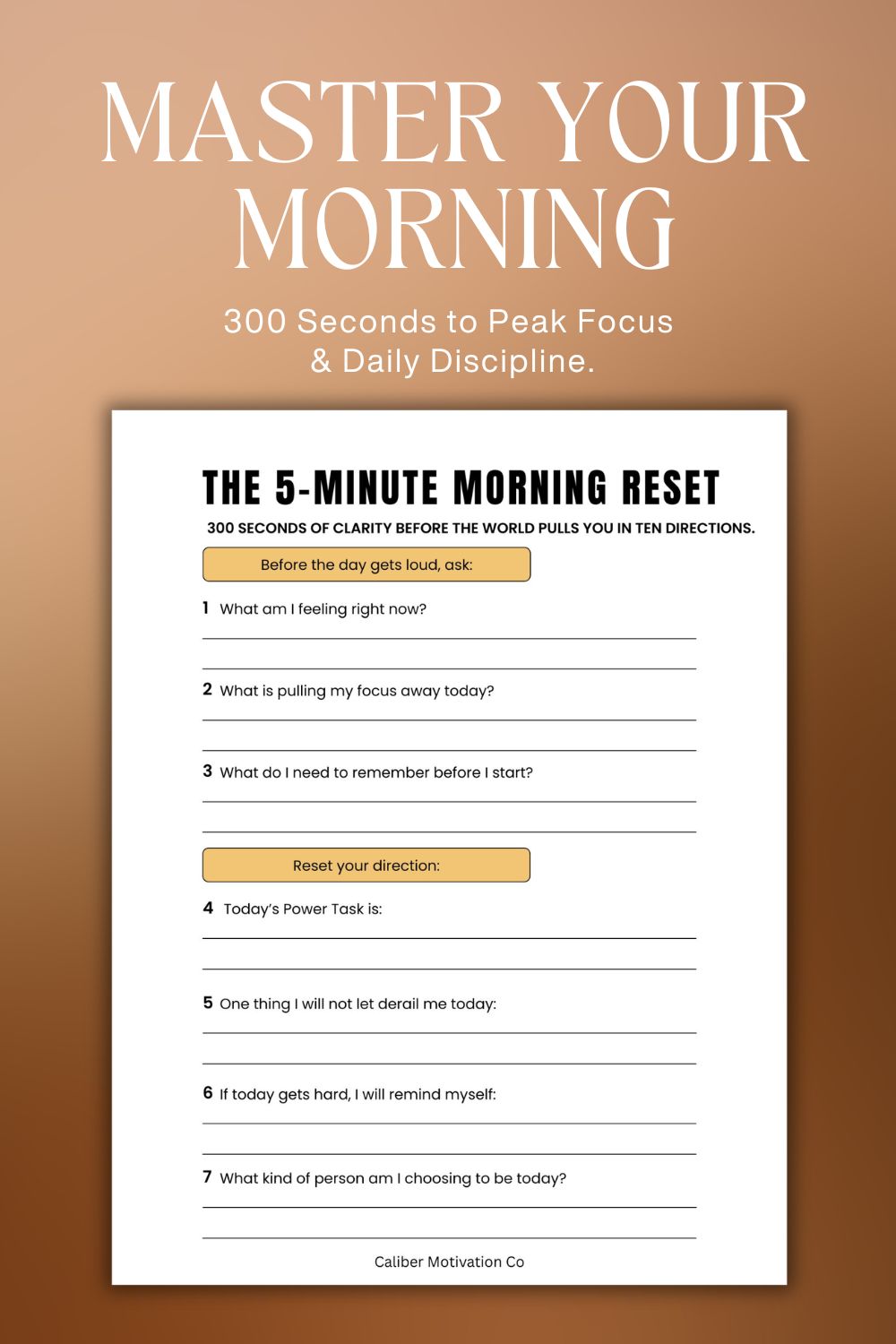
Free 5-Minute Morning Reset
Build stronger discipline, focus, and consistency with the free 5-Minute Morning Reset guide from Caliber Motivation Co. Get new blog posts, mindset strategies, and practical systems for long-term growth delivered straight to your inbox.
A Quick Reality Check
AI is useful, but it will not build discipline for you.
You can copy the best prompt in this article, get a great answer, and still ignore it. The tool can show you what needs to change. You still have to do the work.
That distinction matters.
I use AI when I need to sort through a problem, challenge my thinking, or turn a messy goal into clear next steps. However, I don’t expect it to create motivation for me.
Think of it more like a coach asking better questions.
A good AI prompt for discipline can help you recognize an excuse, simplify an overwhelming task, or decide what deserves your attention today. Then you close the chat and act on the answer.
That is where these prompts become valuable. They are not shortcuts around discipline. They are tools that can help you practice it.
What AI Actually Adds to the Process
Using AI becomes useful when you give it enough context to work with.
Instead of staring at a goal and wondering where to begin, you can give AI the details and ask it to help you organize them.
For example, you can use it to:
- turn a large goal into a step-by-step plan
- compare different options before making a decision
- create questions that force you to think more deeply
- build a daily checklist around a specific goal
- review what worked and what didn’t at the end of the day
That makes AI less like a motivational tool and more like a practical planning partner.
However, the quality of the answer depends heavily on the quality of the prompt. A vague question usually gets a vague response. Give it real details, and you’ll get something much more useful.

3 Benefits of Using AI Prompts for Discipline
1. It helps You Make Better Decisions Faster
Discipline gets harder when every small decision turns into a debate.
Should you work now or later? Finish the hard task or do the easy one first? Keep going or call it a day?
AI prompts for discipline can help you sort through those choices quickly. You can give AI the situation, your priorities, and your limits, then ask it to help you choose the next best move.
For example, you could ask:
- Which task should I do first based on urgency and importance?
- What can I realistically finish in the next hour?
- Which task am I avoiding because it feels uncomfortable?
- What should I remove from today’s list?
AI won’t make the decision for you. However, it can stop you from wasting 30 minutes debating a choice that should take five.
2. It Makes Big Goals Feel More Manageable
A goal can sound simple until you actually try to work on it.
“Get in shape,” “build my business,” or “be more productive” doesn’t tell you what to do at 7:00 tomorrow morning. That’s where AI can help turn a broad goal into specific actions.
You can ask it to break a goal into:
- daily tasks
- weekly milestones
- smaller deadlines
- priority actions
- realistic next steps
For example, instead of telling yourself, “I need to work on my business,” you could ask AI to create a 45-minute work session focused on one specific outcome.
That gives you something concrete to start.
3. It Gives You a Simple Way to Review Your Day
Discipline improves faster when you actually review what happened.
At the end of the day, you can use AI to walk through what you planned, what you finished, what got skipped, and what needs to change tomorrow.
You might ask:
- What went well today?
- Where did I lose time?
- What should I carry over?
- What should I stop doing tomorrow?
- What deserves more attention?
This kind of review helps you make small adjustments before problems turn into habits.
You don’t need a complicated tracking system. Sometimes five focused minutes at the end of the day is enough to help you make tomorrow better than today.
Artificial intelligence is already changing how people think, work, and make decisions.
If you want a deeper understanding of the technology behind it, you can learn more about what artificial intelligence is and how it works in this article: What is artificial intelligence (AI)?

Why AI Prompts Still Don’t Work Sometimes
AI can be useful, but weak prompts usually lead to weak answers.
If you ask something broad like, “How can I be more disciplined?” you’ll probably get general advice. The better approach is to give AI enough context to understand the problem.
Instead of asking:
How do I stop procrastinating?
Try:
I keep avoiding a task that takes about 45 minutes. I usually put it off until late afternoon, then tell myself I’m too tired. Help me figure out what’s getting in the way and give me one practical way to handle it tomorrow.
Specific details give AI something useful to work with.
A Simple AI Discipline System You Can Use Daily
You don’t need dozens of prompts. A simple routine is easier to use consistently.
You can use AI at three points:
- Morning: Decide what matters most.
- Midday: Check whether you’re still on track.
- Evening: Review what worked and what needs to change tomorrow.
You could even use the same three questions each day:
- What matters most today?
- What’s getting in my way right now?
- What should I adjust for tomorrow?
If you want a more structured way to review your habits, spot where you’re slipping, and decide what to fix next, use the AI Audit System.
👉 Use this AI Audit System to fix your discipline and take action
Final Thought
AI won’t create discipline for you.
However, AI prompts for discipline can help you plan more clearly, make decisions faster, and work through the moments when you feel stuck.
Use the tool to get clarity. Then close the screen and take the next step.
Where are you struggling with discipline right now: starting, finishing, staying focused, or staying consistent? Drop it in the comments.