
Have you ever had a day when your overstimulated mind seemed to pull you in a dozen different directions before breakfast?
That’s exactly how this last Saturday was for me.
My first stop was a ditch that needed to be weed-whacked. Normally, I pull my zero-turn mower out first so I can reach everything else because my trailer is only 6 by 10 feet, leaving barely enough room to squeeze around it. I climbed on, pulled the drive levers, and the engine stalled.
I tried again, but nothing changed. Instead of backing the mower out, I climbed over it to grab my weed whacker from the rack and the gas can behind it. After finishing the ditch, I started the mower one more time, hoping it had somehow fixed itself.
It hadn’t. The mower still wouldn’t move.
I called the repair shop, but no one answered. I called my mechanic’s cell phone with the same result, so I sent him a text and started driving across town, hoping they were simply too busy to answer the phone. A couple of blocks from the shop, my phone finally buzzed.
“We’re closed.”
I turned around and headed back home. On the way, I stopped at Publix to pick up dog food, helped the customer in front of me after he dropped some cash, then waited while the cashier corrected his order because a drink hadn’t been scanned. After paying for my groceries, I turned to leave and almost walked away without my debit card until someone called me back.
By then, my body was standing in the checkout line, but my mind was somewhere else. I was wondering whether my mower could even be fixed before Monday, whether the engine was failing, whether I’d have to replace a machine that could cost around $4,000, and, if it was repairable, how much the repair would cost. At the same time, I was thinking about the clients I had to text to cancel, how I was going to rearrange my workweek, what time the Fourth of July cookout started that evening, whether I’d have time to finish the laundry first, the dishes I had promised to bring, and everything else waiting for me when I got home.
None of those thoughts seemed overwhelming by themselves.
Together, they were competing for the same limited attention.
That’s when it hit me.
The problem wasn’t my phone or the broken mower. The real problem was that my attention had become overloaded. You probably think an overstimulated mind comes from spending too much time staring at a screen, and technology can certainly make it worse, but that’s rarely where it starts.
An overstimulated mind develops when unexpected problems, unfinished tasks, unanswered questions, and constant decisions all compete for your attention at the same time. Before long, your focus becomes fragmented, and you haven’t even opened a single app.
So why does that happen?
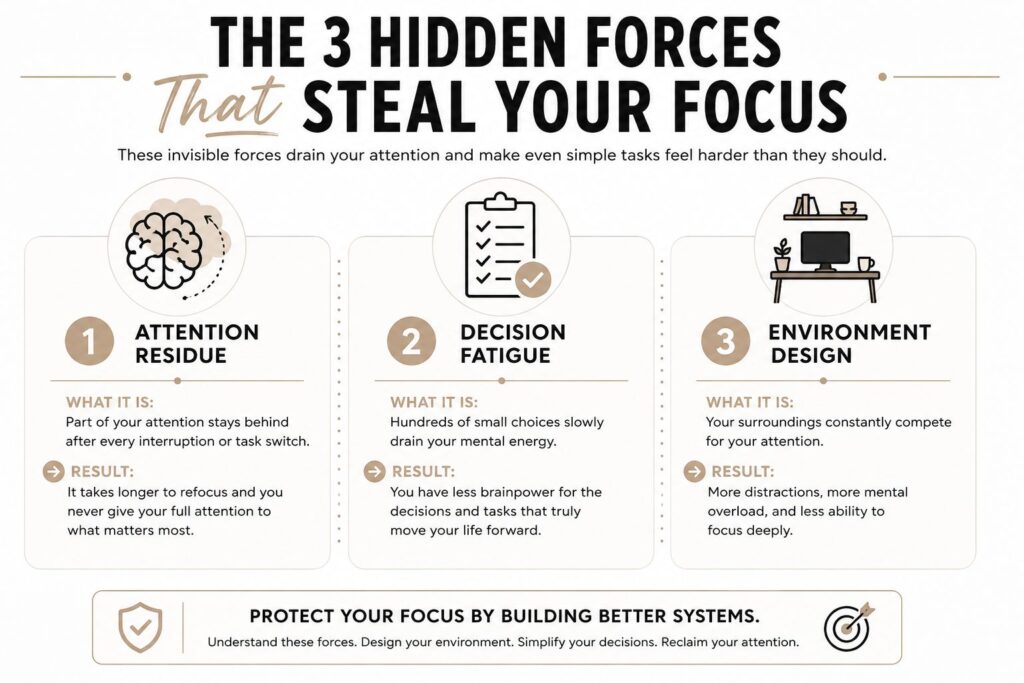
The Three Hidden Forces That Steal Your Focus
If your attention seems harder to hold than it used to be, you’re not imagining it. An overstimulated mind isn’t usually caused by one big problem. Instead, it’s often the result of several hidden forces working together until your mental energy becomes scattered and your focus starts slipping.
Three of the biggest culprits are attention residue, decision fatigue, and environment design. Each one affects your brain differently, but together they can make even simple tasks feel more difficult than they should.
- Attention residue happens when your mind can’t fully let go of one task before moving to the next. Even though your body has moved on, part of your attention is still stuck on the previous problem.
- Decision fatigue develops after making hundreds of choices throughout the day. Every decision uses a small amount of mental energy, leaving fewer cognitive resources for the problems that truly matter.
- Environment design is the often-overlooked influence your surroundings have on your attention. Constant notifications, visual clutter, and easy access to distractions quietly compete for your focus, even when you don’t realize it.
The good news is that none of these forces are permanent. Once you understand how they work, you can begin building habits and systems that protect your attention instead of constantly trying to recover it.
Let’s start with the one that catches most people by surprise: attention residue.
Disclosure: This post may contain affiliate links. If you purchase through these links, Caliber Motivation Co. may earn a small commission at no extra cost to you.
Why Attention Residue Keeps You Stuck
You might think the solution to an overstimulated mind is to simply force yourself to calm down and concentrate. However, the problem is often much deeper than simply trying to concentrate harder.
Research shows that after an interruption, it can take more than 20 minutes on average to fully return to the task you were originally working on. The more frequently you’re interrupted, the harder it becomes to regain deep focus because part of your attention remains attached to the unfinished task. This challenge of regaining deep focus is explored in Deep Work by Cal Newport, which explains why uninterrupted concentration has become one of today’s most valuable skills.
Imagine you’re writing an important email when your phone rings. Before you can finish that conversation, a text message comes in. A few minutes later, someone walks into your office and asks a quick question. Even after you’ve returned to your email, your brain is still holding onto those unfinished conversations.
That’s attention residue.
Your body has returned to the task.
Your mind hasn’t.
The result is fragmented thinking, slower problem-solving, and a growing sense that you can’t fully concentrate on anything for very long. Over time, those interruptions don’t just steal minutes from your day—they quietly reduce the quality of your attention.
But attention residue doesn’t work alone. While your mind is busy clinging to unfinished tasks, a second hidden force is quietly draining your remaining energy throughout the day: decision fatigue.
Join The Standard
Get practical articles on discipline, mindset, structure, and execution delivered straight to your inbox.
No hype. No fluff. Just real-world strategies to help you stay focused and keep building.
No spam. Unsubscribe anytime.
The Hidden Cost of Tiny Decisions
The second hidden force affecting your focus is decision fatigue—the gradual decline in mental energy that happens after making hundreds of decisions throughout the day.
Each decision you make, no matter how small, requires your brain to spend a little mental energy. Most of those choices seem insignificant on their own, yet together they slowly drain the focus you need for meaningful work, solving problems, and handling unexpected challenges.
Think about how many decisions you make before lunch:
- What should I wear?
- What should I eat?
- Should I answer this text now or later?
- Which task should I start first?
- Do I need to stop at the store after work?
None of those questions are difficult by themselves. However, your brain still has to process every one of them. By the time something important happens, you’ve already spent a surprising amount of mental energy on decisions that could have been made yesterday—a concept explored in Willpower by Roy F. Baumeister, which examines how repeated decisions gradually deplete mental resources.
The result isn’t just mental exhaustion. It becomes harder to stay focused, prioritize what matters, and think clearly when an unexpected problem lands in your lap. Instead of using your attention to solve important challenges, you’ve already spent part of it on decisions that never really mattered.
Managing your internal mental energy is crucial, but it’s still only half the battle. The third force working against your focus doesn’t come from inside your mind at all—it’s the physical environment around you
How Your Environment Shapes Your Focus
Attention residue and decision fatigue both happen inside your mind. However, there’s a third influence that comes from outside your brain: your environment.
Researchers who study environment design have found that your surroundings quietly shape your attention throughout the day. The easier something is to see, hear, or reach, the more likely your brain is to notice it—even when you’re trying to focus on something else.
Think about your workspace for a moment.
- Is your phone sitting next to your keyboard?
- Are email notifications popping up every few minutes?
- Do you have a dozen browser tabs open?
- Is the television on in the background?
- Is your desk cluttered with unfinished work?
None of those distractions seem overwhelming by themselves. However, constantly filtering out background noise wastes energy, leaving you with less mental stamina to finish the task in front of you.
Your environment can either support your goals or constantly undermine them. When your surroundings encourage concentration instead of distraction, staying productive requires far less day-to-day effort. James Clear explores this same idea in Atomic Habits, showing how small changes to your environment can make good habits easier and distractions harder to follow.
Managing these external distractions is the final step in understanding why your focus fades. Now, it’s time to look at how to fix it.

Build Systems Before You Need Them
By now, you’ve seen the three biggest forces working against your focus. The good news is that you don’t need three different solutions. You don’t have to constantly pull your attention back every time life pulls it away.
You need systems that protect your focus.
Focus isn’t created in the moment. It’s protected long before you need it. Every system you build ahead of time preserves more of your mental energy for the moments that matter most.
A reliable system creates structure, reduces mental overload, and gives your brain a predictable framework to fall back on when life becomes unpredictable. Instead of depending on perfect conditions or constant self-control, you create a foundation that helps protect your attention even when your day doesn’t go according to plan.
You can’t prevent every broken mower, urgent phone call, schedule change, or surprise expense. However, you can build systems that handle the predictable parts of your day automatically, leaving more of your mental energy available for the challenges you never saw coming.
The next step is learning which simple, research-supported systems have the biggest impact—and how you can begin using them to protect your focus every day.
3 Science-Backed Ways to Protect Your Focus
You don’t need to overhaul your entire lifestyle to see results. A few intentional, day-to-day systems are all it takes to make a remarkable difference.
1. Plan Tomorrow Before Today Ends
One of the easiest ways to protect your focus is to reduce tomorrow’s decisions before the day even begins. Spending just ten minutes planning ahead frees up mental energy for the unexpected challenges you can’t predict.
Before you finish your workday or go to bed, try preparing a few things in advance:
- Lay out tomorrow’s clothes.
- Decide on your meals.
- Write down your top three priorities.
- Map out appointments, errands, or your work route.
- Gather anything you’ll need first thing in the morning.
Planning ahead reduces unnecessary decisions, preserving more of your mental energy for the moments that matter most.
2. Batch Similar Tasks Together
Constantly switching between emails, phone calls, text messages, social media, and deep work fragments your attention. Instead of reacting to every interruption as it happens, group similar tasks into dedicated blocks of time.
For example:
- Answer emails during scheduled times.
- Return calls and text messages in one block.
- Check social media once or twice a day instead of after every notification.
- Complete similar errands together instead of making multiple trips.
Working on similar tasks together reduces unnecessary task switching, making it easier to stay focused on one activity before moving to the next.
3. Design an Environment That Protects Your Focus
Your environment influences your attention all day long, whether you notice it or not. Small changes to your surroundings can reduce distractions and make focused work feel much easier.
Try creating an environment that supports concentration:
- Silence non-essential notifications.
- Leave your phone across the room during focused work.
- Use a paper planner or journal instead of relying on dozens of browser tabs.
- Keep your workspace clean and organized.
- Remove visual distractions before starting an important task.
When your environment supports your goals instead of competing with them, protecting your focus becomes much easier and requires far less mental effort.
Build a Mind That Doesn’t Need Constant Stimulation
An overstimulated mind isn’t a personal weakness. It’s often the result of carrying too many decisions, distractions, and unfinished thoughts at the same time.
The goal isn’t to eliminate every interruption or create a perfect routine. Life will always demand your attention. The goal is to build systems that protect your focus so you can keep moving forward when those demands inevitably show up.
One of the simplest systems you can build is a daily reflection habit. That’s exactly why I created the Becoming Journal—to help you slow down, reduce mental clutter, and intentionally redirect your attention toward the person you’re becoming.
Don’t worry about trying to build every system at once. Start with one small routine. Build another when that one becomes second nature. Over time, those small changes reduce mental overload and make focused work feel natural instead of exhausting.
The quality of your work depends on the quality of your attention.
And the quality of your attention depends on the systems you build.
Your focus isn’t something you find.
It’s something you protect.