I used to believe certain people simply had an access code to my emotions until I started learning how to be unbothered.
Say the right word, push the right button, or send a curt text, and I would be locked into a mental loop for hours. Replaying conversations, building fiery arguments I’d never say out loud, and feeling my chest tighten over something that took them ten seconds to say.
I assumed that was just how life worked—that letting external circumstances run my mood was an unavoidable reality.
I was wrong.
The moment you realize why you get bothered is the moment you take back your power. What they did may be real, but the story you attach to it often determines how long it controls you.
Being unbothered doesn’t mean nothing gets to you. It means what gets to you doesn’t get to decide what you do next.
The Gap Between Event and Response
Most of us operate under a default, automatic reaction:
Event = Emotion
Someone cuts you off in traffic, you get furious. A client pushes a deadline, you panic. A friend forgets to reply, you feel rejected. It feels like touching a hot stove and pulling your hand back—a pure reflex.
But there is another step sitting in the middle: the meaning we give the situation. Two people can experience the exact same event and walk away feeling completely different because they tell themselves different stories about what happened.
I wish I could tell you I’m the calm, enlightened driver when someone cuts me off in traffic. I’m not. My first reaction is usually to grip the wheel and think, “Who does this guy think he is?” The difference now is that I’m learning caught-in-the-act awareness: realizing I don’t have to let one idiot driver rent space in my head for the next twenty minutes.
The other driver triggered the moment. My internal story decided how long I stayed in it.
Self-Leadership, Not Indifference
Now, you might think being unbothered means becoming cold, detached, or numb. Maybe you picture someone who never reacts, never cares, and just lets everything roll off their back.
But that’s a misconception.
It means you still feel the emotion, but you choose what happens next.
When anger or friction hits, you don’t have to abandon your standards, ignore the problem, or let people cross your boundaries. You simply decide what to do with that energy—responding with deliberate control rather than impulse.
| WHAT UNBOTHERED IS NOT | WHAT UNBOTHERED ACTUALLY IS |
| Suppression (Holding anger in until it festers) | Emotional Regulation (Feeling the emotion, but choosing your action) |
| Apathy (Caring about nothing and having no standards) | Purposeful Focus (Directing energy only to what serves your vision) |
| Passivity (Allowing people to cross your boundaries) | Self-Leadership (Maintaining your center regardless of the noise) |
The Hidden Cost of Reactivity
Reactivity feels satisfying for a split second. Lashing out, getting the last word, or drafting a sharp comeback gives a quick hit of validation. But every time you react out of bruised pride, you pay a steep price:
- Stolen Focus: Hours spent replaying conversations in your head are hours stolen from building your life, your work, and your goals.
- Escalated Problems: A reactive business owner can turn one minor customer issue into a refund, a public argument, a negative review, and a ruined afternoon. The original problem was small. The reaction multiplied it.
- Eroded Trust: People make mental notes when you blow up or get fragile under pressure. When your team, clients, or family realize you are unpredictable, they stop bringing you honest feedback.
- Drained Physical Energy: Perceived threats—like an ego bruise or a harsh comment—can trigger a massive physical stress response. Treating every minor annoyance like a battlefield leaves you exhausted.
I was so guilty of this last year.
How I Let One Problem Keep Costing Me
Around Christmas, I had a client stiff me on money I was counting on. That one hit caused a financial ripple effect, and instead of dealing with the loss and moving forward, I let the anger sit there.
For months, every time I thought about that client, I got mad all over again. I replayed what happened, thought about what I should have said, and kept carrying something that had already happened and couldn’t be changed.
The money being gone was a real problem. But staying angry about it for months created a second problem that I was causing myself.
Eventually, I had to admit that being furious wasn’t getting the money back. It wasn’t fixing the financial mess it caused, and it definitely wasn’t helping me focus on making more money.
What I could do was learn from it, tighten my business practices, protect myself better next time, and stop letting one bad client keep taking from me long after the job was over.
Sometimes the original problem costs you once. Reactivity makes you keep paying for it.
Real-World Lessons in Mastering Your Reactions
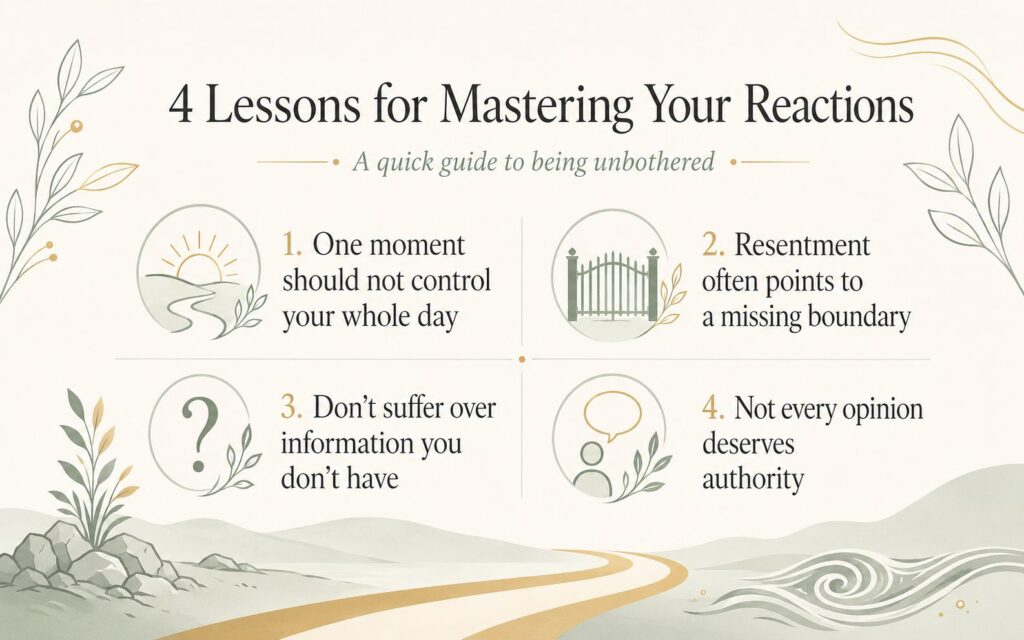
Lesson 1: The Email That Stole Half the Day
A business owner opens an email from a client at 8:15 a.m. The message is short, blunt, and easy to read as disrespectful.
She immediately starts writing a furious response. Then deletes it. Writes another. Calls a friend to vent. Checks the email again. By lunchtime, she has spent four hours mentally arguing with someone who likely spent two minutes typing a message while rushed between meetings.
- The Lesson: The email didn’t ruin her morning. Her reaction to the story she assigned to it did.
- The Application: Separate the raw facts from the tone you assumed. Strip away the story, address the actual question calmly, and save your mental bandwidth for your real work.
You know what I’m talking about. One comment, one email, one tone of voice, and suddenly you’re replaying the whole thing in your head, calling someone to vent, or building an argument long after the moment has passed.
That’s the trap. The original moment may last thirty seconds, but our reaction can keep it alive for hours, , days, or even months.
Lesson 2: Resentment Is Often a Missing Boundary
You agree to take on a project. Before long, an extra request comes in, followed by another and then another. Instead of addressing it, you get angrier each time because you think, “They should know better.”
- The Lesson: Resentment often grows where a boundary should have been set. They don’t need to know better—you need to communicate better.
- The Application: State the scope and price clearly, then explain what happens next. No long speeches, no underlying anger, no guilt. Pure clarity.
I recently went through this with a lawn client. We agreed on a set price for the job, but each time I showed up, more work was added without any increase in pay.
At first, I kept doing it. But over time, I started resenting the job and dreading going there because I felt like I was being taken advantage of.
The problem was that I had never clearly addressed it.
Once I finally spoke up, explained that the extra work needed to be reflected in the price, and got the rate adjusted, the resentment disappeared. I was being paid fairly, the expectations were clear, and suddenly I didn’t mind going there anymore.
Lesson 3: Don’t Suffer Over Information You Don’t Have
You send a message to a partner, client, or friend. Hours pass with no reply. Suddenly, your mind writes an entire script: Are they angry? Did I say the wrong thing? Am I being ignored?
Or maybe their phone battery died.
- The Lesson: Stop making yourself suffer over information you do not have.
- The Application: Don’t fill silence with the worst possible explanation. Give the situation a neutral meaning until you have real facts, and don’t tie your self-worth to someone else’s response time.
Just this past weekend, I had a situation where I could have reacted poorly. I finished a job and went four days without getting paid, which was unusual for this particular client.
Of course, my mind started going there. I wondered if something had happened, whether there was a problem, or why I hadn’t been paid. But instead of reacting to assumptions, I waited until I actually knew what was going on.
It turned out he had simply gone on a cruise.
Nothing was wrong. There was no issue with the work, and there was no reason for me to create a problem before I even had the facts.
That is exactly why we have to be careful about filling in missing information ourselves. Sometimes the story causing us stress isn’t even true.
Lesson 4: Criticism Needs Authority Before It Can Hurt
Someone criticizes your idea in a meeting or makes a passive-aggressive remark about your choices. You instantly feel defensive and annoyed.
- The Lesson: The more authority you give someone else’s opinion, the more power it has to disturb your peace. If a five-year-old calls you incompetent, you laugh because their opinion carries no weight. When an adult says it, it stings only because you handed their perspective weight over your identity.
- The Application: You can’t control what people say, but you choose how much weight to give their words. When you are grounded in who you are, another person’s opinion is just noise—it doesn’t get to dictate your day.
Choosing the amount of weight that you give their words can be much harder when the criticism comes from someone we respect, love, or value. Their opinion naturally matters more to us,, so their words can hit harder than a random comment from someone we barely know.
The point is not to stop caring what trusted people think. It is to decide whether their criticism is useful, fair, and worth acting on instead of letting it automatically define how you see yourself.
How to Apply “Unbothered” Daily
The Unbothered Leader (In Business)
Business is full of friction—canceled deals, difficult clients, platform updates, and delays.
Being an unbothered leader doesn’t mean ignoring problems; it means treating problems as information rather than personal attacks. When a customer complains or a project stumbles, a reactive owner looks for someone to blame. An unbothered owner looks for a process to fix.
A Real-World Business Example
Imagine a client sends a message saying they are unhappy with part of the work and want it corrected.
A reactive owner reads the message as an attack. They get defensive, fire off a sharp response, explain why the client is wrong, and turn one fixable issue into an argument.
An unbothered owner reads the same message and asks, What actually needs to be solved here? They separate the client’s tone from the actual problem, clarify what happened, fix what needs fixing, and move on.
Same complaint. Same business. Completely different outcome.
The difference is not whether the problem happened. The difference is who stayed in control when it did.
Being unbothered doesn’t mean you don’t care about your business. It means you care too much about your mission to let minor friction hijack your momentum.
In Relationships
In personal life, people frequently project their own stress, fatigue, and bad days onto whoever happens to be standing nearby.
When someone speaks to you with edge, train yourself to pause and ask: “Is this about me, or is this about them?” Sometimes, they are simply expressing their own internal noise. You don’t have to absorb someone else’s storm just because they brought it into the room.
A Real-World Relationship Example
Imagine walking through the door and a partner or family member snaps at you over a minor issue, like dishes left in the sink.
A reactive response takes the tone personally. You match their heat, get defensive, list everything you did that day, and turn a five-second moment into a two-hour fight.
An unbothered response notices the sharp edge and pauses. You consider that the reaction may not really be about the dishes at all. They could be carrying stress from work, exhaustion, or something else entirely.
You still address the issue, but you do it without taking the bait or absorbing the other person’s mood.
Same interaction. Same tension. Completely different outcome.
Being unbothered doesn’t mean you don’t care about the person. It means you refuse to let someone else’s temporary bad mood become your emotional emergency.
Being Unbothered Does Not Mean Accepting Disrespect
There is a massive difference between staying calm and being a doormat. Staying unbothered does not mean tolerating disrespect—it means handling it with quiet authority.
Notice the shift in power between reacting in the moment and responding with control. The situation may be the same, but the outcome can look completely different depending on which one you choose.
| REACTIVE RESPONSE | CALM, UNBOTHERED RESPONSE |
| Lashing out or arguing | Pausing to assess the facts |
| Emotional escalation | Setting a clear, firm boundary |
| Defensive posture | Taking direct, decisive action |
| Handing over your peace | Keeping full control of your center |
You can set a firm boundary calmly, let go of a toxic client without drama, or walk away from a bad situation without losing control. Calmness is not passivity; it is control.
The 3-Second Pause
Mastering your reactions takes practice. When you feel yourself getting triggered, give yourself three seconds to interrupt the impulse and work through these three steps before emotion takes over.
- Pause: Stop before you speak, type, or send. Give your mind a moment to step back from the knee-jerk reaction. (Notice the heat)
- Examine the Story: Ask yourself, “What story am I telling myself right now about what this means?” (What am I assuming?)
- Choose Purpose Over Ego: Ask, “Does reacting to this serve what I’m trying to build, or am I just feeding my pride?” (What serves my long game?)
When you stop and work through these three steps, you create space between the trigger and your response. That space gives you a chance to act with intention instead of letting the first wave of emotion make the decision for you.
The more often you practice that pause, the easier it becomes to stay grounded when something tries to pull you off balance.
Disclosure: This post may contain affiliate links. If you purchase through these links, Caliber Motivation Co. may earn a small commission at no extra cost to you.
Protect the Long Game
Life will not get less unpredictable. People will not suddenly become perfectly polite. The world is not going to quiet down just so you can finally feel at peace.
The goal is not to change the outer world just to make yourself feel grounded. It is to build an inner standard so steady that outside chaos no longer gets to decide how you respond.
You have limited time, limited attention, and limited energy. Stop spending all three proving points that will not matter next month. Handle what requires action, protect your peace, and put the rest of that energy back into the life, relationships, and business you are building.
Being unbothered is not about avoiding life. It is about refusing to let every disruption decide who you become.
If you want to go deeper on this idea, I recommend reading The Obstacle Is the Way by Ryan Holiday. It’s a practical look at how to stop wasting energy on what you can’t control and focus on how you respond instead.
Ready to Build Your Daily Discipline?
Mastering your mindset starts with the systems you use every day. Explore the Caliber Motivation Co. collection for tools, planners, and gear designed to keep you focused, grounded, and aligned with your highest standards.
Join The Standard
Get practical articles on discipline, mindset, structure, and execution delivered straight to your inbox.
No hype. No fluff. Just real-world strategies to help you stay focused and keep building.
No spam. Unsubscribe anytime.