Learning how to overcome imposter syndrome wasn’t something I expected to write about. Every time I hit Publish, there’s still a little voice in the back of my mind asking, “What if people read this and think I don’t know what I’m talking about?”
It doesn’t matter how many hours I’ve spent researching, how many obstacles I’ve overcome, or how much I’ve accomplished. That little voice still shows up.
The difference is that I don’t let it make the decision anymore. I hit Publish anyway.
If you’ve ever felt like a fraud despite working hard and accomplishing more than you give yourself credit for, you’re in the right place. I’ll show you why imposter syndrome happens, why perfectionism keeps it alive, and the practical steps you can take to build confidence through action instead of waiting for it to magically appear.
What Is Imposter Syndrome? (And Why It Isn’t a Sign of Weakness)
First identified by psychologists Pauline Clance and Suzanne Imes in 1978, imposter syndrome is the persistent belief that your accomplishments are the result of luck, timing, or other circumstances instead of your own ability. It’s that quiet, nagging voice that tells you your success isn’t really earned and that, sooner or later, someone is going to discover you don’t belong.
The truth is, imposter syndrome isn’t a character flaw or a sign of weakness. It’s surprisingly common. Research suggests that around 70% of people experience imposter syndrome at some point in their lives, and it often affects capable, ambitious, high-achieving people the most. For many, it goes hand in hand with perfectionism. You set such an impossibly high standard for yourself that every mistake, learning curve, or setback feels like proof that you’re not good enough—even when all the evidence says otherwise.
One thing surprised me while researching this topic: imposter syndrome usually doesn’t show up when you’re staying comfortable. It tends to appear when you’re stretching yourself, learning something new, or stepping into a bigger challenge. Whether you’re starting a new job, launching a business, going back to school, speaking in public, or simply chasing a bigger goal, self-doubt often shows up the moment you begin to grow.
That mental friction isn’t a sign you’re failing. More often, it’s a sign you’re leaving your comfort zone and asking more of yourself than ever before.
If that sounds familiar, you’re not broken—and you’re certainly not alone. In fact, some of the most accomplished people in the world have openly admitted they’ve wrestled with the exact same thoughts. The surprising part isn’t that they experienced imposter syndrome. It’s that they refused to let it stop them.
“The only way to stop feeling like an outsider is to keep working until you become an insider.”
Why Even Successful People Feel Like Frauds
When you look at someone who has reached the top of their field, it’s easy to assume they possess an unshakable sense of confidence. We imagine that once you achieve a certain level of success, wealth, or recognition, the self-doubt naturally disappears.
But the data shows the exact opposite is true. Success doesn’t cure imposter syndrome. In many cases, it actually amplifies it.
Consider some of the most accomplished people in the world.
Maya Angelou, despite writing eleven books, admitted she often worried people would eventually discover she wasn’t as talented as they believed.
Michelle Obama has spoken openly about questioning whether she truly belonged in rooms filled with influential leaders, even while serving as First Lady of the United States.
Those examples prove something important: imposter syndrome isn’t a lack of ability. It’s often a distorted view of your own ability.
Why Success Doesn’t Silence the Voice
So why does this happen?
According to Dr. Valerie Young, one of the world’s leading experts on imposter syndrome, high achievers rarely stop to celebrate what they’ve accomplished. The moment they reach one goal, they move the finish line. Yesterday’s impossible dream becomes today’s expectation. Instead of appreciating how far they’ve come, they immediately focus on the next challenge and wonder if they’re ready for it.
In other words, you don’t feel like a fraud because you’re failing.
You often feel like a fraud because you’re growing faster than your confidence—and sometimes even your identity—can catch up. Your circumstances can change long before the way you see yourself does.
Think about someone who earns a promotion but still feels like the new employee. Or the first-generation college graduate who still feels like they don’t belong. Even after reaching a major goal, it can take time for your mind to catch up with your new reality.
That’s why imposter syndrome can affect people from every walk of life. It doesn’t discriminate based on intelligence, talent, education, or success. It simply finds different ways to convince different people that they aren’t enough.
The question is, how does it show up for you?
Which Type of Imposter Syndrome Do You Have?
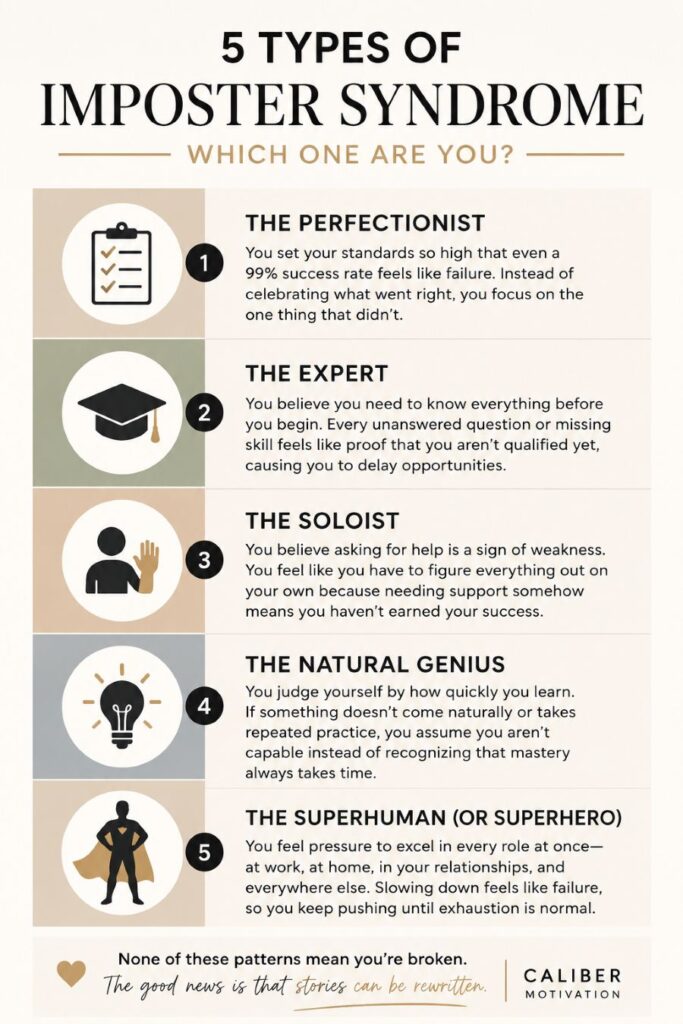
Not everyone experiences imposter syndrome the same way. Through years of research, Young identified five common patterns that explain how these thoughts tend to show up. Understanding your type is the first step toward breaking the cycle.
As I read through these, I realized I could see a little of myself in every one of them. The Perfectionist, Soloist, and Superhuman stood out the most, but I also recognized pieces of the others. You may discover the same thing as you read through them.
The Perfectionist
You set your standards so high that even a 99% success rate feels like failure. Instead of celebrating what went right, you focus on the one thing that didn’t. If it isn’t perfect, you struggle to see it as good enough.
The Expert
You believe you need to know everything before you begin. Every unanswered question or missing skill feels like proof that you aren’t qualified yet, causing you to delay opportunities while you chase “just a little more” knowledge.
The Soloist
You believe asking for help is a sign of weakness. You feel like you have to figure everything out on your own because needing support somehow means you haven’t earned your success.
The Natural Genius
You judge yourself by how quickly you learn. If something doesn’t come naturally or takes repeated practice, you assume you aren’t capable instead of recognizing that mastery always takes time.
The Superhuman (or Superhero)
You feel pressure to excel in every role at once—at work, at home, in your relationships, and everywhere else. Slowing down feels like failure, so you keep pushing yourself until exhaustion becomes normal.
None of these patterns mean you’re broken. They simply reveal the stories you’ve been telling yourself. The good news is that stories can be rewritten.
How Perfectionism Fuels the Trap
As you probably noticed, most of these patterns have one thing in common: perfectionism.
Whether you’re the Perfectionist chasing flawless results, the Expert trying to know everything, the Soloist refusing to ask for help, or the Superhuman trying to excel at every role, perfectionism quietly fuels the cycle.
Many people wear perfectionism like a badge of honor. They mistake it for having high standards. However, there is a massive difference between pursuing excellence and demanding perfection.
Perfectionism doesn’t raise your standards. It moves the finish line.
Psychologists generally describe perfectionism in two ways: adaptive perfectionism and maladaptive perfectionism. One helps you grow. The other keeps you stuck.
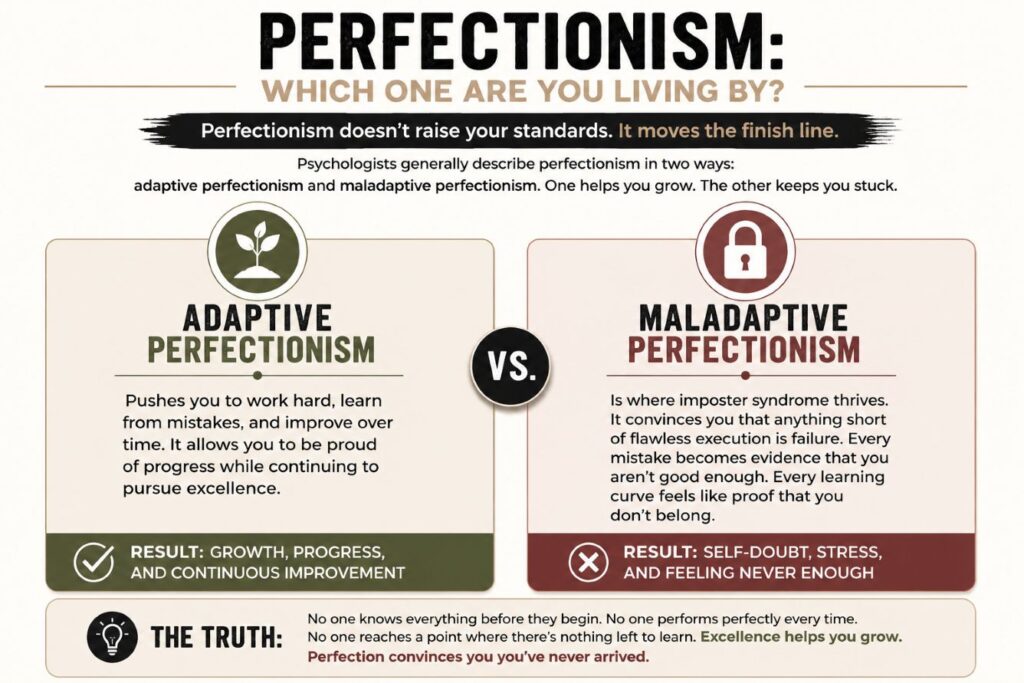
If you’re stuck in the cycle of imposter syndrome, chances are you’re dealing with maladaptive perfectionism, not healthy ambition. The goal isn’t to lower your standards. It’s to stop expecting perfection before allowing yourself to take the next step.
Healthy ambition encourages growth because it accepts that mistakes are part of learning. Perfectionism, on the other hand, convinces you that every mistake is evidence you aren’t capable enough to succeed. That’s a standard no one can live up to.
The truth is that excellence helps you grow because it focuses on progress. Perfection keeps moving the finish line, making you feel like you’ll never be ready. If you keep waiting until everything feels perfect, you’ll spend your life waiting instead of moving forward.
Disclosure: This post may contain affiliate links. If you purchase through these links, Caliber Motivation Co. may earn a small commission at no extra cost to you.
Stop Waiting for Confidence
If you’re waiting to feel completely confident before taking the next step, you could be waiting for the rest of your life. One of the biggest lies imposter syndrome tells you is that confidence comes first. It doesn’t.
It’s easy to assume successful people take action because they’re confident. In reality, they become confident because they keep taking action. Every presentation, interview, workout, difficult conversation, blog post, or business they build becomes another piece of evidence that says, “I’ve done hard things before. I can do this too.”
Think back to the first time you drove a car. Chances are, you weren’t confident. You were nervous because you’d never done it before. The same is true when starting a new job, launching a business, speaking in front of a group, or hitting Publish on something you’ve worked hard to create.
Confidence wasn’t what got you started. It was the result of showing up, making mistakes, learning, and trying again. That’s why waiting until you feel ready keeps you stuck. Confidence isn’t a requirement for action—it’s the reward for taking it.
If you’re looking for a deeper dive into this mindset, The Confidence Gap by Russ Harris explains why waiting to feel confident keeps people stuck. Instead of teaching you how to eliminate fear, it shows you how to take meaningful action despite it. That’s the same principle this article is built on.
Instead of asking yourself, “What if I’m not ready?” start asking, “What’s one small step I can take today?” Every action you take weakens self-doubt and strengthens self-trust, even if you don’t notice it right away.
Build the Evidence
When you’re trapped in maladaptive perfectionism, your brain starts looking for proof that you aren’t good enough. Every mistake feels enormous, while your hard work, progress, and accomplishments barely get your attention. Over time, you begin believing the story your self-doubt is telling instead of the reality you’ve created.
The way out is surprisingly simple: stop relying on how you feel and start paying attention to what you’ve actually done.
Imposter syndrome isn’t defeated by pretending you’re confident or repeating positive affirmations you don’t believe. It’s weakened every time you keep a promise to yourself, finish a difficult task, learn a new skill, or push through something that once intimidated you. Every one of those moments becomes another piece of evidence that you’re more capable than your inner critic wants you to believe.
That’s why I encourage you to keep track of your wins, no matter how small they seem. Write down the projects you’ve completed, the obstacles you’ve overcome, the compliments you’ve received, and the goals you’ve achieved. When self-doubt shows up—and it probably will—you’ll have something much stronger than feelings to lean on.
You’ll have proof.
The voice of imposter syndrome may still speak from time to time, but it becomes much harder to believe when your own actions keep proving it wrong.
The 7-Day Evidence Challenge
For the next seven days, I want you to become a collector of evidence instead of a collector of doubts. At the end of each day, write down three things you did well. They don’t have to be life changing. Maybe you finished a project, had a difficult conversation, learned a new skill, or simply showed up when you didn’t feel like it.
The goal isn’t to prove you’re perfect. It’s to remind yourself that you’re making progress.
At the end of the week, read your list from beginning to end. You’ll probably notice something surprising. While your inner critic has been telling you that you aren’t doing enough, the facts tell a very different story.
Confidence isn’t built by waiting for the perfect moment. It’s built by collecting enough evidence that your self-doubt can no longer argue with reality.
Final Thoughts: Hit Publish Anyway
If there’s one thing I hope you take away from this article, it’s this: confidence isn’t the starting line. It’s the finish line.
That little voice in your head may never disappear completely. It still shows up for me every time I hit Publish. The difference is that I no longer let it make the decision.
You don’t have to eliminate self-doubt before taking action. Every challenge you face, every promise you keep to yourself, and every obstacle you overcome becomes another piece of evidence that you’re more capable than you think.
So stop waiting until you feel qualified enough, smart enough, or confident enough to take the next step. Start where you are, do the work that’s in front of you, and let your actions reshape the way you see yourself.
If you’re ready to build more discipline, confidence, and consistency, explore the planners, journals, and productivity tools in the Caliber Motivation Shop. They’re designed to help you stop waiting for the perfect moment and start building the life you want—one intentional step at a time.
If this article challenged the way you think, subscribe below and never miss the next one.
Join The Standard
Get practical articles on discipline, mindset, structure, and execution delivered straight to your inbox.
No hype. No fluff. Just real-world strategies to help you stay focused and keep building.
No spam. Unsubscribe anytime.