We’ve all been there. You set your alarm for 5:30 AM with plans to get ahead, finish something important, or finally work on the goal you keep putting off. But when that alarm goes off, your bed feels like a warm hug from an angel, and your brain whispers, “Just five more minutes, you earned it.” Fast forward three hours: you’re rushing out the door with cold coffee, feeling defeated before your day has even started. The truth is simple – motivation gets you excited, but Discipline Is Destiny when it comes to who you actually become.
If you’re trying to build a better life and stop breaking promises to yourself, you don’t need more willpower. You need a system that helps you make better choices when you’re tired, distracted, stressed, or tempted to quit. In this guide, we’ll break down seven practical lessons that can help you strengthen self-control, build better habits, and become more consistent.
The Power of Choice: Why Discipline Is Destiny in Daily Life
Every single day, we make hundreds of choices, many of them on autopilot—what to eat, whether to scroll on social media, or how to respond when someone cuts us off in traffic. Those choices may seem small in the moment, but repeated over time, they start shaping the direction of your life.
That idea sits at the heart of Ryan Holiday’s bestselling book, Discipline Is Destiny: The Power of Self-Control. Holiday draws on Stoic philosophy to show how self-control, restraint, and better decisions can give you more control over where your life goes.
If you want more book recommendations for staying productive when life feels overloaded, see 3 Books for Productivity When Your Life is Overloaded.
The Compound Effect of Small Wins
Think of your daily self-control like compound interest in a bank account. A single choice to skip dessert or read ten pages of a book won’t instantly change your body or mind today. But repeat that choice 365 times, and you completely alter your future.
- Tip: Start noticing your “micro-decisions.” When you feel the urge to check your phone while working, label what’s happening: “I’m uncomfortable, and I want a quick distraction.” Naming the impulse gives you a chance to choose what happens next.
These seven lessons show you how to take those small daily choices, turn them into better habits, and build the self-control to stay on track when temptation, stress, or distraction shows up.
1. Build an Environment That Makes Discipline Easier
If you have to fight yourself every night just to stay out of the cookie jar, you might be making discipline harder than it needs to be. A better approach is to shape your environment so the good choice takes less effort and the bad choice takes more.
Research on self-control suggests that disciplined people often reduce temptation before it becomes a problem. They arrange their surroundings so they don’t have to keep negotiating with themselves all day.
How to Architect Your Environment
- Remove Friction for Good Habits: Want to workout in the morning? Lay out your clothes, sneakers, and water bottle right next to your bed the night before.
- Add Friction for Bad Habits: Want to stop checking your phone during deep work? Place it in another room, or put it inside a drawer on silent mode.
- Example: Consider the story of a software designer who kept getting distracted by video games while working from home. Instead of relying on self-control, he packed up his gaming console in a box and stored it in the attic every Sunday night. The friction of climbing into the attic to play a game was so high that he naturally focused on his business instead.

2. Master the Art of Delayed Gratification
Instant gratification makes it easy to choose what feels good now over what will help you later. We can order food in minutes, stream anything on demand, and reach for our phones the second we get bored.
Because of that, waiting can feel harder than it used to. However, building self-control means learning to sit with a little discomfort instead of immediately giving in to every urge.
Immediate Comfort — snoozing, scrolling, impulse spending
→ Possible Long-Term Cost — lost time, regret, stalled progress
Short-Term Discomfort — working, saving, exercising, staying focused
→ Possible Long-Term Reward — progress, confidence, and more freedom
Practical Ways to Practice Delayed Gratification
- Use the 10-Minute Rule: When you suddenly want to buy something, quit a task, grab junk food, or check your phone, wait ten minutes first. That short pause gives you time to decide instead of reacting automatically.
- Finish One Thing Before Rewarding Yourself: Complete your planned work block before opening social media, watching TV, or moving on to something more fun.
- Delay Impulse Purchases: For anything you don’t truly need, give yourself 24 hours before buying it. You may still want it tomorrow, but now you’re making a decision instead of reacting to an impulse.
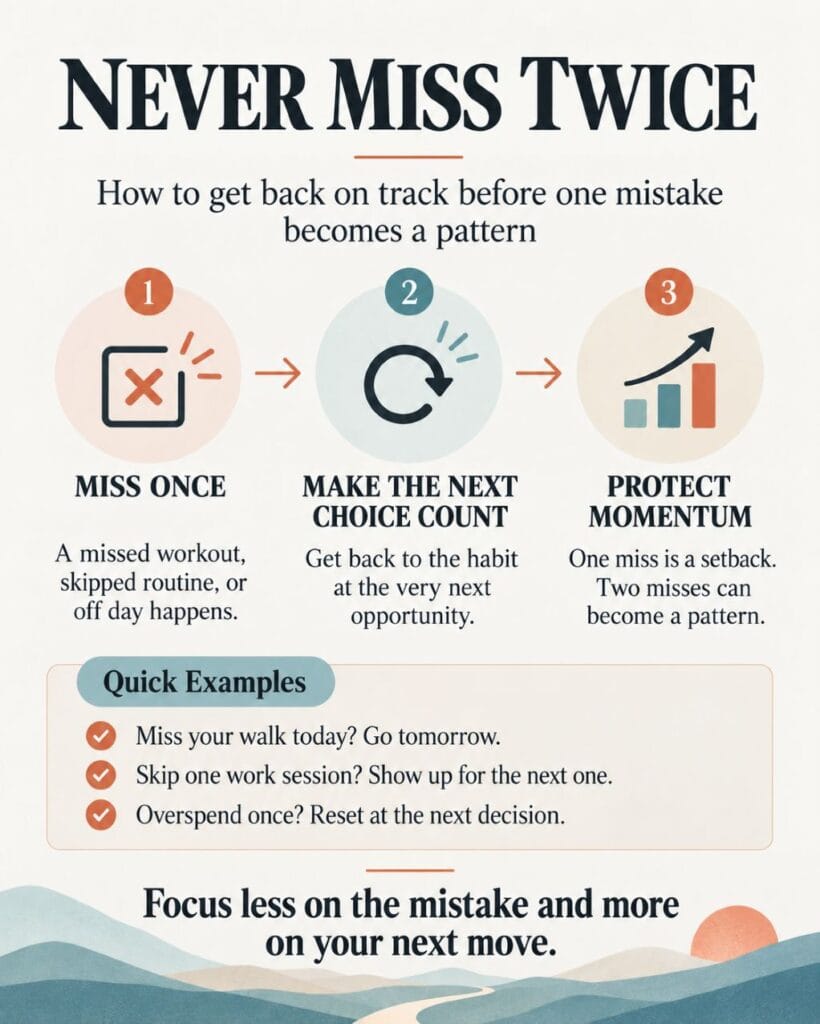
3. Follow the “Never Miss Twice” Rule
Missing once doesn’t mean you’ve failed. It means life happened.
Maybe you skipped a workout, ignored the budget, missed your reading time, or put off a task you meant to finish. That can happen to anyone.
The real danger starts when one miss gives you permission to keep missing.
A single bad day is usually easy to recover from. However, two or three in a row can start turning into a new pattern.
Make the Next Choice Count
The idea behind “never miss twice” is simple: don’t focus on the mistake for too long. Focus on the next chance to get back on track.
For example:
- Miss your walk today? Go tomorrow.
- Overspend at lunch? Don’t let dinner become another impulse purchase.
- Skip one work session? Show up for the next one.
- Miss your evening routine? Do a shorter version the next night.
You don’t need to make up for the missed day with some huge effort. You just need to stop the slip from becoming your new normal.
Use a Backup Version of the Habit
Some days won’t leave room for the full routine.
That’s where a backup version helps.
- Workout: 45 minutes becomes 10.
- Writing: 1,000 words becomes 200.
- Reading: 20 pages becomes 5.
- Evening reset: Five steps become the two most important ones.
This keeps the habit alive without pretending every day will go perfectly.
Don’t Turn One Mistake Into a Story About Yourself
This part matters.
Missing one workout does not mean you’re lazy. Overspending once does not mean you’re terrible with money. Losing focus for a day does not mean you lack discipline.
Those are actions, not identities.
Instead of saying, “I always mess this up,” ask:
“What is the next useful thing I can do?”
That question keeps you moving forward.
Tip: Discipline isn’t about never slipping. It’s about refusing to let one mistake decide what happens next.
4. Regulate Your Emotional Triggers
A lot of self-control problems start with emotion, not laziness. You procrastinate because a task feels overwhelming, scroll because you’re bored, or spend because you’re stressed.
Once you notice the trigger, you can deal with the real problem instead of only fighting the habit.
Notice What Happens First
Pay attention to what you’re feeling before you make a choice you regret.
- Stressed
- Tired
- Bored
- Frustrated
- Avoiding something
- Looking for a quick escape
For example, if you reach for your phone every time work gets difficult, the problem may not be the phone. You may be avoiding discomfort.

Pause Before You React
When you feel yourself getting overwhelmed or irritated, give yourself a little space before acting.
Take a short walk, wait before replying, write down what’s bothering you, or ask yourself what outcome you actually want.
Tip: Emotional discipline doesn’t mean ignoring your feelings. It means noticing them without letting them make the decision for you.
5. Design High-Impact Morning and Evening Routines
Routines make discipline easier because they remove some of the decisions you have to make each day. Instead of figuring everything out from scratch, you already know what happens next.
A simple evening routine can prepare you for tomorrow, while a solid morning routine can help you start with purpose instead of reacting to everything around you.
The Ideal Bookend Framework
| Routine Phase | Recommended Actions | Purpose |
|---|---|---|
| Evening Bookend | Set out clothes or tools, write down tomorrow’s top priorities, and prepare anything you’ll need in the morning. | Makes the next day easier to start. |
| Morning Bookend | Drink water, review your priorities, and begin one important task before distractions take over. | Helps you start with direction and momentum. |
You don’t need a complicated routine with ten steps. The best routine is one you can actually repeat, even on busy days.
Tip: Start with two or three actions that make the biggest difference, then build from there.
6. Use the 2-Minute Rule to Beat Procrastination
Procrastination often makes a task feel harder than it really is. The biggest barrier is usually getting started.
That’s where the 2-Minute Rule helps. Commit to working on the task for just two minutes. If you still want to stop after that, you can.
Why This Works
The goal isn’t to finish the whole project in two minutes. It’s to make starting feel small enough that you actually begin.
For example:
- Writing: Open the document and write one sentence.
- Exercise: Put on your shoes and move for two minutes.
- Cleaning: Pick one small area and start there.
- Business: Send one email, make one call, or complete one small task.
Once you start, continuing often feels easier because the task is no longer sitting in your head as one big thing you have to face.
Tip: When a task feels overwhelming, shrink the starting point instead of waiting until you feel ready.
7. Focus on Identity-Based Habits, Not Just Outcome Goals
Goals tell you what you want to achieve. Identity-based habits focus on the kind of person you want to become.
For example, “I want to write a book” is an outcome. “I’m someone who writes consistently” is an identity.
When progress feels slow, outcome goals can lose their pull. However, identity-based habits give you a reason to keep going because each action becomes proof of who you’re becoming.

How to Shift Your Identity
- Cast votes for yourself: Every time you follow through, you reinforce the identity you want to build.
- Change the way you talk to yourself: Instead of saying, “I have to work out,” try, “I take care of my body.”
- Focus on evidence: One small action may not change much today, but repeated actions build self-trust over time.
You don’t have to feel like a disciplined person before you act like one. Start with the behavior, and let the identity catch up.
Tip: Ask yourself, “What would the person I’m trying to become do next?”
Final Thoughts: Your Destiny Is Built One Choice at a Time
Self-control isn’t about becoming rigid or never enjoying your life. Real discipline gives you more freedom because you’re not letting every mood, temptation, or bad day decide what happens next.
Remember, discipline is destiny. You do not need to overhaul your entire life overnight. Pick just one lesson from this guide, apply it today, and focus on being 1% better than you were yesterday.
Immediate Action Step
What is one small choice you can make right now to cast a vote for your future self? Share your commitment in the comments below or write it down on a sticky note and place it where you’ll see it every morning!
Ready to build stronger habits and stay consistent when motivation fades? Visit the Caliber Motivation Co. shop for practical tools designed to help you stay focused, organized, and moving forward.
Join The Standard
Get practical articles on discipline, mindset, structure, and execution delivered straight to your inbox.
No hype. No fluff. Just real-world strategies to help you stay focused and keep building.
No spam. Unsubscribe anytime.