
AI content editing is becoming more valuable because while AI makes content cheap and fast, it does not make every draft accurate, useful, or worth publishing.
Generative artificial intelligence tools can turn a brief prompt into a full draft in a fraction of the time traditional writing requires. However, those drafts often contain repetitive sentences, robotic language, missing context, and factual errors.
That gap creates a real opportunity for people who know how to fact-check, structure, refine, and improve AI-generated content. By positioning yourself as a human-in-the-loop editor, you can build a practical service business that helps companies protect their brand quality while keeping up with modern content demands.
Still, turning AI content editing into a business takes more than knowing how to clean up a draft. You need a clear offer, a simple way to price the work, the right tools, a plan for finding clients, and a system that can grow without trapping you in another full-time job.
What Businesses Actually Need From an AI Content Editor
Businesses do not need someone to simply run AI-generated text through a grammar checker. They need an editor who can turn rough output into content that is accurate, clear, on-brand, and ready to publish.
That means your value comes from doing the work AI cannot reliably handle on its own:
- Fact-checking: Verify claims, statistics, quotes, and sources before they reach the public.
- Brand voice: Make sure the content sounds like the company, not like a generic AI template.
- Better structure: Remove repetition, tighten weak sections, and organize the content so readers can follow it easily.
- Search intent: Make sure the article actually answers what the reader came looking for.
- Human judgment: Catch weak reasoning, missing context, awkward phrasing, and claims that do not hold up.
- Final quality control: Deliver content the client can publish with confidence.
The goal is not to make AI content look “human.” The goal is to make it useful, trustworthy, and worth publishing.
That is what businesses are paying for: not basic cleanup, but judgment, accuracy, consistency, and a finished product that protects their brand.
The 5-Pillar AI Content Refinement Checklist
Good AI content editing is not about fixing whatever looks wrong first. It is about checking the same critical areas every time so the final piece is accurate, clear, on-brand, and ready to publish.

1. Fact-Checking and Source Auditing
Generative AI can present false information as if it were accurate. Therefore, you’ll have to verify important statistics, dates, product claims, quotes, and research findings before the content goes live.
Whenever possible, trace important facts back to reliable primary sources. Never assume a claim is accurate just because an AI tool presented it confidently.
2. Brand Voice and Tone Alignment
If you use ChatGPT for business content, you have probably seen the same language patterns appear again and again. AI-generated text often leans on phrases such as “game-changer,” “testament,” “delve,” and “in today’s fast-paced world.”
Remove those tired expressions and replace them with language that sounds like the actual client. Moreover, build a simple brand guide so future edits become faster and more consistent.
3. Structural and Flow Refinement
AI-generated drafts often fall into the same rhythm: similar sentence lengths, predictable paragraphs, and ideas that start to blur together. Even when the information is accurate, the writing can still feel flat.
Improve the reading experience by:
- breaking up dense sections
- varying sentence structure
- improving transitions
- organizing lists
- removing repeated ideas
- making headings easier to follow
The reader should never have to fight through the article to understand the point.
4. Search Intent and SEO Optimization
Good SEO is not about stuffing keywords into a draft.
You have to start by asking what the reader actually wants when they search the topic. Then make sure the article answers that question clearly and early instead of making them dig for it.
From there, organize H2 and H3 headings logically, use related search terms naturally, and format key points so the page is easy to scan.
5. Adding Value and Insight
Strong editing should add something the raw draft did not have. That might be real experience, clearer examples, better context, stronger analysis, or expert insight that gives the reader more than a generic summary.
As an editor, your job is to deepen the piece. Add context that explains why something matters, examples that make an idea easier to understand, or insight that helps the reader see the topic differently.
But never invent experience just to make the article sound more authoritative. Instead, pull real knowledge from the client or add insights you can actually support.

How to Structure and Price Your Editing Services
If you want to make real money from this, you will have to treat it like a business from the start. That means knowing what you are charging for and making it easy for a client to understand what they get.
You do not have to charge by the word just because that is how editing has always been priced. In many cases, it makes more sense to price the work based on how much research, rewriting, fact-checking, and cleanup the project actually needs.
This follows the same principle behind learning how to turn one skill into recurring monthly income. You are not just selling your time. You are packaging a result the client needs.
A simple way to think about it is:
Per-Piece Rate → Complexity Tiers → Monthly Batch Retainer
Effective Pricing Models
There is no single right way to price this kind of work. The best model depends on how much editing, research, fact-checking, and restructuring each project needs.
Per-Piece Pricing: If you want to keep things simple, charge a set amount for each article, guide, landing page, email, or other deliverable. The client knows the price upfront, and you are not punished for getting faster and better at the work.
Complexity Tiers: Some projects will take more effort than others. A basic blog cleanup should not cost the same as a technical article that needs deeper research, source verification, and major rewriting. You can create different pricing levels based on how much work is involved.
Monthly Batch Packages: If a client publishes regularly, you can offer a set number of edited articles, newsletters, or pages each month. This can give the client predictable support while giving you steadier recurring income.
Whatever model you choose, make sure your price reflects the work behind the finished piece. You are not charging for grammar fixes alone. You are charging for research, editing, judgment, accuracy, brand consistency, and a final product the client feels confident publishing.
And if ongoing client work does not appeal to you, niche digital asset licensing is another option. Instead of editing for clients month after month, you create reusable assets such as templates, graphics, or business resources that can be sold or licensed repeatedly.
Disclosure: This post may contain affiliate links. If you purchase through these links, Caliber Motivation Co. may earn a small commission at no extra cost to you.
Essential Tools for an AI Content Editor
You do not need a bunch of different software to get started. In fact, buying a pile of subscriptions before you have clients is an easy way to go broke before you have even made your first dollar.
Start simple. Use the tools that actually help you do the work better, and add more only when you have a real reason.
A basic setup could include:
- Grammarly or ProWritingAid: Good for catching awkward wording, grammar issues, and sentences that just do not read right.
- Plagiarism and Originality Tools: Useful for checking copied wording or suspicious overlap. Just do not let some AI-detection score convince you that good writing is bad or bad writing is good.
- SEO Tools: Rank Math can help you clean up on-page SEO. Ahrefs can help with keyword research, search intent, and finding gaps in the content.
- Google Docs or Notion: You need somewhere to keep client notes, revisions, brand guidelines, and feedback without turning your workflow into a mess.
The tools are there to help you, not make decisions for you.
A grammar checker can tell you a sentence looks wrong. You still have to decide whether changing it actually makes the writing better.
That is the part the client is paying for.
If you are not the best writer yet but this business idea still sounds like a good fit, do not count yourself out. Writing is a skill you can improve, and a couple of solid books can help you get better at the part no software can do for you. Everybody Writes by Ann Handley is a good place to start for clear, practical business writing, while On Writing Well by William Zinsser can help you tighten your sentences, cut clutter, and make your writing easier to read.

Practical Ways to Find Your First Editorial Clients
You do not need a huge audience to land your first client. You just need to know where to look.
Start with businesses that already publish a lot of content. If they are putting out blog posts, newsletters, landing pages, or social content every week, they already have a reason to care about quality control.
Good places to look include:
- marketing agencies
- SEO agencies
- SaaS companies
- consultants
- business coaches
- ecommerce brands
- newsletter publishers
- content-heavy small businesses
Then actually go find them.
Search LinkedIn for titles like Content Manager, Marketing Manager, SEO Manager, Agency Owner, or Founder. Look at company websites and check whether they have an active blog, resource center, or newsletter.
You can also use Google to search for businesses in a niche you understand, then look at what they are publishing. If the content is frequent but uneven, repetitive, poorly structured, or clearly needs stronger editing, that is a potential lead.
Freelance platforms such as Upwork can help too. Search for terms like AI content editor, content editor, fact-checker, blog editor, or SEO content editor to see what clients are already asking for.
The goal is not to contact everybody. Find businesses that clearly publish enough content to have an ongoing editing problem, then show them how you can help solve it.
Actionable Client Outreach
Once you find a business that looks like a good fit, do not send a vague message saying you “offer editing services.” Give them a reason to pay attention.
Partner With Content Agencies: Marketing and SEO agencies often juggle several clients at once. If their team is stretched thin, offer to help with editing, fact-checking, or final content review.
Offer a Small Sample: Find a public article with weak structure, repeated ideas, unsupported claims, or broken links. Edit a short section and show them exactly what you changed and why. You are not giving away the whole job. You are proving that you can spot problems and improve the work.
Use Freelance Platforms Strategically: On sites like Upwork, build your profile around specific services such as AI content editing, fact-checking, blog editing, or B2B content review. The more specific you are, the easier it is for the right client to understand what you do.
If you do not have paid work to show yet, create your own portfolio. Generate a few rough drafts on topics you know well, edit them, and save the before-and-after versions. That gives potential clients something concrete to judge.
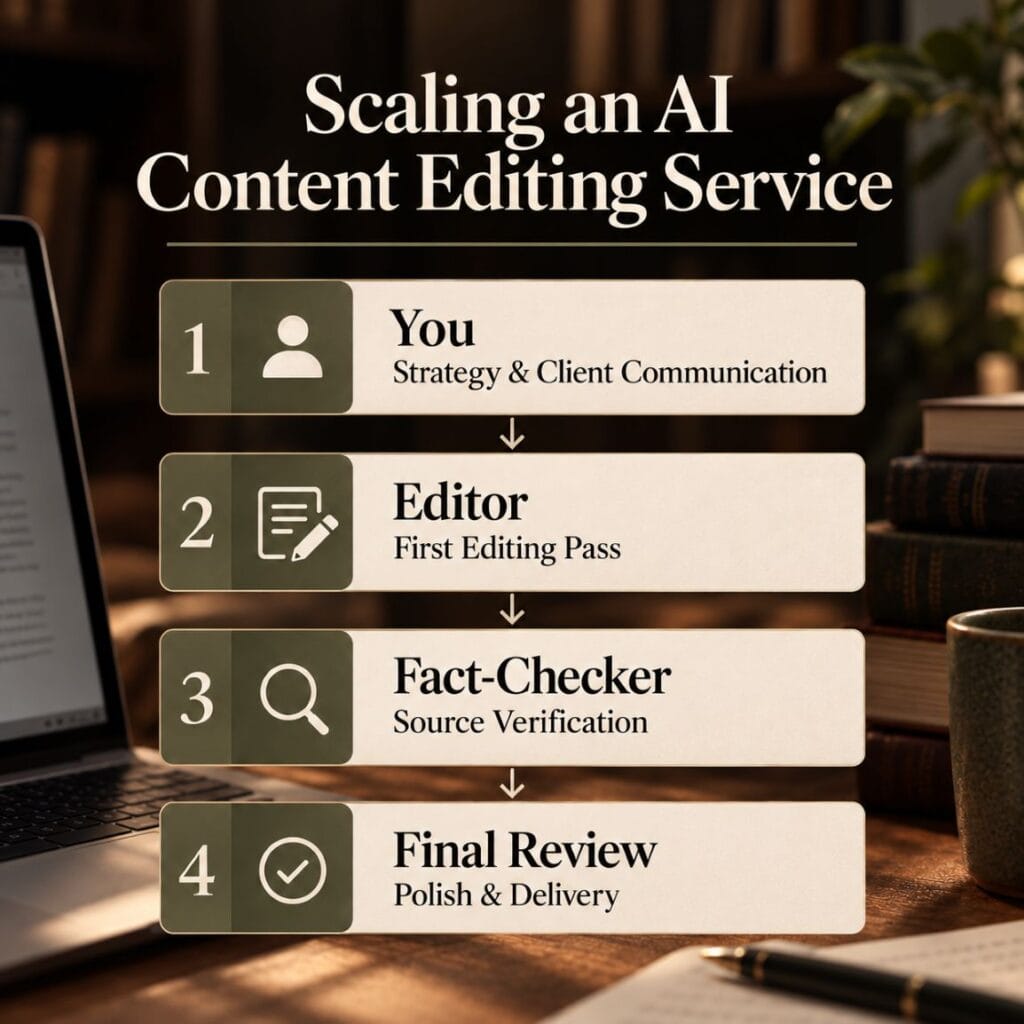
Scaling From Freelancer to a Sustainable Service Agency
When you first start, you will probably do everything yourself. You will find clients, edit the content, check facts, make revisions, and send the finished work back.
That is fine in the beginning.
The problem comes when you have more client work than you can comfortably handle on your own. At that point, you have two choices: work more hours or start getting help with parts of the job.
If you want the business to grow without taking over your entire life, bringing in help can make sense.
For example, you might keep control of the parts that need your judgment, such as:
- talking with clients
- deciding what each project needs
- setting quality standards
- doing the final review
Then you could hire qualified freelancers to help with specific tasks, such as:
- first-round editing
- fact-checking
- source verification
- organizing research
- checking formatting
Before you hand work to someone else, write down exactly how you want the job done. These written instructions are often called standard operating procedures, or SOPs.
Your SOPs might explain:
- how new client work is received
- where files are stored
- how facts should be checked
- what the client’s brand voice should sound like
- how many revisions are included
- what must be checked before the work is delivered
The goal is simple: someone should be able to follow your process without guessing.
You do not have to build a big agency. Even one reliable freelance editor or fact-checker can help you take on more work without doing every single task yourself.
Just make sure the quality stays consistent. If you start handing work off before your process is clear, you can end up creating more problems instead of less.
Building Your AI Content Editing Service Step-by-Step
I do not suggest quitting your job tomorrow just because this business idea sounds good. Start small, learn the work, and prove to yourself that you can find clients and deliver something they are willing to pay for before you depend on it for your income.
You also do not need twelve software subscriptions or years of AI experience to get started. What you need is a good eye for weak content, attention to detail, and a process you can repeat.
Start with three AI-generated drafts on topics you understand well. Fact-check the claims, rewrite awkward sections, improve the flow, and make the final version sound like something you would actually be comfortable putting your name on.
Then save the original draft and your edited version side by side. Those before-and-after examples can become the start of your portfolio and give potential clients something real to judge.
As AI gets better at generating drafts, the value shifts toward judgment. Knowing how to verify facts, improve structure, protect a brand’s voice, and catch weak reasoning is what makes you useful beyond the tool itself.
A real business starts when you solve a real problem consistently. AI content editing gives you one way to turn writing skills, attention to detail, and good judgment into a practical online service.
If you are working toward more independence, stronger habits, and better systems for managing your goals, visit the Caliber Motivation Co. shop for practical tools designed to help you stay disciplined, follow through, and keep building.
Join The Standard
Get practical articles on discipline, mindset, structure, and execution delivered straight to your inbox.
No hype. No fluff. Just real-world strategies to help you stay focused and keep building.
No spam. Unsubscribe anytime.