
Building a productized service starts with one simple question: what do you already know how to do that someone else would rather pay to have handled? That could be WordPress, Canva, Pinterest, email marketing, editing, or another skill you already use.
The mistake is trying to sell every skill at once. When each client gets a completely different offer, the work becomes harder to price, harder to repeat, and harder to grow.
I know that story all too well. When every dollar depends on doing another job, you finish one piece of work and immediately have to start thinking about where the next payment is coming from.
A better approach is to take one useful skill, connect it to one recurring problem, and turn that result into a clear service with a set scope and price. If the client needs that result every month, the service can become recurring client work instead of another one-and-done project.
That’s what this article will show you how to build. We’ll break down what a productized service is, look at practical examples, and walk through how to package, price, and sell one skill as a repeatable monthly service.
What Is a Productized Service?
A productized service is simply a service packaged with clear boundaries. Instead of saying, “Tell me what you need and I’ll give you a quote,” you offer a specific result for a specific price.
Usually, the client knows three things before they buy:
- What they receive
- The price they pay
- What the service includes — and what it doesn’t
That simplicity matters. Traditional freelance work can change from client to client. One customer needs five hours of work, another needs fifteen, and a third keeps adding tasks that were never part of the original agreement.
A productized service makes the offer easier to understand and easier to repeat. That’s really the point: the client doesn’t have to guess what they’re buying, and you don’t have to rebuild the job from scratch every time.
One-Time Productized Services vs. Monthly Retainers
Not every productized service has to be recurring. Some are sold as one-time, fixed-price packages.
For example, someone might charge a set fee to build a WordPress website, create an email opt-in form, or organize an existing process. On the other hand, some services solve problems that come back every month.
A website still needs maintenance. A business still needs newsletters. A blog still needs fresh Pinterest content.
That makes recurring problems a natural fit for a monthly retainer.
For example:
- One-time package: Set up a WordPress landing page, contact form, and email opt-in for $500–$750.
- Monthly service: Maintain the website, run updates, check backups, and handle basic changes for $150–$250 per month.
The advantage isn’t that recurring revenue becomes guaranteed. Clients can leave, expenses can change, and the work still has to be delivered.
However, having several monthly clients can make your income more predictable than starting from zero every month. That matters when you’re trying to build a real service business instead of constantly chasing the next job.
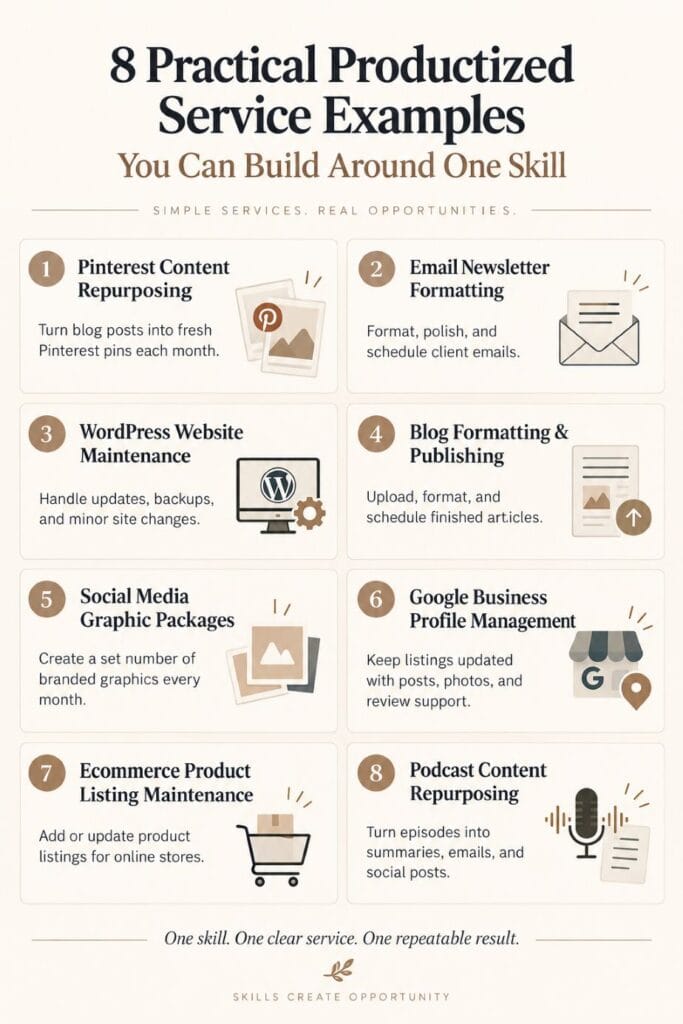
8 Practical Productized Service Examples You Can Build Around One Skill
You don’t need twenty different skills to build a recurring service business. You need one useful skill that solves the same problem again and again.
In many cases, you can start with tools and skills you already know. More importantly, the service needs to be clear enough that you can define what the client receives each month.
Here are eight practical productized service ideas you could build around one skill.
1. Pinterest Content Repurposing
A blogger may publish great content but might not have the time to promote it consistently. You could offer a repeatable service that turns existing articles into fresh Pinterest content each month.
For example, a monthly package might include:
- 4 blog posts provided by the client
- 20 new Pinterest graphics
- Titles and descriptions for each pin
- Scheduling included
Instead of selling generic ‘Pinterest help,’ you’re selling a defined monthly output. The client knows what gets delivered, and you know exactly where the work begins and ends.
2. Email Newsletter Formatting
Many business owners have plenty to say to their email list. However, formatting, checking links, and scheduling those emails often gets pushed aside.
Your monthly service could include:
- 4 newsletters formatted each month
- Links checked before scheduling
- Images added when needed
- Emails scheduled in the client’s platform
The client provides the main message. You handle the work needed to get it sent. That makes the service useful without turning you into their entire marketing department.
Possible pricing: Around $200–$500 per month for a basic newsletter formatting package, depending on the number of emails, platform, design work, and whether scheduling is included.
3. WordPress Website Maintenance
A small business website doesn’t stop needing attention after it goes live. Plugins need updates, links break, and small changes come up.
WordPress recommends regular site maintenance to help keep a website running smoothly over time. A monthly website-care package could include scheduled updates, backup checks, broken-link checks, and a set amount of minor website edits.
The important part is defining the limits before the client signs up. That keeps a monthly maintenance package from turning into unlimited website work.
Possible pricing: Around $100–$300 per month for a basic WordPress maintenance package, depending on how many sites you manage, the level of hands-on support included, and whether minor edits are part of the package.

4. Blog Formatting and Publishing
Some writers and business owners can write the article but don’t want to spend another hour formatting it inside WordPress. You could take finished drafts and handle the publishing work.
A package might include:
- 4 articles uploaded each month
- Headings and spacing formatted
- Internal links added from client instructions
- Images inserted
- Categories and tags applied
- Posts scheduled for publication
That turns a basic website-management skill into a repeatable service. Instead of charging for random website help, you’re selling a defined publishing package.
Possible pricing: Around $150–$400 per month for a basic blog formatting and publishing package, depending on how many posts are included, whether images need to be sourced, and how much optimization or setup is involved.
5. Social Media Graphic Packages
Not every business needs someone to manage its entire social media strategy. Some simply need a steady supply of clean, branded graphics.
You might offer 12 or 20 graphics each month based on content the client already has. Because the number of designs, revisions, and platforms is set in advance, both sides know where the job begins and ends.
That clarity is what makes it work as a productized service. You’re selling a repeatable result, not unlimited design work.
Possible pricing: Around $200–$600 per month for a social media graphic package, depending on the number of graphics, platforms, revisions, and whether captions or scheduling are included.
6. Google Business Profile Management
Local businesses can get busy serving customers and forget about their online presence. A recurring package could handle basic Google Business Profile activity each month.
Google allows profile managers to update business information, add photos, publish posts, and respond to reviews; you can read more in the Google Business Profile Help Center. For example, your package might include regular updates, fresh photo uploads, listing checks, and review-response assistance. Again, you aren’t offering to handle every part of the company’s marketing.
You’re taking responsibility for one clearly defined piece. That makes the service easier to explain, price, and repeat.
Possible pricing: Around $150–$500 per month for basic Google Business Profile management, depending on how many locations you manage, how often you post, and whether review responses, photo updates, and listing checks are included.

7. Ecommerce Product Listing Maintenance
Online stores regularly add products, change prices, update photos, or revise descriptions. That creates an opportunity for someone comfortable working inside Shopify, WooCommerce, or another ecommerce platform.
A monthly package could include a set number of new product listings and updates to existing listings.
For example: Up to 20 new or updated product listings each month for one fixed price.
That’s much easier for a business owner to understand than simply advertising yourself as an “ecommerce assistant.” They can see exactly what they’re buying before the work starts.
Possible pricing: Around $200–$600 per month for ecommerce product listing maintenance, depending on how many listings are included, how complex the products are, and whether image resizing, SEO fields, or variation setup are part of the package.
8. Podcast Content Repurposing
One podcast episode can create far more content than the audio alone. However, the host may not have time to turn every episode into supporting content.
A monthly package might take four episodes and create:
- 4 episode summaries
- 8 social media posts
- 4 email blurbs
- Selected quotes or takeaways
The original content already exists. Your skill is turning it into useful material the client can publish elsewhere.
That makes content repurposing another strong example of a repeatable service. The client keeps producing episodes, and you keep turning those episodes into additional content.
Possible pricing: Around $300–$800 per month for podcast content repurposing, depending on how many episodes are included and whether you’re creating summaries, email copy, social posts, graphics, or short-form clips.
The Pattern Behind Every Productized Service
Notice what these examples have in common. None of them says, “I can help with whatever you need.”
Instead, each productized service answers four simple questions:
- What problem am I solving?
- What exactly will I deliver?
- How much work is included?
- What happens again next month?
In other words, you’re not trying to become a bigger freelancer. You’re trying to build a service that works the same way every time.
That’s also where ruthless consistency matters. When you become dependable at solving one problem, clients don’t have to keep wondering whether the work will get done.
Sometimes the best way to simplify a business is to stop adding more and start narrowing the offer.
Disclosure: This post may contain affiliate links. If you purchase through these links, Caliber Motivation Co. may earn a small commission at no extra cost to you.
Want to Go Deeper on Productizing a Service?
If this business model makes sense to you, Built to Sell by John Warrillow is worth a look. The book follows a service-business owner who learns to narrow his offer, create a repeatable process, and build a business that depends less on custom work.
That lines up closely with the idea behind a productized service: instead of selling “whatever you need,” you create something clear enough to explain, deliver, and repeat.
Check the current price of Built to Sell on Amazon.
How To Turn Your Skill Into A Service People Will Pay For
Once you decide what skill you want to sell, the next step is giving it clear boundaries. Define what the client provides, what you deliver, the scope of work, and what lies outside the package.
That matters because small requests can pile up quickly. A clear scope keeps a monthly service from turning into unlimited work for the same price.
Your price should cover more than the hours you spend doing the task. Think about software, communication, revisions, administrative time, taxes, and the difficulty of the work. The price still needs to make sense after those costs are considered.
Then look for businesses that already have the problem you solve. If you offer Pinterest content, for example, you might find businesses publishing good articles but rarely promoting them. If you maintain WordPress sites, you might look for small businesses with outdated plugins, broken links, or neglected pages.
Specific outreach works better than simply saying, “Let me know if you need help.” Show the owner what you noticed, explain what you handle, and make it easy for them to understand what they would be paying for.
You Don’t Need To Know Everything To Start
A productized service isn’t about becoming someone’s all-purpose freelancer. It’s about getting good at solving one useful problem and building a clear service around it.
You may already know more than you think. WordPress, Canva, Pinterest, email platforms, ecommerce tools, editing, and content management are all skills businesses pay people to handle.
Start with the skill you can deliver confidently, define the service clearly, and look for clients who already need that work done.
If you’re building something of your own, visit the Caliber Motivation Co. shop for practical tools designed to help you stay organized, disciplined, and focused on the work ahead.
Join The Standard
Get practical articles on discipline, mindset, structure, and execution delivered straight to your inbox.
No hype. No fluff. Just real-world strategies to help you stay focused and keep building.
No spam. Unsubscribe anytime.