
Starting a Virtual Assistant Business might be your ticket out of the 9-to-5 grind, especially if you’re tired of putting your best skills to work for someone else’s success. But before you picture yourself working from a beach with a laptop and a cold drink, there’s something you need to understand.
Working for yourself doesn’t automatically mean working less. In fact, you might work harder in the beginning than you ever did for an employer. The difference? You’re building something that belongs to you.
And if you’ve spent years managing schedules, handling customers, solving problems, or keeping an office from falling apart, you may already have skills businesses will pay for. That’s where becoming a specialized virtual assistant gets interesting. Instead of competing for low-paying administrative jobs, you can focus on services that solve specific business problems.
You don’t need a fancy degree or thousands of dollars in equipment to explore this opportunity. However, you do need a skill people value, a plan to find customers, and the discipline to follow through.
In this guide, we’ll cover seven practical steps to build a specialized virtual assistant business, find paying clients, and create a realistic path toward leaving your 9-to-5.
What Is a Specialized Virtual Assistant Business?
A virtual assistant (VA) is someone who helps businesses remotely rather than working in their office. Some handle everyday administrative tasks like scheduling appointments, organizing inboxes, updating spreadsheets, and answering customer questions. A specialized VA takes things further by focusing on a particular industry or service.
To understand the difference, imagine two virtual assistants. The first offers general administrative help to almost any business. The second works exclusively with small construction companies, handling job schedules, estimate follow-ups, customer records, and all that paperwork contractors would rather avoid.
Both offer valuable services, but the second assistant brings something extra to the table. She understands how construction businesses operate and the problems their owners face. Instead of spending weeks learning the industry, she can get to work solving problems she already understands.
And that’s what makes specialization so valuable. You’re not just selling administrative hours. You’re offering knowledge and skills that can save a business owner time, reduce mistakes, and make their daily workload easier. When you can do that consistently, you give clients a stronger reason to choose you over someone offering basic administrative support.
Of course, specializing doesn’t mean you need to know everything before getting started. It means choosing an area you understand, building the skills you’re missing, and getting good at solving the problems your customers actually have.
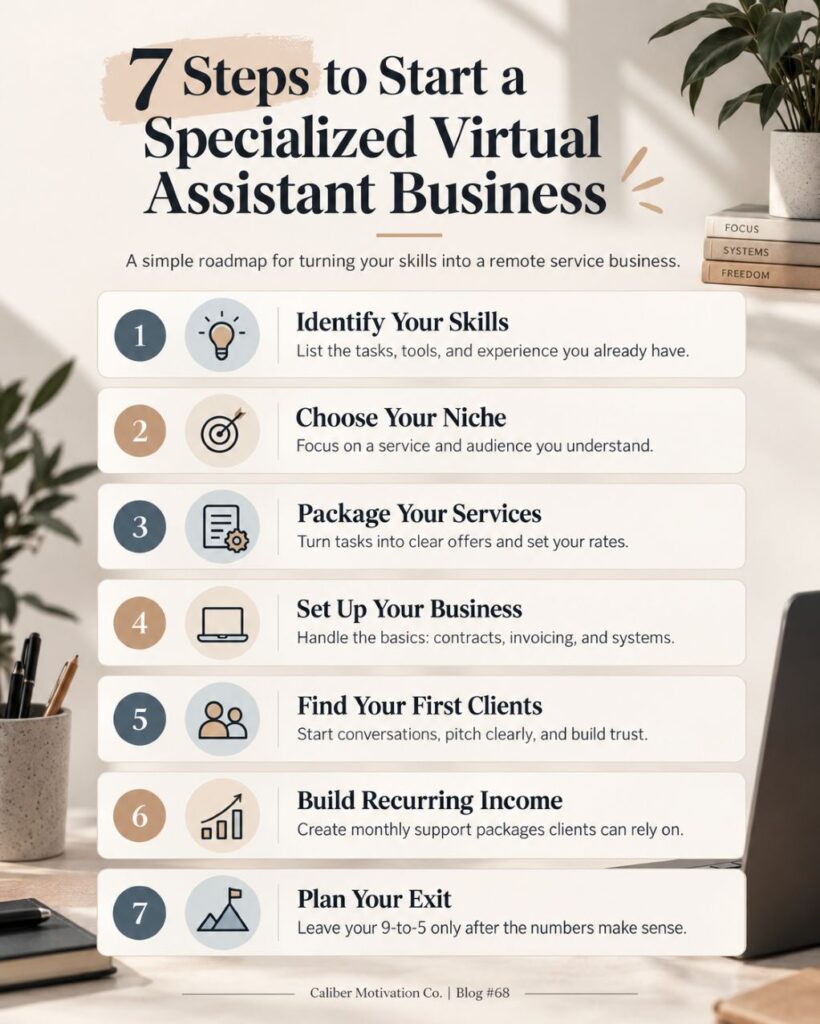
Step 1: Identify Skills You Can Turn Into a Virtual Assistant Business
Before you spend money on courses, software, or a website, take a good look at what you already know. Seriously, you might have more marketable skills than you think, especially if you’ve spent years handling responsibilities that have become second nature.
Have you worked in customer service, managed schedules, handled invoices, organized inventory, or trained employees? Those aren’t just tasks you check off during your workday. They’re skills that other businesses need, and some owners would gladly pay someone capable of handling them.
The trick is figuring out which skills have value outside your current job and how you could turn them into services people would actually buy.
Start With Your Work Experience
Let’s say you’ve spent eight years working in a dental office. You understand appointments, patient communication, paperwork, and the daily headaches of keeping a busy practice organized. You probably don’t think of those responsibilities as business opportunities because, well, they’re just part of your job.
But think about it from a business owner’s perspective. Smaller dental practices sometimes need administrative support without hiring another full-time employee. Your experience could give you a head start because you already understand how those offices operate, although handling medical information requires proper training and privacy safeguards.
Or maybe you’ve spent years working in retail management, dealing with everything from inventory headaches to unhappy customers. You already know how to track stock, coordinate employees, and keep records organized, even when things get hectic. Those same skills could translate into e-commerce support for online stores that need someone to keep their daily operations running smoothly.
The more valuable the problem you can solve, the stronger your position when selling your services. Our article, Problem Solving for Entrepreneurs: Why Hard Problems Pay More, explores why businesses value people who can tackle challenges others struggle to solve.
Make a Simple Skills Inventory
Grab a notebook and take a few minutes to figure out what you bring to the table. Don’t overthink it or dismiss something because it seems too ordinary. Skills you’ve used for years might be exactly what another business owner needs.
Write down:
- Five tasks you perform well.
- Three software programs or systems you know.
- Two industries you understand.
- Three problems you’ve solved at work.
- One skill you’d enjoy developing further.
Once you’ve finished, look over your answers and think about how those skills could help a business save time, avoid mistakes, or serve customers better. You might even notice strengths you’ve been taking for granted because they’re such a normal part of your workday.
And don’t worry if the perfect business idea doesn’t jump off the page. Your goal is to identify something useful you can build on, not reinvent your entire career overnight.
Seven Specialized VA Services Worth Exploring
| Specialty | Services You Could Offer |
|---|---|
| Real estate support | Listing administration, appointment coordination, document tracking |
| Bookkeeping support | Invoice processing, expense records, account reconciliation |
| Digital marketing | Email campaigns, content scheduling, basic performance reports |
| E-commerce management | Product listings, inventory updates, customer support |
| Executive assistance | Complex calendars, travel planning, meeting coordination |
| Medical administration | Approved appointment and office support workflows |
| Online course support | Course uploads, student onboarding, platform maintenance |
Some of these specialties require additional training, licenses, or privacy safeguards, so make sure you understand the rules before offering your services. For example, knowing how to manage invoices doesn’t automatically qualify you to provide professional accounting advice. Likewise, real estate and medical administration can involve legal requirements and sensitive information.
The good news is you don’t have to master every service on this list. Start with something you already understand, build on your existing skills, and learn what you need as your business grows. Once you’ve narrowed down your options, the next step is finding out whether businesses are willing to pay for them.
Step 2: Find a Profitable Niche Before Building Your Business
Here’s where many new entrepreneurs get distracted. They spend three weeks picking a business name, designing a logo, and deciding whether their website should be beige or slightly darker beige. Meanwhile, they haven’t spoken to a single potential customer to find out whether anyone actually needs their services.
There’s nothing wrong with wanting your business to look professional, but a beautiful website won’t save a business nobody needs. Before you invest your time and money, make sure there’s real demand for what you plan to offer. After all, the goal isn’t just to start a business. It’s to build one that people are willing to pay for.
Find Businesses That Already Pay for Virtual Assistant Services
One of the easiest ways to research a potential niche is to look at what businesses are already spending money on. Start by searching LinkedIn, Indeed, and freelance platforms for positions related to your chosen specialty. Pay attention to the responsibilities employers list, the software they require, and whether similar requests appear across multiple companies.
For example, if you find several real estate companies looking for help with transaction coordination, that’s a clue worth investigating. Look at the tasks they need handled and compare those requirements with your current skills. You may discover opportunities you hadn’t considered or realize you need additional training before offering that service.
Remember, job postings and competitor websites don’t guarantee clients will hire you. However, they give you a much stronger starting point than guessing what businesses might need.
How to Research Other Virtual Assistant Businesses
You don’t need expensive research tools to see what other virtual assistants are offering. Start with Google and search for phrases like “real estate virtual assistant services,” “bookkeeping virtual assistant packages,” or “e-commerce virtual assistant pricing.” Replace the industry with whichever specialty you’re considering.
Open five websites belonging to independent virtual assistants or small VA agencies. Look for their Services, Packages, and Pricing pages, then write down:
- Who they serve: Real estate agents, online stores, contractors, or another industry.
- What they offer: Specific tasks, bundled services, or monthly support.
- How they charge: Hourly rates, fixed project fees, or monthly retainers.
- What’s included: Service limits, turnaround times, and additional fees.
- What makes them different: Industry experience, certifications, or specialized software knowledge.
If prices aren’t listed, don’t make up numbers. You can also examine public service listings on platforms like Upwork to see how freelancers describe their offers and advertise their rates.
Once you’ve reviewed five competitors, compare your notes. Are they all offering the same basic services? Do some focus on a particular type of customer? You might spot an under served need, although you’ll still need to speak with potential clients to confirm it.
The goal isn’t to copy another VA’s business. It’s to understand what’s already being offered, how services are packaged, and where you could bring something different to the table.

Step 3: Package Your Specialized VA Services and Set Your Rates
Once you’ve chosen a niche, you need to decide exactly what customers are buying. Saying “I can help with anything” might sound flexible, but it doesn’t tell a business owner what you actually do or why they should hire you.
Imagine calling a mechanic who tells you he can do “some car stuff.” You’d probably keep looking for someone who could explain what they specialize in and how much the work will cost. Business owners aren’t much different. They want to know what you’ll handle, how your service works, and what they’re paying for.
That’s why clearly defined service packages matter. Instead of offering a random collection of tasks, you can group related services into an offer that solves a specific problem and gives customers a clear idea of what to expect.
Turn Tasks Into Service Package
Let’s put this into practice. Suppose you want to offer administrative support to small contracting companies. Instead of advertising general virtual assistance, you could create a Contractor Office Support Package that handles several related tasks.
Your package might include:
- Scheduling customer appointments.
- Following up on outstanding estimates.
- Updating customer records.
- Sending approved invoice reminders.
- Preparing a weekly administrative summary.
Now, instead of guessing what you do, a contractor can immediately see how your services might make their workday easier. You could offer these tasks as a monthly package with a set number of hours or a clearly defined workload, depending on what works best for your business.
However, you’ll need to establish some boundaries from the beginning. Otherwise, a client paying for ten hours of administrative support might expect you to become their entire office department, complete with unlimited phone calls and weekend emergencies. That’s not a service package. That’s a headache waiting to happen.
Before accepting any work, create a written agreement explaining exactly what’s included, your working hours, expected turnaround times, payment terms, and how you’ll handle additional requests. This protects both you and your client while preventing misunderstandings that can quickly turn a promising business relationship sour.
How Much Should You Charge as a Specialized Virtual Assistant?
One of the hardest parts of starting a service business is figuring out what to charge. Set your rates too low, and you could end up working longer hours just to cover your bills. Charge too much without the skills or experience to back it up, and you may struggle to attract clients.
There’s no single hourly rate that works for everyone. Your pricing depends on your experience, specialty, the complexity of the work, and what customers are willing to pay. However, you can use some basic math to figure out where your rates need to start.
Let’s say you want your business to generate $4,000 per month after operating expenses but before personal taxes. You estimate another $500 for software, insurance, and other business costs. That means you’ll need $4,500 in monthly revenue.
Now suppose you can realistically bill clients for 80 hours each month. Here’s how the numbers work:
($4,000 + $500) ÷ 80 billable hours = $56.25 per hour
In this example, you’d need to charge approximately $57 per billable hour to reach your target. Of course, that’s assuming you have enough paying clients to fill all 80 hours and collect every payment.
And don’t overlook the word billable. You won’t get paid for every hour you spend running your business. Finding clients, preparing proposals, managing invoices, and keeping your own records organized all take time.
You’ll also need to set aside money for taxes and account for unexpected expenses. As a general starting point, consider saving 25–30% of your net business profit for taxes, although your actual tax obligations may vary. Business revenue and take-home pay are two very different things, and understanding that difference now can save you a nasty surprise later.
Hourly Pricing vs. Monthly Packages
When you’re starting a virtual assistant business, you have two common ways to charge clients: hourly rates or monthly packages. Hourly billing works well when the workload changes from week to week, especially if you’re taking on short-term projects. However, your income may fluctuate depending on how many hours clients need.
Monthly packages, often called retainers, provide a more predictable way to earn money. A retainer is an agreed monthly payment for a specific amount of work or clearly defined services. This can benefit both parties because the client knows what they’re paying for, and you have a better idea of your expected monthly revenue.
For example, you could structure your services like this:
| Package | Monthly Price | Included Support |
|---|---|---|
| Starter | $400 | Up to 8 hours |
| Growth | $750 | Up to 15 hours |
| Premium | $1,200 | Up to 24 hours |
These are hypothetical examples, not guaranteed selling prices or established industry rates. Notice that each package works out to $50 per included hour, which is slightly below the $56.25 hourly target from our earlier calculation. If your business needs a higher rate to remain profitable, you’ll need to adjust your prices or reduce the included hours.
Also, remember that not every service should cost the same. Managing basic administrative tasks is different from handling complex technical projects or specialized systems. Your prices should reflect the skills required, your operating costs, and what customers are willing to pay.
Before offering monthly packages, decide what happens when clients use all their included hours. Will you charge an additional hourly rate, offer an upgrade, or schedule extra work for the following month? Make those terms clear in your agreement so neither side gets an unpleasant surprise.
Ultimately, your goal isn’t to become the cheapest virtual assistant online. It’s to build a business that pays you fairly while giving clients dependable, valuable service.

Step 4: Set Up Your Virtual Assistant Business Without Overspending
Now we get to the part where starting your own business begins to feel real. Fortunately, a remote service business doesn’t usually require the same investment as opening a storefront. If you already have a reliable computer and internet access, you might have most of the equipment you need to get started.
However, keeping startup costs low doesn’t mean you can ignore the business side of things. Even if you’re working alone from your kitchen table, you’ll still need organized records, clear client agreements, and a reliable way to collect payments. Getting those basics in place early can save you plenty of headaches as your business grows.
Handle the Basic Business Requirements
Before accepting your first client, make sure you understand the legal and financial requirements of running a business. In the United States, those requirements vary depending on where you live, the services you offer, and how you structure your business.
The U.S. Small Business Administration provides guidance on registering a business, choosing a legal structure, and obtaining necessary permits. It’s a useful starting point if you’ve never worked for yourself before.
Here are a few things you’ll need to research:
- Business registration: Check whether your state or local government requires registration or a business license.
- Business structure: Decide whether a sole proprietorship or limited liability company (LLC) makes sense for your situation.
- Tax identification: Determine whether you need an Employer Identification Number (EIN) from the IRS.
- Business finances: Consider opening a separate bank account to keep business income and expenses organized.
- Insurance and contracts: Research appropriate business insurance and use written agreements that explain your services and responsibilities.
You don’t necessarily need an LLC to start a virtual assistant business. Many freelancers begin as sole proprietors, although that structure doesn’t provide the same liability protection as an LLC. Because each option has different legal and tax implications, it’s worth getting professional advice before deciding.
You’ll also need to understand your tax responsibilities. Self-employed individuals generally pay income taxes and self-employment taxes, and many must make estimated payments throughout the year. The IRS Self-Employed Individuals Tax Center explains these requirements and provides resources to help you get started.
Taking care of these details might not be the most exciting part of entrepreneurship, but ignoring them can create expensive problems later. A little preparation now will help you run your business with greater confidence as you begin working with clients.
What Equipment and Software Do You Need?
One advantage of starting a virtual assistant business is that you don’t need an office full of expensive equipment. If you already have a reliable computer and a secure internet connection, you’re off to a good start. The rest depends on the services you plan to offer and the tools your clients use.
For most beginners, the essentials include:
- A dependable computer and secure internet connection: You’ll need both to work remotely and communicate with clients.
- A professional email address: Keep business communication separate from personal messages.
- Video meeting software: Zoom or Google Meet can help you communicate with clients.
- Cloud document storage: Google Drive or OneDrive can keep approved files organized and accessible.
- Invoicing and payment tools: Use a system that lets you send invoices and track payments.
- Task management software: Trello or Asana can help you organize projects and deadlines.
- Secure password management: A password manager and multi-factor authentication help protect business accounts.
You don’t need every paid tool on the market to get started. Google Workspace, Microsoft 365, and other platforms offer useful business features, but there’s no reason to pay for six subscriptions when you’re managing one client. Start with what you need, then upgrade as your workload grows.
Also, ask whether clients will provide access to their existing software before purchasing anything. Many businesses already use specific systems and expect their virtual assistants to work within them. The goal is to build an efficient setup, not collect monthly subscriptions you barely use.
Do You Need a Website Immediately?
A professional website can help establish credibility, but you don’t need to spend months building one before looking for clients. A simple website with your services, relevant experience, and contact information is enough to get started. You can always add testimonials, portfolio examples, and more features as your business grows.
If you’re not ready to build a website, start with a professional LinkedIn profile and a one-page document outlining your services. Include who you help, what problems you solve, and how potential clients can contact you. That gives you something professional to share while you focus on finding your first paying customer.
And please, don’t spend $2,000 on branding before you’ve earned your first $200. Your priority is proving that people will pay for your services, not building the fanciest website in your industry. Once you’ve established that demand, you’ll have a much better idea of where to invest your money.

Step 5: Find Your First Virtual Assistant Clients
This is the step that makes many beginners nervous, and understandably so. Learning new software feels manageable, and building a website can even be fun. But approaching a complete stranger and asking them to pay for your services? That’s a different story, especially when you’ve spent your entire career receiving a paycheck rather than finding your own customers.
Fortunately, you don’t need thousands of social media followers or a massive advertising budget to land your first client. What you do need is a clear understanding of who your services can help, where to find those people, and how to start a conversation without sounding like a desperate salesperson.
And remember, you’re not asking anyone to do you a favor. You’re offering a service that could make their business easier to run. Once you understand that distinction, reaching out to potential clients becomes a lot less intimidating.
How to Reach Out to Potential Clients.
Now it’s time to put your research to work and start approaching potential clients. Let’s say you’re targeting local contractors. Begin by creating a list of 20 businesses that fit your ideal customer profile, then visit their websites to learn about their services, company size, and how to contact the owner or office manager.
The key is to make your outreach personal without over-complicating it. Don’t send a generic message announcing that you’re a hardworking virtual assistant who can do everything under the sun. Instead, introduce your specialty and explain how your services might fit their business.
For example, your first message could look something like this:
“Hi Mark, I help small contracting businesses keep estimate follow-ups and customer scheduling organized. I noticed your company handles several service areas, and I wanted to ask whether you currently manage that work in-house or use outside support.”
Notice how the message doesn’t assume the owner has a problem or immediately pressure them into buying something. It introduces a specific service, shows you’ve taken the time to learn about their company, and gives them an easy question to answer. That’s a much better way to begin a professional conversation than sending a long sales pitch.
If the owner responds with interest, ask a few questions about their current workload and what kind of support they’re looking for. You can then explain how your services work and suggest a short introductory meeting. Your goal with the first message isn’t to close a sale. It’s to open the door to a conversation that could lead to a paying client.
One final thing worth knowing: if you contact businesses through cold email, you still need to follow applicable marketing rules. In the United States, the FTC’s CAN-SPAM guidance applies to business-to-business commercial emails, including requirements for accurate sender information and opt-out options.
Where Else Can You Find VA Clients?
Cold outreach isn’t your only option for finding virtual assistant clients. Several platforms and professional networks can help you connect with business owners. However, it’s better to focus on two methods consistently than spread yourself thin trying everything.
- LinkedIn: Search for business owners and managers in your chosen niche. Build a professional profile explaining your services, connect with potential clients, and share useful tips that demonstrate your expertise.
- Freelance platforms: Websites like Upwork let you browse projects and submit proposals. Focus on jobs matching your specialty rather than applying for everything, and remember to account for platform fees.
- Professional groups: Join Facebook or LinkedIn groups where your ideal customers spend time. Participate in discussions, answer questions, and build relationships before promoting your services.
- Local networking: Chamber of Commerce events and business meetups can introduce you to potential clients. Even if you work remotely, local connections can lead to valuable business relationships.
- Referrals: Tell former coworkers and professional contacts what services you’re offering. Be specific about the businesses you serve so people know who to recommend you to.
Start with two channels and set a realistic weekly goal, such as contacting five potential clients or submitting three thoughtful proposals. Track which methods lead to actual conversations, then spend more time on what works.
You don’t need to be everywhere. You need to show up consistently where your potential customers are.
What If You Don’t Have a Portfolio?
If you’re starting from scratch, you probably don’t have client testimonials or a collection of completed projects to show potential customers. That’s okay, but you still need some way to demonstrate what you can do. One option is to create two or three sample projects that reflect the services you’re planning to offer.
For example, if you’re interested in e-commerce support, you could create sample product listings, an inventory spreadsheet, or a customer service response guide for a fictional online store. Clearly label everything as demonstration work, and never present invented results or fake reviews as genuine client experience. You can also offer a small paid trial project with a defined outcome, giving both you and the client a chance to see whether working together makes sense.
And don’t get discouraged if your first few conversations don’t lead to paying work. Some businesses won’t have the budget, others won’t be ready to hire, and a few may already have someone handling those tasks. Use what you learn from each conversation to improve your approach, strengthen your portfolio, and give the next potential client a better reason to hire you.

Step 6: Turn One-Time Projects Into Recurring Monthly Income
Landing your first client feels good, especially when you’ve spent weeks building your business and wondering whether anyone will actually hire you. But constantly chasing the next project can become exhausting, particularly when you’re still working a full-time job and trying to build something on the side.
That’s why recurring services are worth considering. Instead of starting from zero every month, you can offer ongoing support through monthly agreements that provide more predictable income. However, the key is finding services your clients need regularly, not convincing them to pay for work they don’t actually need.
Look for Work Businesses Need Every Month
The best opportunities for recurring income come from tasks businesses need handled regularly. An online retailer might need weekly product updates and customer support, while a course creator may need help enrolling students and maintaining lesson materials. A real estate agent could need ongoing listing administration and appointment coordination.
These services are worth exploring because the work continues beyond a single project. Instead of constantly searching for new assignments, you can build relationships with clients who need dependable support month after month.
For example, suppose you establish four monthly client agreements:
| Client | Monthly Revenue |
|---|---|
| Real estate agent | $750 |
| Online retailer | $1,200 |
| Course creator | $750 |
| Small business owner | $1,200 |
| Total | $3,900 |
That’s $3,900 in hypothetical monthly revenue, assuming every client pays and continues their agreement. It isn’t a promise of what you’ll earn, but it shows how several ongoing clients could contribute to a more predictable income.
However, don’t get so excited about the monthly total that you forget to calculate the workload. If those four contracts require 80 billable hours, you’re earning $48.75 per billable hour before expenses and taxes. That’s also below the hourly target we calculated in Step 3, so you would need to adjust your pricing, workload, or revenue goals.
Recurring income is valuable, but only when the numbers make sense. The goal isn’t to fill every available hour with work. It’s to build reliable client relationships that support a profitable business without leaving you overworked and underpaid.
If you’re interested in exploring this business model further, How To Turn One Skill Into Recurring Monthly Income explains how to turn a useful skill into an ongoing service rather than depending entirely on one-time projects.
Keep Clients by Making Their Lives Easier
Getting hired is only the beginning. Keeping clients requires more than completing tasks and sending invoices. Business owners want to know they can trust you, that their work is getting done correctly, and that hiring you is making their lives easier.
One simple way to build that trust is by sending a weekly progress update. Let clients know what you’ve completed, what still needs attention, and what’s coming up next. For example, your report might include:
- Updated 22 customer records.
- Followed up on 14 outstanding estimates.
- Resolved three scheduling conflicts.
- Flagged two customer requests needing approval.
This gives clients a clear picture of the work you’re handling without making them chase you for updates. It also gives you an opportunity to catch small problems before they turn into bigger ones.
Of course, being dependable doesn’t mean making yourself available around the clock. Set clear working hours, communicate when clients can expect responses, and stick to the services outlined in your agreement. The goal is to become someone clients can count on, not someone they can take advantage of.
When clients see consistent results and enjoy working with you, they’re more likely to renew their agreements and recommend your services to others. That’s how you begin building a business based on long-term relationships rather than constantly searching for the next project.

Step 7: Build a Realistic Exit Plan From Your 9-to-5
Now for the question you’ve probably been thinking about since you started reading. When can you finally hand in your notice and work for yourself full-time?
It’s tempting to quit the moment your virtual assistant business starts making money, especially when you’re tired of answering to someone else’s schedule. However, one profitable month doesn’t mean you’re ready to walk away from a steady paycheck. The goal is to build enough financial stability that you don’t trade one stressful situation for another.
Know Your Numbers Before You Quit
Start by calculating your essential monthly expenses, including housing, utilities, groceries, transportation, insurance, and debt payments. Then factor in business expenses, taxes, and benefits you’ll lose when leaving your employer, such as health insurance or retirement contributions.
For example, if your household needs $3,000 a month, earning $3,000 in business revenue won’t be enough. You’ll need additional income to cover taxes, operating costs, and unexpected expenses.
Before making the leap, consider these three financial checkpoints:
- Consistent income: Your business has generated enough income to meet your needs for several consecutive months.
- Emergency savings: You’ve built a financial cushion, ideally covering three to six months of essential expenses, based on your circumstances.
- Reliable clients: You have ongoing agreements and aren’t depending entirely on one customer for your income.
Make the Transition on Your Terms
You don’t have to quit your job to prove you’re serious about entrepreneurship. If possible, build your virtual assistant business during evenings or weekends while keeping your regular income. You might eventually reduce your employment hours as your client workload and financial situation allow.
And remember, there’s no deadline for becoming self-employed. Some people make the transition in months, while others need a year or longer. What matters is whether your business can support you without putting your financial security at unnecessary risk.
If you’re still deciding whether self-employment is right for you, Reasons to Become an Entrepreneur: 10 Honest Benefits explores what working for yourself can offer beyond the possibility of earning more money.
Don’t quit your job hoping your business will succeed. Build a business strong enough to give you the choice to leave.
Final Thoughts: Is a Specialized Virtual Assistant Business Right for You?
A specialized virtual assistant business isn’t the right fit for everyone. You’ll need to manage deadlines, communicate with clients, handle administrative responsibilities, and find enough paying work to keep the business running. Some days, you’ll probably miss the simplicity of receiving a regular paycheck.
But if you enjoy solving problems, working independently, and taking responsibility for your results, this business model is worth exploring. You can test your services while still employed, learn from real customers, and decide whether self-employment makes sense for your situation.
Your next move is simple: choose one specialty and research five businesses that might need your services. That small assignment will tell you more than another week spent imagining what working for yourself could look like.
Ready to Put Your Plans Into Action?
Having a business idea is one thing. Keeping track of your goals, client outreach, finances, and daily responsibilities is another.
Visit the Caliber Motivation Co. Shop for journals, habit trackers, and practical planning tools to help you organize your work and measure your progress.
A business doesn’t become real because you dream about it. It becomes real when you start doing the work.
Join The Standard
Get practical articles on discipline, mindset, structure, and execution delivered straight to your inbox.
No hype. No fluff. Just real-world strategies to help you stay focused and keep building.
No spam. Unsubscribe anytime.