
Have you ever searched for reasons to become an entrepreneur and wondered whether business ownership would actually improve your life? Maybe you’ve imagined controlling your schedule, increasing your income, or building something that belongs to you. However, the honest benefits have less to do with internet hype and more to do with creating a life that works.
For me, entrepreneurship wasn’t a lifelong dream. I was a single parent trying to hold down a nine-to-five job, but school calls, illnesses, appointments, and other responsibilities kept pulling me away from work.
I still had to earn enough money to live. However, I needed work that allowed me to be the parent my child needed without constantly risking my job whenever life happened.
Starting a landscaping business gave me that flexibility. I built it one customer at a time and learned that flexible work doesn’t mean easy work. It means being able to move a job, handle your child’s needs, and then return to the work that pays the bills.
That experience shaped how I view entrepreneurship. Business ownership can give you more control, more ways to earn, and something of your own to build. However, every benefit comes with responsibility, uncertainty, and work that nobody else will handle for you.
If you’ve thought about starting a business, this article will help you look at the decision clearly. We’ll cover ten honest benefits, what they cost, and how to test an idea without risking everything.
What Does It Mean to Become an Entrepreneur?
An entrepreneur identifies a problem, creates a product or service that solves it, and accepts the risk of building a business around that solution. You don’t need an office, employees, or a large loan to qualify.
A landscaper with a dependable route is an entrepreneur. So is a home baker, freelance designer, mobile dog groomer, consultant, or person selling digital planners from a spare bedroom.
Entrepreneurship and self-employment often overlap, but they aren’t always identical. A self-employed person mainly creates a job for themselves. An entrepreneur may also build products, systems, or a team that allows the business to grow beyond their daily labor.
Neither model is automatically better. You may want flexible personal income, a company you can eventually sell, or a small business that supports your life without taking it over.
According to the U.S. Small Business Administration, the United States had more than 36 million small businesses in 2026. Together, they employed 62.3 million people. Entrepreneurship isn’t a fringe career choice; it’s a major part of the economy.
“Sometimes entrepreneurship doesn’t begin with a dream. It begins when your life no longer fits inside someone else’s schedule.”
Why People Search for Reasons to Become an Entrepreneur
People usually begin thinking about entrepreneurship because something in their working life no longer fits. Their pay has stalled, their schedule controls the family, or their job uses only a fraction of what they can do.
Others notice a problem nobody is solving well. They realize customers might pay for a faster, simpler, kinder, or more dependable solution.
Still, frustration alone isn’t a business plan. Sometimes you need a better employer, stronger boundaries, or new training—not a logo and a nervous breakdown with matching business cards.
Before starting, identify your real reason. A strong reason can carry you through slow months, difficult customers, and the days when your equipment behaves as if it has joined a labor union.
Ask yourself:
- What problem can I solve well?
- Who already needs that solution?
- Why do I want a business instead of another job?
- What skills am I willing to learn?
- What can I test without risking my rent or grocery money?
Tip: Answer those questions before choosing a name or building a website. A clear customer problem matters far more than a clever brand name.
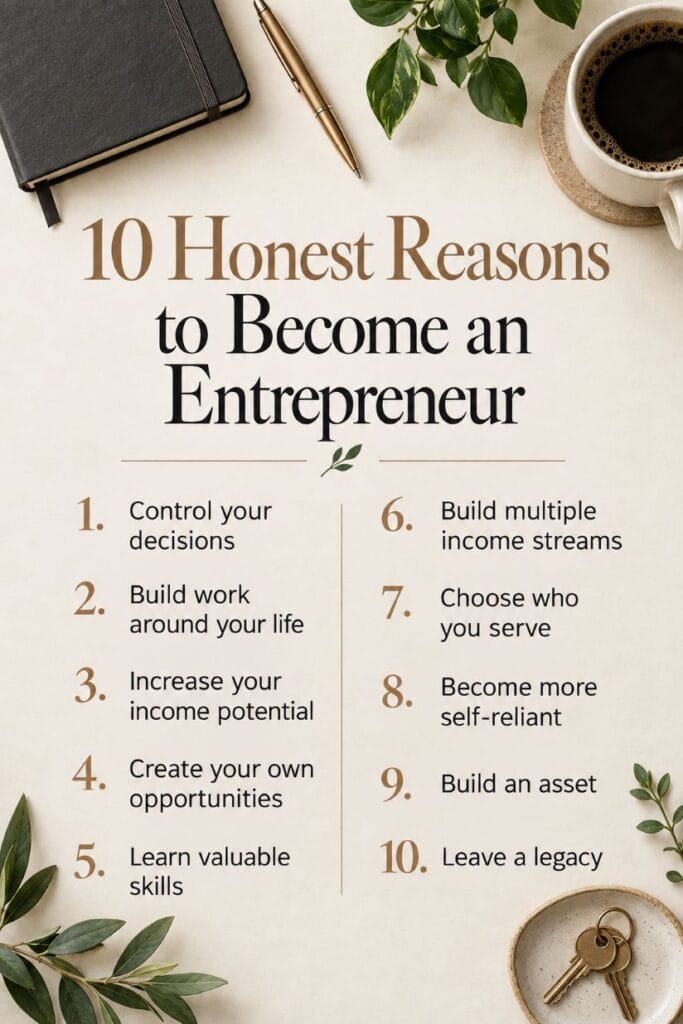
10 Honest Reasons to Become an Entrepreneur
The best reasons to become an entrepreneur go deeper than “being your own boss.” In reality, your customers become one boss, the bank account becomes another, and the broken mower may occasionally run the whole company.
Even so, the following benefits can make that responsibility worthwhile.
1. You Gain More Control Over Your Decisions
Entrepreneurship allows you to decide what you sell, what standards you follow, and how you treat customers. You don’t need three meetings and a manager’s approval to fix an obvious problem.
That control matters when you care about quality. You can refuse rushed work that would damage your reputation, change an inefficient process, or stop serving a customer who repeatedly ignores your boundaries.
Control doesn’t mean doing whatever feels good. It means making the decision and accepting the result.
Apply it: List three work decisions that affect your performance but remain outside your control. Would owning a business realistically give you more influence over them?
2. You Can Build Work Around Your Life
Running your own business can give you more influence over when, where, and how you work. That flexibility may help parents, caregivers, people managing health concerns, and anyone whose life doesn’t fit inside a standard schedule.
However, flexibility isn’t endless free time. In the beginning, you may work longer hours because sales, customer service, bookkeeping, and delivery all belong to you.
The benefit is the ability to shape those hours. You might do physical work before the afternoon heat, reserve one weekday for appointments, or complete focused work before your household wakes up.
Example: The flexibility to arrange my landscaping route around school calls, appointments, weather, and customer needs made it possible for me to remain present as a single parent while still paying the bills. That didn’t make the work easy, but it solved a problem a rigid nine-to-five schedule couldn’t solve for me.
For working parents and caregivers, that flexibility can be one of the most practical reasons to become an entrepreneur. It allows work to support real life instead of forcing every family need into an employer’s schedule.
3. Financial Reasons to Become an Entrepreneur
At a regular job, someone else decides your wage, raise, and available hours. As a business owner, you can raise prices, add services, improve efficiency, or sell products that don’t depend entirely on your time.
That doesn’t create “unlimited income.” Demand, expenses, competition, capacity, and your decisions still create limits. Moreover, revenue isn’t profit; profit is what remains after fuel, supplies, software, taxes, repairs, and other costs.
The honest benefit is that one employer no longer decides what your skills are worth. When you create more value and manage the business well, you have more ways to increase your income.
Apply it: Estimate the price of one offer, the cost to deliver it, and the number you could handle monthly. That calculation is more useful than daydreaming about a six-figure business.

4. You Learn How to Create Opportunities
Entrepreneurs don’t have to wait for the perfect job opening. They can examine their existing skills, find a need, and create an offer around it.
Someone who spent years organizing offices might offer home-organization services. A retail worker who understands displays could help local stores improve how they present products.
Additionally, one opportunity often reveals another. A lawn customer may need hedge trimming, while a blog reader may need a checklist, course, or practical tool.
Tip: Listen for problems people repeat. A frequent complaint can point toward a service or product they already want.
5. You Develop Skills Nobody Can Take Away
Running a business forces you to learn. You may develop skills in sales, negotiation, pricing, budgeting, marketing, customer service, time management, and problem-solving.
Some lessons come from research. Others arrive because something breaks at 7:15 in the morning and four customers expect you by lunch.
Even if your business changes or closes, those skills remain yours. You can use them to rebuild, create another income stream, or become more valuable in a future role.
6. You Can Build More Than One Source of Income
A job normally pays you through one channel. A business can create several related income streams, reducing your dependence on one customer or service.
A fitness coach might offer private sessions, group classes, digital guides, and affiliate recommendations. A writer might offer articles, editing, templates, and a course.
However, adding everything at once creates confusion. Start with one offer that solves one clear problem. Prove people will pay for it before expanding.
Apply it: Write down your main service. Then list two related offers that the same customer might reasonably need next.
7. You Have More Choice Over Who You Serve
Business ownership gives you more power to define your ideal customer. An ideal customer needs your solution, respects the process, and can afford the price.
You won’t love every customer, and one uncomfortable conversation isn’t always a reason to end the relationship. However, you can establish policies, contracts, service areas, and prices that protect the business.
Over time, those standards help you attract better-fitting customers. They also reduce the resentment that grows when you keep accepting work that doesn’t make sense.

8. Self-Reliance Is One of the Strongest Reasons to Become an Entrepreneur
A regular job can feel secure, but one employer controls your entire paycheck. A restructuring, lost contract, ownership change, or management decision can take that security away quickly.
Entrepreneurship carries different risks. However, it teaches you how to find customers, solve problems, make offers, and generate income for yourself.
This is one of my favorite things about working for myself. If I lose one client, it may sting, but it won’t wipe out my entire income because I still have around 50 other clients paying me.
Losing a traditional job is different. Your whole paycheck stops until you find another employer, complete the hiring process, and receive your first check.
That’s why building a customer base can create a deeper form of security. One customer may leave, but you still have the skills, equipment, and relationships needed to replace that income.
Apply it: Don’t confuse dependence on one employer with complete security. Ask whether you’re developing skills that could produce income outside your current job.
9. You Can Build an Asset Instead of Only Selling Time
As mentioned earlier, when you work an hourly job, your paycheck generally stops when the hours stop. However, a well-built business can create assets that continue producing value after the original work is finished.
Those assets can include a trusted name, customer list, documented system, website, course, book, product catalog, email list, or recurring service route. Each gives the business value beyond today’s labor.
This takes time. A new website with three articles and no audience isn’t passive income. It’s a young website wearing work boots.
Still, consistent effort can create leverage. Leverage means one piece of work produces results more than once, such as a useful article attracting readers for years or a digital guide selling repeatedly.
10. You Can Build Something That Outlasts You
The final benefit is legacy. A business can support your family, create jobs, teach your children useful skills, or leave behind products and ideas that continue helping people.
Legacy doesn’t require a national company. A dependable local business that serves a community for twenty years is also a legacy.
Moreover, entrepreneurship lets you demonstrate standards through action. Your family sees you solve problems, keep commitments, learn new skills, and continue building when progress feels slow.
Caliber Motivation grew from lessons I learned through rebuilding my life, raising my family, and running a physical service business. Turning those lessons into tools gives the work a purpose beyond another sale.
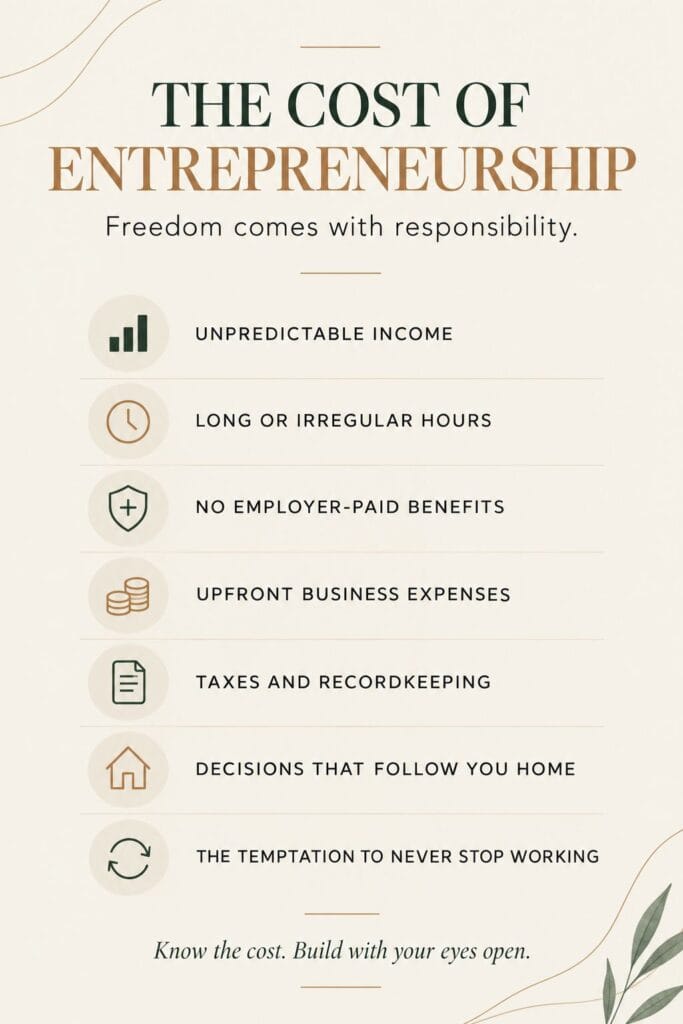
What the Reasons to Become an Entrepreneur Can Cost
An honest discussion of the reasons to become an entrepreneur must include the price. Independence sounds wonderful until you realize nobody else is responsible for generating revenue, replacing equipment, or calming an unhappy customer.
You may face:
- Unpredictable income, especially at the beginning
- Long or irregular hours
- No employer-paid vacation, insurance, or retirement match
- Expenses that arrive before customer payments
- Taxes and records you must manage
- Decisions that follow you home
- The temptation to work constantly because the business is never truly “finished”
The IRS generally requires self-employed people to file an annual return and pay estimated taxes quarterly. Self-employment tax covers Social Security and Medicare, so you must price your work and save accordingly.
Therefore, judge the business by profit, not sales alone. Track expenses, reserve money for taxes, and separate business spending from personal spending.
Is Entrepreneurship Right for You?
You don’t need a fearless personality or a business degree. However, you need enough discipline to act without constant supervision and enough humility to change course when customers prove you wrong.
Entrepreneurship may fit you if you’re willing to:
- Solve problems without waiting to be rescued
- Communicate clearly with customers
- Keep promises and arrive when you say you will
- Learn basic sales, pricing, taxes, and bookkeeping
- Make decisions without perfect information
- Adjust an offer that customers don’t want
- Work consistently before recognition arrives
It may not fit your current season if you need guaranteed income, strongly dislike customer interaction, or can’t absorb a financial setback. That doesn’t mean never. It may mean you should prepare first or test an idea while keeping your job.

How to Test an Idea Without Risking Everything
You don’t need to quit tomorrow, buy 500 products, or rent an office to learn whether your idea has potential. Start with the smallest version that allows a real customer to say yes or no.
The ability to begin small is another of the overlooked reasons to become an entrepreneur. You can test a useful offer before making a major financial commitment.
- Choose one problem. Describe the exact result you can help someone achieve.
- Choose one customer. Identify who feels that problem strongly enough to pay for help.
- Create one simple offer. State what you’ll do, what the customer receives, and the price.
- Talk to real people. Ask questions before building a complicated product.
- Make the first sale. Payment is stronger proof than compliments or social-media likes.
- Deliver the work well. Notice what takes too long, confuses the buyer, or reduces profit.
- Improve and repeat. Adjust the offer using evidence instead of guessing.
If you’re considering a downloadable product, learn how to profit from niche digital products by validating one focused idea before building a large catalog.
For example, don’t begin by creating a twelve-module home-organization course. Offer a paid two-hour session first. You’ll learn what customers struggle with, what language they use, and which outcome they value.
Likewise, don’t finance expensive landscaping equipment before confirming demand. Start with services your current tools can handle, price them correctly, and reinvest after the work proves itself.
Recommended Books for Aspiring Entrepreneurs
Books won’t build your business, but the right one can help you avoid expensive mistakes. These three match the problems a new owner is most likely to face.
Disclosure: This post may contain affiliate links. If you purchase through these links, Caliber Motivation Co. may earn a small commission at no extra cost to you.
- The Lean Startup by Eric Ries: Learn how to test ideas before investing heavily in an unproven product.
- Built to Sell by John Warrillow: Learn how to create repeatable systems so the company doesn’t depend entirely on your daily labor.
- Profit First by Mike Michalowicz: Learn a practical cash-management method designed to make profit a regular part of business planning.
Choose the book that matches your current problem. Then apply one lesson before buying another book. A shelf full of advice won’t rescue an offer nobody has tried to sell.
Should You Become an Entrepreneur?
The strongest reasons to become an entrepreneur are control, self-reliance, growth, and the opportunity to create value on your terms. Those benefits become real only when you accept the work behind them.
Don’t start because social media made entrepreneurship look like laptops, coffee shops, and Tuesday afternoons at the beach. Start because you understand a problem, believe you can solve it, and are willing to learn what the work requires.
You don’t have to risk your entire life to begin. Test one offer, serve one paying customer, track the numbers, and improve from evidence.
That’s how many durable businesses start—not with perfect timing, but with useful work performed well. The first version may be small, but it gives you something powerful: proof that you can create an opportunity instead of waiting for one.
If you’re ready to strengthen your discipline, organize your goals, and build standards that support the work ahead, visit the Caliber Motivation Co. shop. Choose a practical tool that helps you move from thinking about your future to building it.
Join The Standard
Get practical articles on discipline, mindset, structure, and execution delivered straight to your inbox.
No hype. No fluff. Just real-world strategies to help you stay focused and keep building.
No spam. Unsubscribe anytime.