Disclosure: This post may contain affiliate links. If you purchase through these links, Caliber Motivation Co. may earn a small commission at no extra cost to you.
You can know exactly what you need to do and still keep doing the opposite. You can make a plan, start strong, and watch it fall apart when life gets inconvenient. That is the problem The Greatest Salesman in the World was built to solve.
You already know how this goes. The desire to change shows up strong, then disappears just as fast.
Work runs late, something goes wrong at home, and you get tired. Suddenly, that new habit doesn’t seem quite as important.
Og Mandino understood that lasting change could not depend on how driven you felt that morning. He built his message around repetition, discipline, persistence, and action.
The story follows Hafid, a poor camel boy who wants to become a successful trader. If you want to read the full book for yourself, The Greatest Salesman in the World by Og Mandino is worth having on the shelf. Eventually, Hafid receives ten ancient scrolls containing principles for changing how he lives and works.
However, the real power isn’t only in what those scrolls say. It’s in what Hafid must do with them.
He returns to the lessons repeatedly before moving forward. Mandino makes the point clear: knowing what to do does very little if you never live it.
You can read every self-discipline book on the shelf, save quotes, watch videos, and write down ambitious goals. However, none of that changes much if you keep returning to the same old patterns.
You don’t change because you learned something once. You change because you repeat the right actions until they become normal.
Some of the best lessons on discipline were written decades ago. Explore our Forgotten Books series to see which ones still hold up today.
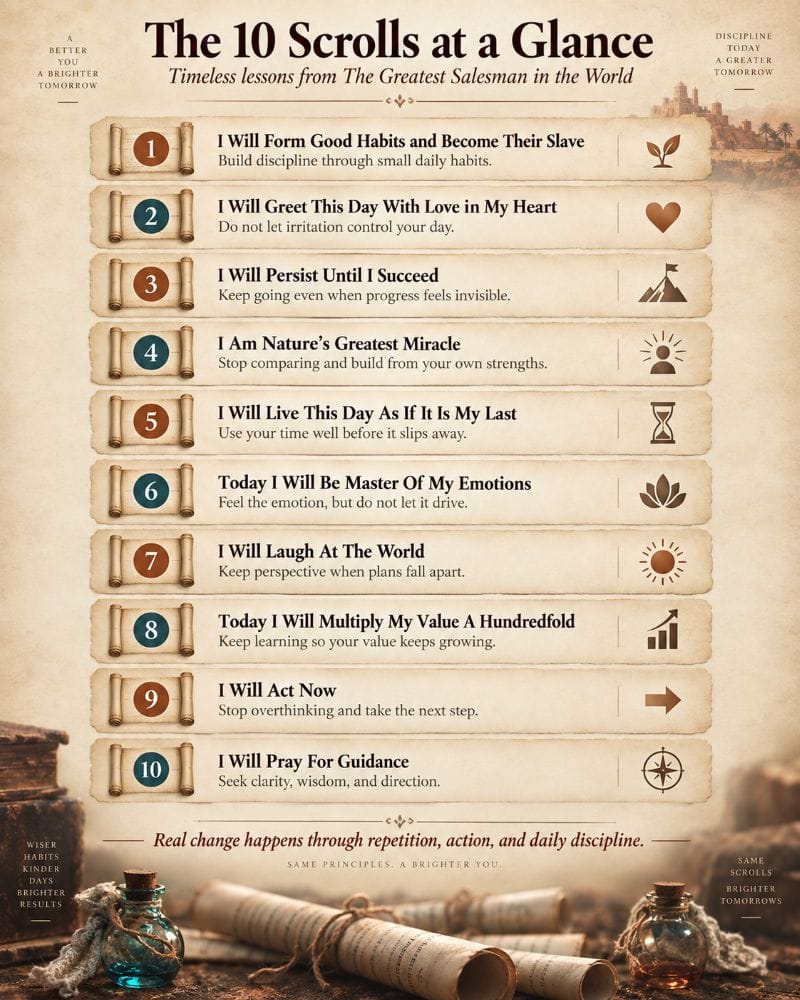
The Greatest Salesman in the World and the 10 Scrolls
The ten scrolls cover far more than sales. They deal with the same things that usually knock you off course: bad habits, weak follow-through, negative thinking, procrastination, emotional reactions, and waiting too long to act.
More importantly, each scroll gives you a different way to work on those problems. As you go through them, don’t just ask what Mandino meant. Ask how you can use each lesson in your own day, because that is where these old ideas start becoming useful.
Scroll 1: “I Will Form Good Habits and Become Their Slave”
Discipline rarely begins with some huge life-changing decision. More often, it starts with boring things you keep doing until they become normal.
You get up and do the work, make the call, write the page, and finish what you said you would finish. Eventually, those choices stop requiring a debate every morning.
That‘s the point. The more automatic the habit becomes, the less you have to argue with yourself about doing it.
Start here:
- Choose one habit that actually matters.
- Make it small enough to repeat on a bad day.
- Stop changing the plan every week.
- Give repetition time to work.
You don’t need ten new habits by Monday. You need one good habit you can trust yourself to keep. These 10 Habits That Quietly Build Discipline Over Time show you exactly where to start without trying to overhaul your whole life at once.
Scroll 2: “I Will Greet This Day With Love in My Heart”
This lesson may sound softer than the others, but don’t dismiss it. You know how fast one bad interaction can change the tone of your whole day.
Someone says the wrong thing, a problem comes up, and suddenly you are carrying that irritation into everything else. That costs you focus, patience, and energy you could have used on something that actually matters.
Mandino’s point is not that you have to like every person or every situation. The point is to stop handing other people control over your state of mind.
Try this today: When something gets under your skin, do not react right away. Give yourself a few seconds and ask, “Does this deserve the rest of my day?”
If the answer is no, let it go and move on. That one habit can save you from turning a five-minute problem into a five-hour distraction.
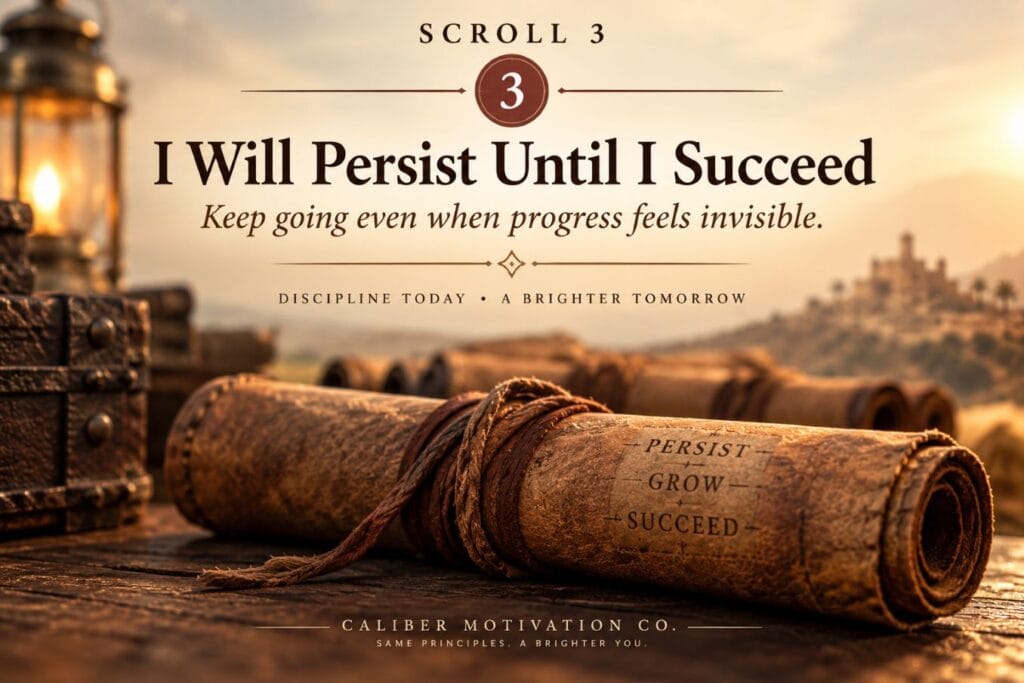
Scroll 3: “I Will Persist Until I Succeed”
Have you ever worked at something for weeks and thought, What is the point? Nothing seems to be happening, nobody notices, and the numbers barely move.
That is the dangerous stretch because slow progress makes it easy to convince yourself that the work isn’t paying off. Anybody can keep going when progress feels obvious, but persistence matters most when the results are still hard to see.
I know that feeling firsthand with this site. Recently, my visitor numbers climbed into the 80s, then slid right back into the 50s. I changed my Pinterest branding, questioned whether I made the right call, and wondered if all the daily effort was actually building anything.
However, in spite of all of it: I will persist until I succeed.
That is exactly where this scroll hits. You cannot let one bad week, one traffic dip, or one disappointing number convince you to abandon what you’re building. Mandino’s lesson is simple: don’t judge the whole process too early. Progress often shows up right after a long stretch of work that feels invisible.
When progress feels slow, do this instead:
- Pick one action you can keep repeating, even when results are not obvious.
- Measure your effort weekly instead of judging yourself emotionally every day.
- Look for small proof that you are improving.
- Give the process enough time before deciding it’s not working.
If you are in one of those stretches where life keeps hitting back, How to Build Grit When Life Keeps Knocking You Down goes deeper into how to keep moving when progress feels painfully slow.
You may be closer than you think. Don’t quit during the quiet part just because nobody can see the progress yet.
Scroll 4: “I Am Nature’s Greatest Miracle”
Comparison will wear you out. It’s easy to look at someone who is further ahead and assume they have something you don’t.
Maybe they found the right strategy, got lucky, or discovered some formula you missed. The problem is that you are usually only seeing the finished result.
What you don’t see are the years spent struggling, learning, failing, changing direction, sacrificing, and continuing when nobody cared what they were building.
That matters because comparing your beginning to someone else’s result will make your own progress feel smaller than it really is. Before long, you start copying what they do, questioning your strengths, and losing focus on the work sitting right in front of you.
Mandino’s point is that your differences have value. Your skills, experiences, failures, and strengths give you something nobody else can copy exactly.
Apply this: The next time comparison creeps in, stop and ask what part of that person’s journey you can’t see. Then bring your attention back to the work you can control today.
Your job is not to become somebody else. Your job is to become more capable at being yourself.
Improve your process, raise your standard, and measure yourself against who you were six months ago.
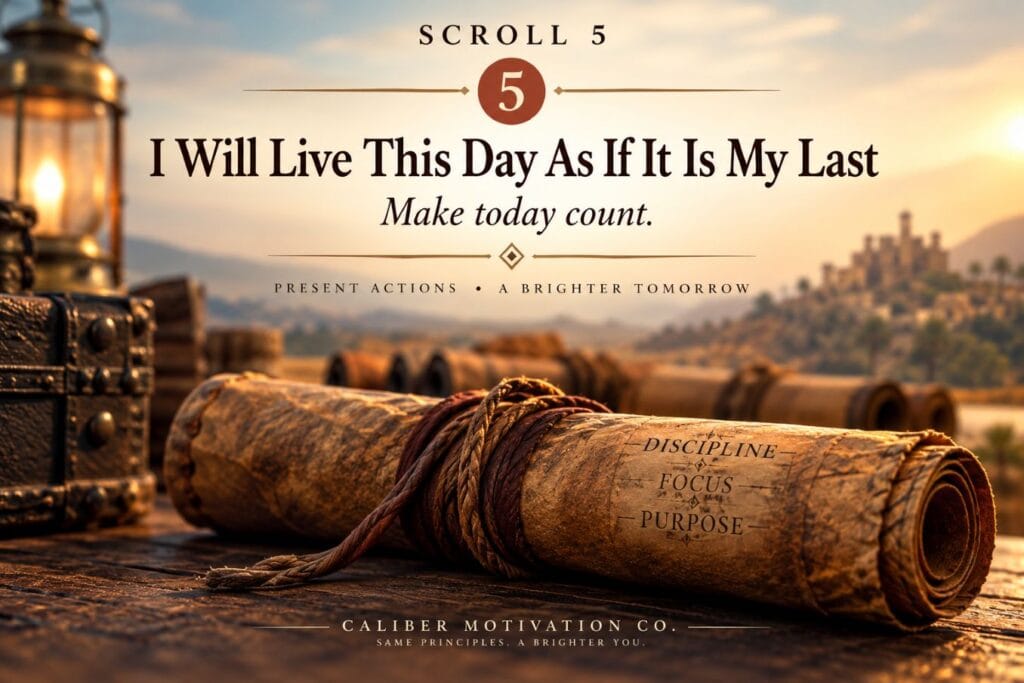
Scroll 5: “I Will Live This Day as If It Is My Last”
It’s easy to fall into the trap of believing you have plenty of time. There will always be another weekend, another Monday, another year, or another chance to finally start doing the things you keep putting off.
So you stay busy. You work, handle responsibilities, chase goals, and tell yourself you will slow down later.
Sometimes we even get so busy trying to build a better life for our kids that we miss the life they are actually living right in front of us. One day they are little, and the next you are wondering how the years disappeared so fast.
That’s the part nobody warns you about. Time does not always feel like it is moving while you are in the middle of it, but then you look back and realize entire seasons are gone.
Mandino’s lesson creates urgency, not panic. He’s not telling you to live recklessly because tomorrow might not come. He is reminding you to stop acting like your time is unlimited.
Put it into practice: Think about one thing you’ve been saying you will do “someday.” Then think about one person you keep saying you will make more time for. Take one real step toward both today.
Maybe you need to submit the application, make the phone call, start saving the money, sit down with your kid without your phone, or finally take that afternoon together you keep postponing.
You can build something meaningful and still be present for the life happening around you. Just don’t get so busy building a future that you miss the people you are building it for.
Scroll 6: “Today I Will Be Master of My Emotions”
You are not going to feel calm, focused, and ready to work every day. Some mornings you will feel exhausted, doubtful, or completely over it. Other times, one frustrating problem can throw your entire mood off.
However, emotional control is not about pretending those feelings are not there. It’s about choosing what you do next instead of letting the emotion make that decision for you.
When doubt tells you to stop, take one small step forward. If you feel overwhelmed, shrink the next step until it feels manageable. And when frustration starts taking over, create some distance before you react.
I do that with this website all the time. When I am trying to solve something technical like site speed and keep hitting dead ends, I can feel the frustration building. Instead of sitting there getting more irritated, I switch tasks, put my focus somewhere I can still be productive, and come back to the problem later with a clearer head.
That is not quitting. It’s creating enough distance from the frustration to keep it from hijacking the rest of my day.
Mandino’s point is that your feelings are real, but they don’t automatically deserve control over your decisions.
Your mood can have a seat, but it does not get to drive.
If your thoughts have a habit of running the show, How to Build Mental Discipline: Your Mind Is a Garden digs deeper into how repeated thoughts shape the way you react, act, and handle difficult days.
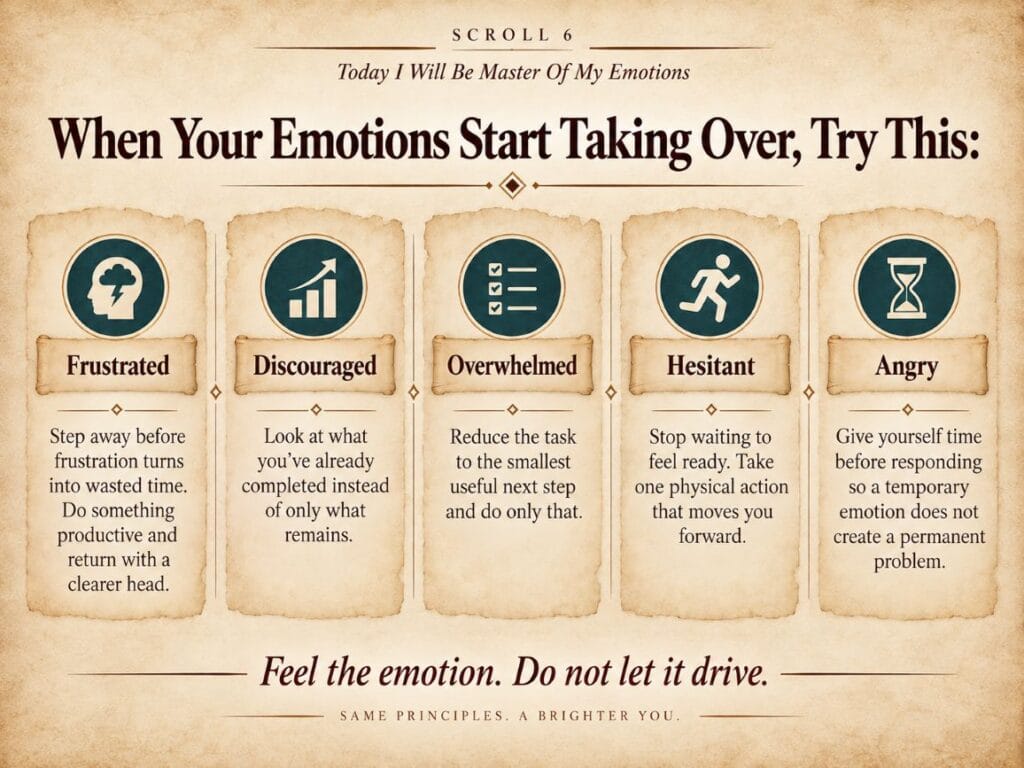
Emotional mastery doesn’t mean you never get angry, discouraged, worried, or overwhelmed. It means those emotions don’t automatically decide what happens next.
Sometimes discipline means pushing through. Other times it means stepping away, redirecting your attention, or giving yourself enough space to think clearly. Either way, you stay in charge of your next move.
If you want to go deeper into that, How to Control Your Emotions and Stay Calm Under Pressure breaks down what to do when frustration, anger, fear, or overwhelm starts taking over. It gives you practical ways to slow the reaction, regain control, and keep one emotional moment from steering the rest of your day.
Scroll 7: “I Will Laugh at the World”
Scroll 7 is about learning not to take every setback so seriously that it destroys your ability to keep going. Mandino uses laughter as a way to regain perspective when life doesn’t go according to plan.
That doesn’t mean problems are funny. It means you stop treating every failure, rejection, or closed door like the end of the world. Sometimes you have to look at what happened, shake your head, take the lesson, and keep moving.
I went through that with Etsy and YouTube. I put in the time, created the content, and eventually realized I was building on platforms I did not control. Their rules, reach, and payouts could change, while the work was still mine to produce.
That realization was frustrating, but sitting around angry about it wouldn’t have changed anything. Instead, I took the lesson and switched gears to build something I actually owned: this website.
That is what this scroll looks like in real life. You can spend months replaying what went wrong, or you can accept that the road changed and find a better way forward.
A setback can hurt without becoming a permanent defeat. Sometimes the thing that didn’t work teaches you exactly what you need to build next.
When a plan falls apart, ask yourself three questions:
- Can I fix it? If yes, stop complaining and fix it.
- Can I learn from it? If yes, take the wisdom and leave the bitterness behind.
- Is the door completely closed? If yes, stop standing there knocking.
That’s where the laughter comes in. Not because losing time, money, or effort is funny, but because eventually you have to refuse to let the setback keep owning you.
Sometimes you laugh at how badly the plan went, take what it taught you, and move on. The setback does not get the final word.

Scroll 8: “Today I Will Multiply My Value a Hundredfold”
Potential sounds good, but results are better. You can have talent, ambition, and great ideas, but none of those things mean much if you never keep developing yourself.
Mandino’s point is that your value grows when you become more useful, more capable, and better at solving problems. That might mean learning a new skill, improving your work, communicating better, or understanding something you used to avoid.
That is something I am doing constantly right now. I watch videos, study other blogs, look at what successful sites are doing, ask AI to teach me things I don’t understand, and take free mini-courses whenever I find one that can help me improve.
None of that feels dramatic in the moment. However, every lesson adds another tool I can use, and over time those small improvements start stacking on top of each other.
Put it into practice: Pick one area where you know you are still weak and spend the next 30 to 90 days improving it on purpose. Do not try to learn everything at once.
You could:
- Read one useful book on the subject.
- Watch a few quality tutorials.
- Take a short course.
- Study someone who is already doing it well.
- Use AI to explain what you don’t understand.
- Practice the skill until you can actually use it.
The goal isn’t to collect information. The goal is to become more capable because of what you’ve learned.
Your standard shouldn’t stay where it was last year. If you keep learning, testing, and applying what works, your value has no reason to stay where it is either.
Scroll 9: “I Will Act Now”
This may be the simplest scroll and the hardest one to argue with. You can think about something for six months, research it, plan it, organize it, and talk about it, but never do anything to bring it to fruition.
Eventually, though, all that needs turn into action. Action closes the gap between the person you say you want to become and the person your daily behavior proves you are.
The longer you delay something that has to be done, the bigger it usually becomes in your head. You start overthinking it, finding reasons to wait, and convincing yourself you need a better time, a better plan, or more confidence.
That’s how good ideas die.
Put this scroll into practice: Stop waiting for the perfect moment and make the first move. If the task feels too big, cut it down until the next step feels obvious.
Need to write? Open the document. Need to exercise? Put your shoes on. Need to make the call? Dial the number before your brain builds a case against it.
If you catch yourself constantly finding reasons to wait, Overcome Excusitis: How to Stop Making Excuses and Start Moving digs into the excuses that sound reasonable but quietly keep you from taking action.
You don’t need to finish everything today. You just need to stop standing still.
Act now. Let the next step create the momentum.

Scroll 10: “I Will Pray for Guidance”
Sometimes effort alone won’t give you the answer. You can work hard, think through every option, and still reach a point where you’re not sure what the next move should be.
That’s where this scroll matters. Mandino ends with guidance because discipline doesn’t mean pretending you have every answer.
Sometimes you need wisdom more than speed. Other times, you need clarity more than another plan.
Praying for guidance isn’t about asking for an easy road. It’s about asking for the strength to handle what comes next and the wisdom to recognize the right direction when it appears.
Put this scroll into practice: When you feel stuck, stop asking only, “How do I get out of this?” Ask, “What am I supposed to learn here, and what do I need to become to get through it?”
Then give yourself enough quiet to actually listen for the answer. That might mean prayer, journaling, walking without your phone, or simply stepping away from the noise long enough to think clearly.
You still have to act. Guidance won’t replace the work, but it can keep you from wasting months pushing in the wrong direction.
Ask for clarity, then have the courage to move when you get it.
The Real Lesson Behind The Greatest Salesman in the World
I think the biggest lesson Og Mandino left behind is that real change doesn’t happen overnight. You don’t become a different person in one big moment. You become different through the small choices you keep making every day.
Real discipline grows quietly through ordinary decisions nobody applauds. You do the work when you’re driven, and then you do it again when you’re not.
Eventually, you stop asking whether you’re disciplined because your actions answer the question for you.
If you want help turning that repetition into something you can actually track, the 30-Day Discipline Reset gives you a simple structure for habits, standards, and daily execution.
Build the Discipline the Scrolls Demand
Reading about discipline is easy, but living it on an ordinary Tuesday is where things get hard. Choose one habit and start there, then repeat it long enough to prove your word actually means something.
If you want to see that consistency build over a longer stretch, the 90-Day Habit Tracker gives you a simple way to track the repetitions and see your progress on paper.
After that, raise the standard again.
If you’re ready to put that principle into practice, visit the Caliber Motivation Co. shop. You’ll find practical tools built for stronger habits, better focus, and consistent daily execution.
Join The Standard
Get practical articles on discipline, mindset, structure, and execution delivered straight to your inbox.
No hype. No fluff. Just real-world strategies to help you stay focused and keep building.
No spam. Unsubscribe anytime.