There have been plenty of days when I knew exactly what I needed to get done, yet I still found ways to avoid starting it. The Now Habit by Neil Fiore helps explain something many people miss: procrastination is not always laziness and treating it that way can make the problem worse.
Maybe you know the feeling. You have that one important task to do, but suddenly the kitchen counter needs cleaning, your email needs checking, and apparently today is the perfect day to organize that drawer full of chargers you have not touched since 2019.
You are doing things, so you are not exactly sitting around doing nothing. However, you are still avoiding the one thing that matters most.
Disclosure: This post may contain affiliate links. If you purchase through these links, Caliber Motivation Co. may earn a small commission at no extra cost to you.
What Is The Now Habit?
The Now Habit is a book about procrastination, pressure, perfectionism, and how we respond to difficult work. Neil Fiore approaches procrastination differently from the usual advice that tells you to simply work harder or become more disciplined.
Instead, he asks you to look underneath the delay. In many cases, procrastination can become a way to escape fear, stress, overwhelm, or the pressure to do something perfectly.
That distinction matters because you cannot solve every kind of procrastination with another planner or longer to-do list. Sometimes you already know exactly what you need to do, but the task has become so mentally heavy that starting feels harder than the work itself.
The Now Habit Changes the Question
When you procrastinate, you may ask yourself, “Why can’t I just make myself do this?” However, a more useful question is, “What about this task am I trying to escape?”
Maybe you are dealing with fear of failure. Perhaps you are worried someone will judge your work, or maybe the project feels so large that you cannot figure out where to begin.
Additionally, you may be putting more pressure on yourself than the task actually requires. Telling yourself, “I have to finish this entire project today,” creates a very different feeling than saying, “I am going to work on the first part for 30 minutes.”
The project did not change. However, the starting point did, and that can make a huge difference.
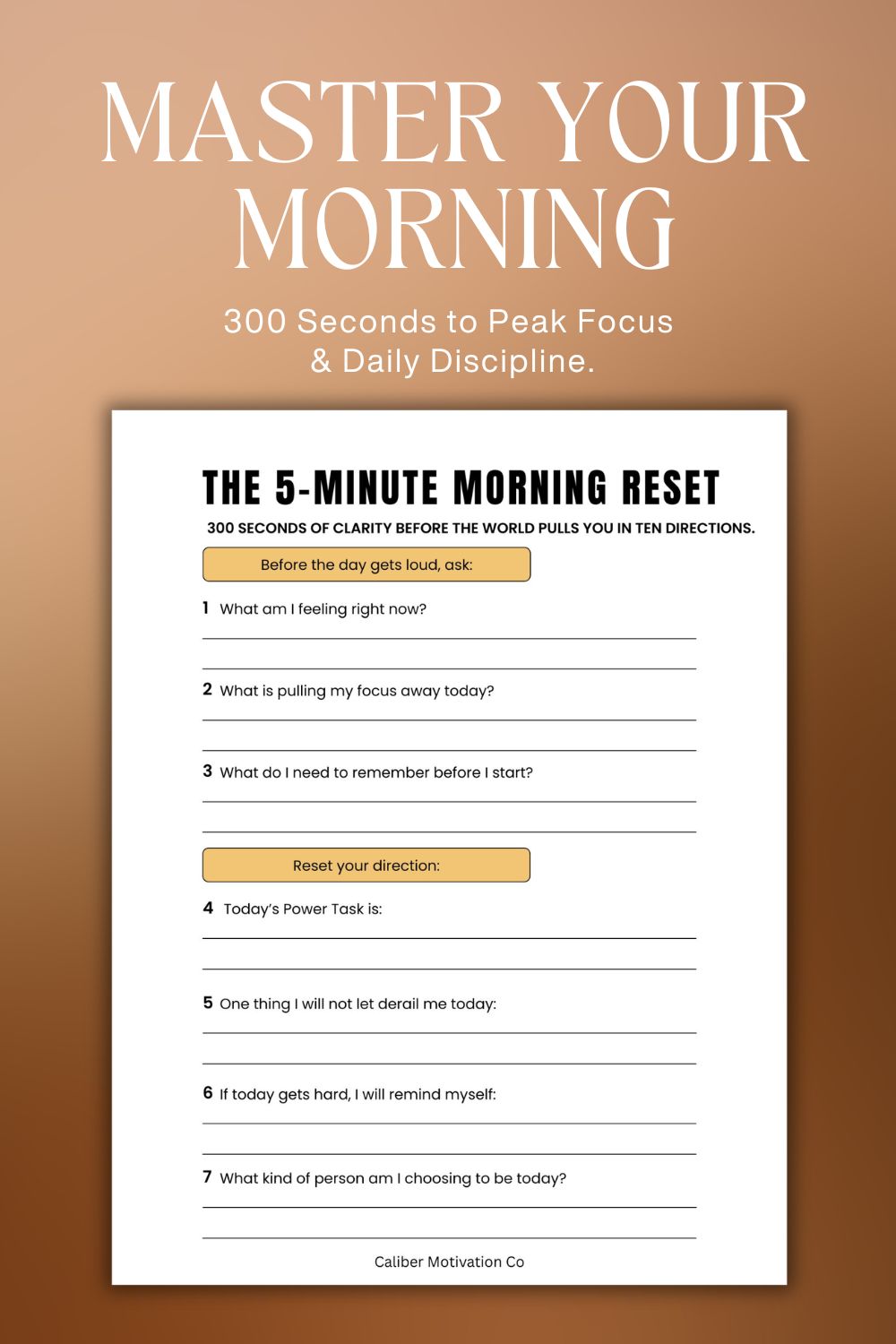
Sometimes the best way to break procrastination is not to overhaul your whole day. Instead, start with one small reset that helps you clear the mental clutter and decide what matters first. If your mornings tend to disappear before you get traction, the 5-Minute Morning Reset can help you slow down, refocus, and choose your next move before the day starts pulling you in ten directions.
Free 5-Minute Morning Reset
Build stronger discipline, focus, and consistency with the free 5-Minute Morning Reset guide from Caliber Motivation Co. Get new blog posts, mindset strategies, and practical systems for long-term growth delivered straight to your inbox.
Why Procrastination Is Not Always Laziness
Laziness and procrastination can look similar from the outside, but they are not always the same thing. A person can deeply care about finishing something and still avoid starting it.
Imagine you have to create an important presentation for work. You want it to go well, so your brain starts producing helpful little thoughts such as, “What if I mess this up?” and “This needs to be perfect.”
Now the presentation does not feel like a normal task anymore. Instead, it feels like someone handed you a final exam, turned on a spotlight, and invited everyone you know to watch.
So you escape for a few minutes. You check social media, answer an email that could have waited, or suddenly decide you need to research the best storage containers for a pantry you do not even plan to reorganize.
That escape gives you temporary relief. However, the task is still there when you come back.
How the Procrastination Cycle Works
Procrastination usually follows the same basic pattern. You get a task, the task feels uncomfortable or overwhelming, and you start looking for a way to escape that feeling.
At first, avoiding the task gives you relief. You check your phone, answer an easier email, clean something, or tell yourself you will start after lunch.
However, the deadline keeps getting closer. Now the pressure is worse because you still have the original task, plus less time to finish it.
Eventually, panic takes over. You rush through the work, finish exhausted, and promise yourself you will never wait that long again.
Then another difficult project shows up, and the same thing happens.
That is the procrastination cycle: pressure leads to avoidance, avoidance gives temporary relief, and temporary relief creates even more pressure later.
The Now Habit Lesson #1: Stop Staring at the Finish Line
Large projects become harder when you keep staring at the finished result. If you sit down thinking, “I have to write 2,000 words today,” the whole job can feel like too much before you even begin.
Instead, ask yourself what starting could actually look like. You might write five section headings, research one source, draft the introduction, or spend 30 minutes on the first section.
Now you have something specific to do. Moreover, you are no longer trying to figure out the entire project before you take the first step.
That small change matters. A huge, undefined project is easy to avoid, while one clear next step gives you somewhere to begin.

Use a 30-Minute Work Block
One of the most practical ideas in The Now Habit is working in focused blocks instead of demanding that you finish everything at once. A 30-minute block feels much easier to start than an open-ended work session.
For example, “building a website” sounds enormous. However, “spend 30 minutes writing the homepage introduction” gives you one clear job with an ending.
I use this same approach when I am working on a blog. Instead of trying to write, edit, format, optimize, link, and finish the entire article in one sitting, I handle one part at a time.
I might start with the title, focus keyword, meta description, and tags. Then I take a break and come back later to format the headings, edit the sections, and make sure everything reads the way I want it to.
After another break, I may work only on internal and external links. Then I come back again and add the images.
That means one blog may get finished in several focused rounds instead of one long marathon. However, each round moves the article forward, and I never have to sit down feeling like I need to finish every single part at once.
You could use the same approach with almost anything:
- Spend 30 minutes writing a product description.
- Spend 30 minutes organizing receipts.
- Spend 30 minutes researching one business idea.
- Spend 30 minutes updating one page of your website.
- Spend 30 minutes answering important emails.
Once you begin, you may decide to keep going. However, even if you stop after 30 minutes, you still made progress—and that is a lot better than spending another hour avoiding the task. the project forward.
Starting Is Often Harder Than Working
Think about an old lawn mower that has been sitting for a while. Sometimes getting the engine started takes more effort than keeping it running once it finally catches.
Work can feel the same way. You may spend two hours avoiding something that only takes 45 minutes once you finally begin.
That is why shrinking the starting point can work so well. Instead of telling yourself, “I need to finish this,” tell yourself, “I am going to work on this for 30 minutes.”
Once you start, the task usually feels less intimidating because you are no longer thinking about the whole job at once. You are just dealing with the part in front of you.
Stop Waiting Until You Feel Ready
Another common form of procrastination sounds reasonable at first. You tell yourself you will start when you feel focused, motivated, rested, confident, or inspired.
Unfortunately, “ready” is terrible at keeping appointments. Tomorrow may arrive, and you may still feel tired, distracted, unsure, or annoyed that the task exists at all.
I see this in my own landscaping work. There are days when I do not feel like going at all, but once I get there and force myself to start, I usually settle into the work and make it through the day.
That is the part that’s easy to forget. Motivation does not always come first; sometimes action creates the momentum you were waiting for.
You do not need confidence to open the document. Likewise, you do not need perfect motivation to make the first phone call, write the first paragraph, or handle the next small step in front of you.

The Now Habit Lesson #2: Understand the Unschedule
Fiore also teaches a planning method called the Unschedule. Despite the name, it does not mean throwing your calendar away and hoping everything works out.
Instead, the Unschedule starts by accounting for the life you already have. You put things such as meals, sleep, family time, appointments, exercise, travel, and recreation on the calendar first.
Then you look at what time actually remains for focused work. As a result, you stop planning your day like you somehow have 14 free hours hiding in it.
That can be surprisingly helpful because many of us tell ourselves things like, “I have all Saturday.” In reality, Saturday includes breakfast, errands, laundry, phone calls, family responsibilities, and at least one mystery problem nobody planned for.
Your “whole day” may only contain three good working hours. However, once you can actually see those hours, you can use them on purpose instead of wondering where the day went.
Why Scheduling Your Life First Can Help
If every hour of your calendar looks like work, your brain has a good reason to resist starting. It may feel as though beginning one project means giving up the rest of your day.
However, when personal time already has a place, work feels more contained. You may know that you are working from 6:00 to 6:30, then eating dinner or taking a walk.
That gives the work an ending point. Additionally, it keeps one task from feeling like it is going to swallow your whole evening.
This does not mean responsibilities disappear. Instead, it helps you see work as one part of your life rather than something that takes over every available minute.
Record the Work You Actually Complete
Another useful idea is paying attention to completed work instead of filling your calendar with huge promises. When you record a finished 30-minute block, you create evidence that you are moving.
That matters because guilt is not evidence. You can spend an hour feeling terrible about being behind and still end that hour with nothing finished.
Meanwhile, one focused work block gives you something real. You wrote the page, sent the email, completed the estimate, or finally opened the project you had been avoiding.
Four 30-minute blocks equal two hours of focused work. Moreover, those small blocks add up fast when you repeat them over several days.

The Now Habit Lesson #3: Pay Attention to Your Language
The way you talk to yourself can create resistance before you even begin. Phrases such as “I have to,” “I should have,” and “this must be perfect” pile pressure onto the task.
Fiore encourages you to use language that gives you a sense of choice and points you toward action.
The difference can seem small at first, but notice how each reframe lowers the pressure without letting you off the hook. You are still responsible for the work; you are simply talking to yourself in a way that makes starting easier.
| Pressure-Filled Thought | More Useful Reframe |
|---|---|
| “I have to finish this today.” | “I choose to start one section now.” |
| “This needs to be perfect.” | “I can improve a rough first version.” |
| “I should already be finished.” | “I can make progress from where I am.” |
| “I have too much to do.” | “What is the next specific step?” |
| “I need hours for this.” | “What can I accomplish in 30 minutes?” |
Changing your self-talk does not make deadlines disappear or remove responsibility. However, it can reduce the extra pressure that makes starting harder than it needs to be.
You still have to do the work. The goal is to make it easier to begin instead of turning every task into a mental battle.
Perfectionism Can Look Like Procrastination
Perfectionism can be hard to recognize because it often sounds responsible. You may tell yourself that you simply have high standards and want to produce good work.
There is nothing wrong with high standards. However, problems start when your standard becomes, “I cannot release this until there is nothing left to improve.”
Imagine you create a new product. You change the cover, rewrite the description, adjust the layout, change the cover again, and then spend two days debating fonts as though civilization depends on your decision.
Meanwhile, the product still is not available for anyone to buy. At that point, perfectionism may no longer be helping you improve the work. It may simply be helping you avoid the uncomfortable moment when someone else finally gets to judge it.
Separate Creating From Improving
One way to reduce perfectionism is to stop trying to create and perfect something at the same time. First, make the rough version. Then come back and improve it.
This works because you cannot edit something that does not exist. Additionally, a rough draft gives you material to work with instead of forcing every sentence to arrive perfectly the first time.
The same rule works beyond writing. Create the first product, first plan, first presentation, or first version, then make it better.
A finished version can teach you something because you can test it, improve it, and get feedback. An idea sitting unfinished on your computer can’t do any of that.

Understanding Procrastination Does Not Mean Excusing It
There is an important balance here. Understanding why you procrastinate does not mean giving yourself permission to avoid every uncomfortable responsibility.
Sometimes you simply do not feel like doing the work. However, waiting until you feel like it can become another form of procrastination.
The answer is still action. The difference is that you can take action without spending the first 20 minutes beating yourself up.
Choose the next task, make the starting point smaller, and begin. You can hold yourself accountable without turning every unfinished task into proof that something is wrong with you.
Try This The Now Habit Exercise Today
Choose one task you have been avoiding and make it specific. “Work on my business” is too broad, while “write the product description for my new item” gives you something concrete.
Next, ask yourself what makes the task uncomfortable. Maybe you are confused, overwhelmed, worried about doing it badly, or simply unsure where to start.
Then use this simple process:
- Pick one task. Keep it specific enough that you know exactly what you are working on.
- Choose one 30-minute action. Make the first step small enough that it does not feel overwhelming.
- Remove obvious distractions. Put the phone down, close extra tabs, and give the task your full attention.
- Set a timer and begin. Work only on that one task until the timer ends.
- Record what you finished. Focus on the progress you made instead of everything still left to do.
Afterward, decide whether you want to keep going or come back to it later. The point is not to create a perfect day; the point is to make starting easier and build visible progress.
What The Now Habit Teaches About Real Productivity
At first, Fiore’s approach may sound softer than the usual advice about discipline. However, understanding resistance does not mean avoiding responsibility.
In fact, it can make discipline more useful. Instead of wasting energy fighting yourself, you learn how to reduce unnecessary pressure and get moving faster.
Real productivity is not about feeling motivated every hour. Moreover, it is not about cramming every minute of your life with work.
It is about knowing what matters, choosing the next clear step, and doing the work often enough that you keep moving forward.
Some days you may get three great hours of work done. Other days, one focused 30-minute block may feel like dragging a refrigerator uphill, but both still count.
The Bigger Lesson From The Now Habit
The biggest lesson from The Now Habit is that procrastination deserves more thought than simply calling yourself lazy. If fear, perfectionism, overwhelm, or pressure keeps making you avoid important work, adding more guilt may not solve anything.
Instead, make the starting point smaller, protect some space for your actual life, and focus on completed work rather than perfect plans. Then repeat that process until getting started becomes easier.
You do not need to conquer the whole project today. However, you do need to begin somewhere, and thirty focused minutes is a pretty good place to start.
Keep Building Your Productivity System
The Now Habit is one of the books featured in 3 Books for Productivity When Your Life Is Overloaded. That article also explores Discipline Is Destiny by Ryan Holiday and The 7 Habits of Highly Effective People by Stephen R. Covey, giving you three different approaches to getting important work done.
However, reading about productivity only helps when you turn ideas into action. If you want practical tools for building stronger habits, tracking your progress, and staying consistent when motivation disappears, visit the Caliber Motivation Co. shop and build a system you can actually use.
Join The Standard
Get practical articles on discipline, mindset, structure, and execution delivered straight to your inbox.
No hype. No fluff. Just real-world strategies to help you stay focused and keep building.
No spam. Unsubscribe anytime.