
Perplexity for entrepreneurs can cut through one of the biggest problems in business: finding reliable information fast. So, if you’re growing a business, Perplexity is for you.
Bad information leads to bad decisions. Outdated statistics, weak sources, and unverified assumptions can cost you time and money.
That is where Perplexity stands out.
It combines live web research with AI-generated summaries and source citations. Instead of opening link after link, you can research a question, compare information, and check the original sources.
However, Perplexity is not a magic truth machine. You still need to verify important claims and use your own judgment.
Think of it this way: ChatGPT and Gemini are stronger for creative problem-solving and building. Perplexity is built for research, current information, and source-backed answers.
Here are 15 smart ways to use Perplexity for entrepreneurs to study competitors, research markets, verify facts, and make stronger business decisions.
1. Use Perplexity for Entrepreneurs to Research a Business Idea
A business idea can sound great until you start testing it against the market. Perplexity helps turn that early research into a guided process instead of a pile of open tabs.
Start with the idea itself, then dig into demand, competitors, customer complaints, industry growth, and possible barriers. From there, follow-up searches can take you deeper into the areas that matter most.
For example, if you are considering a new product, Perplexity can help you compare similar offers, identify recurring customer complaints, and find recent market reports. You can then open the cited sources and see where the information came from.
The real value is not getting a quick yes-or-no answer. It is seeing the market from several angles before you spend money.
Used this way, Perplexity gives you a stronger starting point for deciding whether an idea deserves more research, testing, or investment. It does not make the decision for you, but it can help you make that decision with better information.
2. Analyze Your Competitors
Competitor research is more useful when you look beyond names and prices. Perplexity can help you study how other businesses position themselves, what they offer, and where customers keep running into problems.
Ask it to compare several competitors in one search. You can look at pricing, product features, customer reviews, recent changes, and the language each company uses to sell its offer.
That makes patterns easier to spot. You may find that every competitor targets the same buyer, makes the same promise, or gets criticized for the same weakness.
Those patterns matter because they can reveal openings in the market. Instead of copying what everyone else is doing, you can use the research to see where your business has room to stand apart.
Then follow the citations back to the original sources. The goal is not to collect competitor facts. It is to understand the market well enough to make a sharper move.
3. Spot Current Market Trends
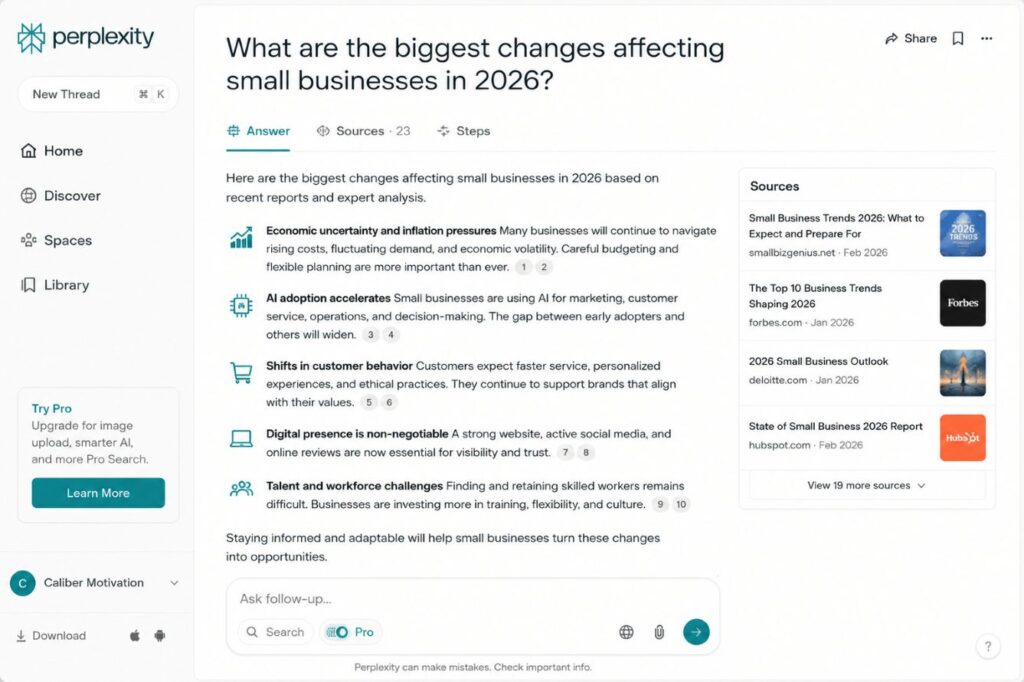
Markets rarely stand still. Customer behavior shifts, new competitors appear, technology changes, and yesterday’s strategy can lose momentum fast.
Perplexity is useful here because it can pull together recent news, industry reports, company announcements, and other current sources around a specific market. That gives you a broader picture without forcing you to piece everything together from separate searches.
The key is to get specific. Instead of asking, “What are the trends in my industry?” narrow the question by time frame, customer type, or market.
For example, ask what has changed during the past six months and which shifts could affect a business like yours. Then follow the citations into the reports or announcements that matter most.
Used this way, Perplexity helps you spot change earlier and decide which trends deserve attention before they become obvious to everyone else.
4. Understand What Your Target Customer Is Asking
Good market research starts with listening. Customers constantly reveal what they want through questions, complaints, reviews, forums, and public discussions.
Perplexity can bring those conversations together and help you see what keeps coming up. Instead of relying on one loud complaint, look for the same problem appearing across several sources.
Those patterns can reveal more than customer frustration. They can point toward better products, stronger FAQs, clearer product descriptions, useful blog topics, and gaps in customer support.
You can also take the research deeper with follow-up questions. Ask which complaints appear most often, which customer groups mention them, and whether competitors are already solving the problem well.
The goal isn’t to guess what customers want. It’s to find evidence of what they already care about.
5. Validate Statistics Before Publishing Content
A single bad statistic can weaken an otherwise strong article. The problem is that outdated numbers, incorrect dates, and unsupported claims can spread quickly online.
Perplexity can help you trace those claims back to their sources. Instead of simply asking whether a statistic is correct, ask where it originally came from, when it was published, and whether newer data is available.
This is especially useful when checking AI-generated content. A confident answer from an AI tool can still contain an old number, misquoted study, or statistic repeated without the original context.
However, a citation alone does not prove a claim is accurate. Open the source, check the date, and make sure it actually supports what you plan to publish.
That extra minute of verification can protect the credibility you spent years building.
6. Find Credible Sources for Blog Posts
Research can take longer than writing when you know what information you need but cannot find a source worth citing.
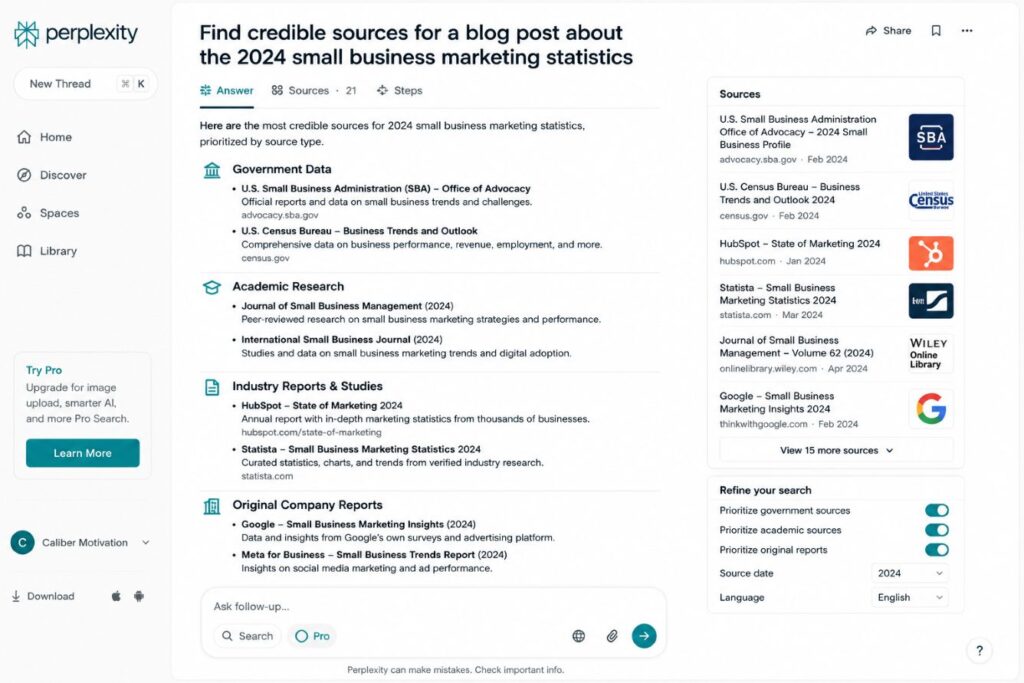
Perplexity can narrow that search by looking across different types of sources and bringing the strongest options into one place. Instead of accepting whatever ranks first, you can tell it what kind of evidence you want.
For example, ask it to prioritize government data, academic research, original company reports, industry studies, or other primary sources. When a topic needs stronger evidence, you can also narrow your research toward academic sources instead of relying on general web results.
That becomes especially useful when you are writing about statistics, market numbers, research findings, or anything that can change over time.
Perplexity helps you find the evidence faster. However, you still need to open the source, check its date and credibility, and make sure it actually supports what you plan to say., or claims that could change over time.
7. Research Products and Materials Before Sourcing
Choosing a product or material involves more than finding a supplier with the right price. Quality standards, common defects, customer complaints, and competing products can all affect what you decide to sell.
Perplexity can help you explore those questions before you start contacting manufacturers. Ask about commonly used materials, reported problems, relevant standards, competing features, and recent developments within the product category.
Then take the research deeper. If a certain material keeps appearing, investigate why manufacturers use it, what alternatives exist, and what customers say about its durability or performance.
This gives you a better foundation when you finally talk with suppliers. You can ask sharper questions because you already understand the basic terminology, potential problems, and available options.
However, online research cannot verify a manufacturer’s claims or guarantee product quality. Use Perplexity to become a better-informed buyer, not as a replacement for samples, testing, and direct supplier conversations.
8. Compare Software and Business Tools
Choosing business software can turn into hours of opening tabs, reading reviews, and comparing features that may already be outdated.
Perplexity can speed up that process by researching several tools at once. Ask it to compare the features that actually matter to your business, such as pricing, integrations, free-plan limits, customer support, and business size.
You can also make the comparison specific to your situation. Tell Perplexity what you need the software to accomplish, your budget, and which features you cannot compromise on.
Instead of giving you a generic list of “best” tools, the research can help narrow your choices based on what fits your needs.
Then use the source links to check current pricing, plan limits, and features directly on each company’s website. Software changes constantly, so that final verification matters.
The goal isn’t to find the tool everyone recommends. It’s to find the tool that makes sense for the way you actually work.
9. Research Pricing in Your Niche
Pricing gets difficult when you have no idea what the rest of the market is charging. Set your price too low and you can destroy your margins. Set it too high without enough value behind it and customers may walk away.
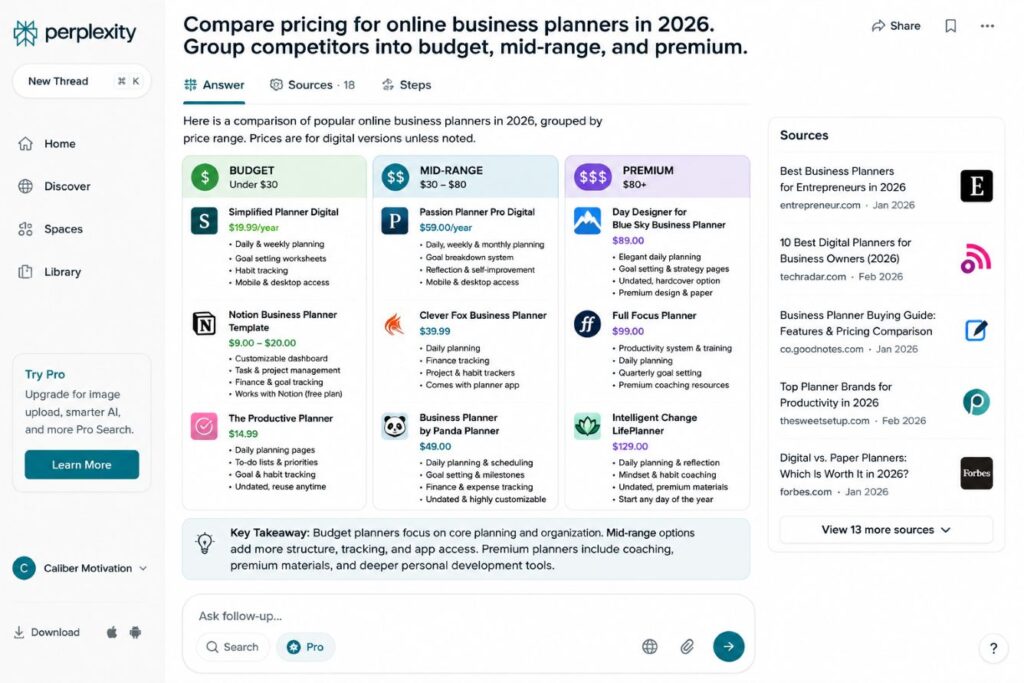
Perplexity can help you build a clearer picture of the current market. Ask it to research competitor prices, packages, subscription levels, discounts, and the features included at different price points.
Then look beyond the numbers. A $50 product and a $100 product may serve different customers, offer different quality, or solve different problems.
You can also ask Perplexity to group competitors into budget, mid-range, and premium positions. That makes it easier to see where your own offer fits and where there may be room in the market.
However, competitor pricing should give you context, not dictate your price. Your costs, margins, quality, positioning, and customer value still determine what you should charge.
10. Track Industry Changes and Emerging Threats
A business can be running smoothly while the market around it quietly changes. New regulations, technology, platform updates, supply problems, and shifting customer habits can quickly change what works.
Perplexity can help you keep up without manually checking dozens of websites. Ask it to research recent developments within your industry and summarize the changes most likely to affect businesses like yours.
You can make the research more useful by setting a time frame. For example, ask:
“What significant changes have happened in my industry during the past 30 days, and which ones could affect a business like mine?”
Then dig deeper into anything that matters. Follow the sources, compare different reports, and determine whether the change requires action or simply deserves watching.
This can turn Perplexity into a regular business intelligence tool rather than something you only open when you have a question.
The earlier you see a meaningful change, the more time you have to decide what to do about it.
11. Find Content Topics Competitors Have Overlooked
You don’t need another generic blog idea. You need to find questions people are asking that your competitors have not answered well.
Perplexity can help uncover those gaps by researching common questions, discussions, and search topics within your niche. Then you can compare what people want to know against what competing websites already cover.
Look beyond topics nobody has written about. Some of the best opportunities come from subjects competitors have covered, but covered poorly.
You may find articles with outdated information, shallow explanations, missing examples, or important follow-up questions left unanswered. Those weaknesses give you a chance to create something more useful.
Perplexity can also help you explore related questions and different angles around the same subject. That can turn one promising idea into several pieces of content built around what your audience actually wants to know.
Finding a content gap does not guarantee rankings. However, it gives you something far more valuable than another random keyword: a reason for your content to exist.
12. Evaluate Potential Affiliate Products and Programs
A high commission does not make an affiliate program worth promoting. If the product is a poor fit for your audience, the extra income is not worth losing their trust.
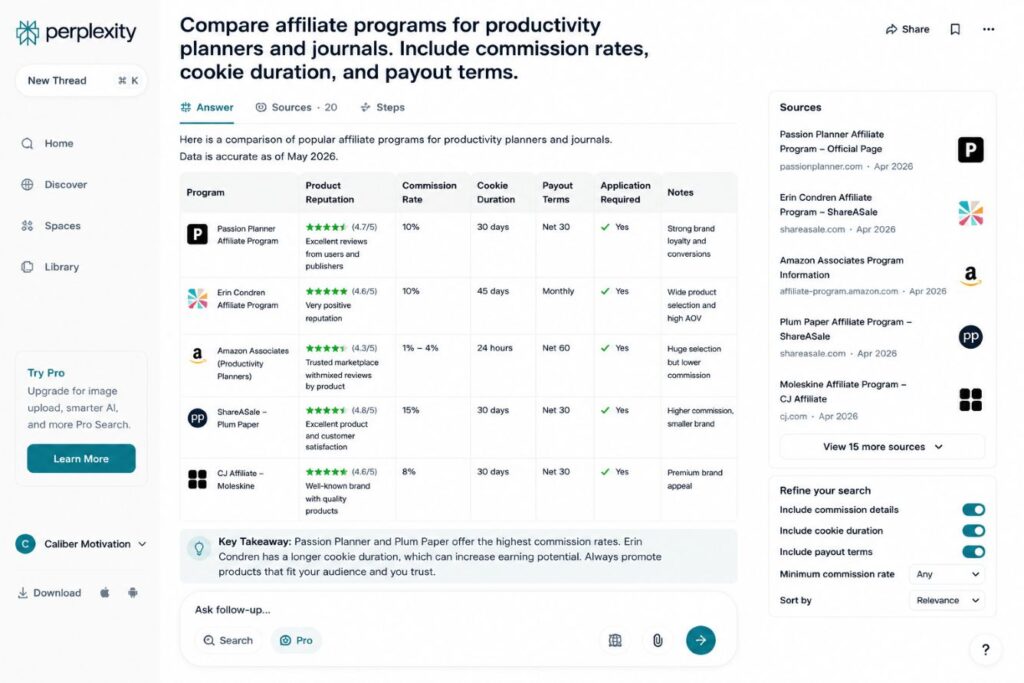
Perplexity can help you investigate an affiliate opportunity before you apply or recommend anything. Research the company, product reputation, commission structure, cookie duration, payout terms, and feedback from other publishers.
You can also compare several programs at once. This makes it easier to see which offers provide fair terms while still matching the needs of your audience.
However, affiliate programs change. Once Perplexity helps you narrow the options, visit each program’s official website and verify the current commission rates, requirements, and terms yourself.
Then look beyond the numbers. Ask whether you would still recommend the product if there were no commission attached to it.
If the answer is no, it probably does not belong on your website.
13. Upload and Analyze Business Documents
Long reports and dense documents can bury the information you actually need. Perplexity can help you work through them without reading every page from beginning to end.
Upload a supported document and start asking specific questions about its contents. You can have Perplexity summarize sections, locate figures, compare information, explain complicated language, or pull out the points most relevant to your business.
That makes document analysis more interactive. Instead of accepting one broad summary, you can keep asking follow-up questions and dig deeper into anything that catches your attention.
For example, a long industry report could become a conversation about market growth, customer behavior, or the specific numbers that affect your business.
However, be careful about what you upload. Avoid sharing confidential, private, or sensitive business information unless you understand how the platform handles your data.
Additionally, AI can help you understand a document, but it should not make high-stakes decisions for you. Legal contracts, financial documents, and other important materials still deserve review from a qualified professional.
14. Build Deeper Reports With Perplexity Research
Some business questions are too big for a single search. You may need to understand competitors, pricing, customer demand, market trends, and industry changes before you can see the full picture.
Perplexity’s deeper research tools can handle that kind of work across multiple searches. It gathers information from different sources, connects the findings, and organizes them into a more complete research report.
That can save hours when you are exploring a new market, planning a product, studying an industry, or preparing for an important business decision.
You can also continue the research after the report is finished. Ask follow-up questions, challenge a conclusion, investigate conflicting information, or dig deeper into one part of the findings.
However, a polished report can still contain weak sources or incorrect conclusions. Treat it as a research starting point, not unquestionable fact.
For decisions that could cost you serious time or money, open the important sources and verify the evidence yourself.
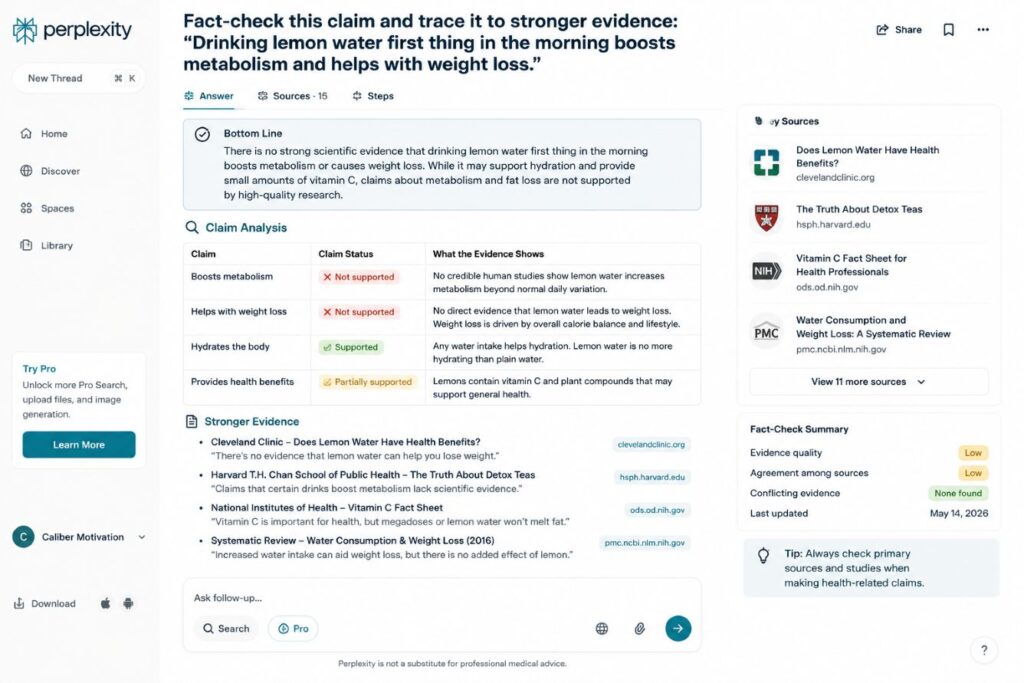
15. Fact-Check Other AI-Generated Content
AI can help you create faster, but factual claims still need proof.
ChatGPT, Gemini, and other generative tools can produce strong drafts while getting dates, statistics, quotes, or studies wrong.
Perplexity is useful because it can help you trace those claims back to stronger evidence. Instead of asking another AI whether something is true, use it to locate the report, study, company page, or primary source behind the claim.
That gives you a cleaner workflow:
Create with AI. Research with Perplexity. Publish with confidence.
The point is not to make one AI police another. It is to use Perplexity to shorten the path between a claim and the evidence behind it.
AI should make you faster. It should not make you careless.
How to Get More From Perplexity
Getting better results from Perplexity starts with using the right research approach for the question. A quick business question and a deep industry investigation do not need the same kind of search.
For everyday research, start with a focused question and use follow-up searches to narrow the results. Perplexity can suggest related questions that help you explore angles you may not have considered.
For more specialized research, choose sources that fit the subject. For example, academic research can help you find studies and scholarly material instead of relying only on general web results.
When the question is more complex, Perplexity’s deeper research tools can investigate multiple sources and bring the findings together. This works well for competitor research, market analysis, industry changes, and other questions with several moving parts.
Use Collections to Build a Research System
One of Perplexity’s most useful features is the ability to organize ongoing research around a subject or project. Instead of treating every search as a separate task, Collections can keep related research together.
An entrepreneur could create Collections for:
- Competitor research
- New product ideas
- Industry trends
- Customer research
- Content ideas
- Suppliers and materials
Over time, that turns Perplexity into more than a place to ask random questions. It becomes an organized research system you can return to as your business grows.
Perplexity for Entrepreneurs: Overview and Features
| Feature | Details |
|---|---|
| Best For | Live web research, competitor research, comparisons, and fact-finding |
| Key Features | Web search, cited answers, deeper research tools, file analysis, and source links |
| Pricing | Free and paid options are available; check Perplexity directly for current pricing |
| Core Advantage | Brings research and sources together so you can investigate questions faster |
Pro Tip: Use Perplexity and ChatGPT Together
You do not need one AI tool to do everything.
Think of Perplexity as a smarter search engine. Use it when you need current information, source-backed research, competitor data, or a fast way to investigate a question.
Then move into ChatGPT when you want to brainstorm, write, organize ideas, build a plan, or turn that research into something useful.
The advantage comes from using each tool for what it does best.
If you want more practical ways to use ChatGPT in your business, read our 15 Smart Ways to Use ChatGPT for Entrepreneurs guide next.
For more tools, comparisons, and practical ways to use AI in your business, explore our AI for Entrepreneurs hub.
Disclosure: This post may contain affiliate links. If you purchase through these links, Caliber Motivation Co. may earn a small commission at no extra cost to you.
Recommended Perplexity Books
If you want to go beyond basic searches, a good guide can help you build stronger research habits and get more from Perplexity. These two books cover different skill levels, so choose the one that matches how deeply you want to use the platform.
Perplexity: The Research Playbook
Best for: Beginners and everyday business research
Perplexity AI: The Research Playbook: Master AI-Powered Research — From Pro Search to Deep Research, Spaces, and Beyond (AI for Everyone) by Ken Tannenbaum is a 2026 guide to using Perplexity for serious research. It covers search modes, models, research workflows, citations, and ways to get more useful results from the platform.
Perplexity: The Advanced Research Playbook
Best for: Entrepreneurs who want advanced research workflows
Perplexity AI: The Advanced Research Playbook: Advanced Query Architecture, the Perplexity API, and Enterprise Research Workflows by Ken Tannenbaum goes beyond basic Perplexity searches. It covers advanced query design, API use, and more complex research workflows for people ready to take the platform further.
Final Thoughts on Perplexity for Entrepreneurs
Better information can lead to better decisions.
Perplexity will not run your business for you. However, it can shorten the distance between having a question and finding useful information worth acting on.
That means less time digging through search results and more time understanding markets, competitors, customers, and opportunities.
Ultimately, Perplexity for entrepreneurs works best as a research partner. Ask better questions, stay curious, and use what you learn to make sharper business decisions.
Turn Your Research Into Action
Knowing what to do and actually doing it are two different things.
Research can point you in the right direction. However, discipline determines whether you follow through.
At Caliber Motivation Co., we build tools for people who are serious about turning plans into consistent action.
Visit the Caliber Motivation Co. Shop to explore planners, growth tools, apparel, and resources built for discipline, focus, and long-term progress.
Join The Standard
Get practical articles on discipline, mindset, structure, and execution delivered straight to your inbox.
No hype. No fluff. Just real-world strategies to help you stay focused and keep building.
No spam. Unsubscribe anytime.