
Problem solving is one of the most valuable skills you can develop if you’re going to build a business that lasts.
I spent years believing hard work was enough.
If I worked longer hours, took on more jobs, and stayed busy, I figured the money would eventually follow. As a landscaper, I’ve spent countless days working in the Florida heat until I was completely exhausted.
The strange thing was that some of my hardest days were not my most profitable.
The brutal truth is that the market does not pay you for effort.
It pays you for the value you create by solving problems.
That lesson changed how I viewed business. The entrepreneurs who earn the most are rarely the people working the hardest physically. Instead, they are usually the people solving the biggest problems.
If you want to build true self-sufficiency, problem solving must become one of your most valuable skills.
What Problem Solving Really Means
If you wait until something breaks, you’re already behind.
However, the best entrepreneurs solve problems before they become emergencies.
They identify obstacles.
They remove friction.
They simplify complexity.
They create systems that make life easier for other people.
Every successful business exists because it solves a problem.
You don’t earn money because you work hard. You earn money because you solve problems. Customers spend money when you remove a frustration, solve a challenge, or help them reach a goal.
Think about the businesses you interact with every day:
- Mechanics solve transportation problems.
- Software companies eliminate wasted time and improve efficiency.
- Landscapers solve maintenance and property management challenges.
- Contractors solve construction and repair problems.
- Accountants solve tax and financial issues.
- Consultants help businesses make better decisions.
The industry does not matter.
The principle remains the same.
Businesses create value by removing obstacles. The larger the obstacle and the better the solution, the more valuable that business becomes.
That is why problem-solving sits at the top of the Self-Sufficiency Pyramid.
The Trap of Easy Work
You will be tempted to look for easier work.
You will see people promising shortcuts, passive income, and quick success. You will hear that there is an easier path.
However, easy work usually attracts the most competition.
When a task requires little skill, little responsibility, and little risk, almost anyone can do it. As a result, prices fall and profits shrink.
The marketplace rewards value.
Value often exists on the other side of difficulty.
If anyone can do what you do, you become easier to replace.
If you develop skills that few people are willing to learn, you become more valuable.
If you solve problems that others avoid, you create opportunities that others never see.
Therefore, the goal is not to find easier work.
The goal is to become harder to replace.
The goal is to build skills, judgment, and experience that increase your value over time.
That’s where better opportunities, higher income, and greater freedom are usually found.
The Money Is Around the Mower

I learned this lesson firsthand running a landscaping business.
You might think the money is in pushing a mower.
It isn’t.
Almost anyone can buy a mower and cut grass.
The real money is around the mower.
When a customer’s lawn starts dying, they don’t need someone to cut it shorter. They need someone to identify the cause.
When drainage problems turn a yard into a swamp, they need a solution.
When irrigation systems fail, they need someone who can diagnose the issue.
When schedules fall apart, equipment breaks down, or unexpected problems appear, they need someone who can think clearly under pressure.
That is where your value increases.
Customers pay for certainty.
They pay for clarity.
Most importantly, they pay for outcomes.
The moment you stop selling labor and start selling solutions, your value begins to rise.
Bigger Problems Create Bigger Opportunities
You may want fewer challenges.
Less pressure.
Fewer difficult decisions.
That sounds appealing. However, growth usually moves in the opposite direction.
The more responsibility you are willing to carry, the more opportunities become available.
As your responsibilities grow, your problems change.
You stop worrying only about today’s tasks.
You start thinking about customers, systems, operations, finances, and long-term growth.
Each level brings more pressure.
However, each level also creates more opportunity.
Responsibility and reward tend to grow together.
That is why avoiding difficult problems often limits your future.
You do not need to be the smartest person in the room to succeed.
You do need the willingness to step forward when others step back.
The marketplace rewards that willingness because responsibility is rare.
Why Expertise Creates Leverage
One of the most important lessons in business is understanding the difference between a commodity and an expert.
A commodity competes on price.
An expert competes on results.
Anyone can lower their prices.
Very few people can consistently deliver outcomes.
That distinction changes everything.
When your knowledge helps solve expensive problems, price becomes a smaller part of the conversation.
Your clients are not buying your time.
They are buying confidence.
They are buying experience.
They are buying a result they cannot easily create on their own.
That is why every hour you spend improving your ability to solve difficult problems increases your future earning potential.
A Resource for Building Expertise

If there is one lesson that separates high-value entrepreneurs from everyone else, it is this:
Stop selling effort.
Start building expertise.
Disclosure: This post may contain affiliate links. If you purchase through these links, Caliber Motivation Co. may earn a small commission at no additional cost to you.
That is one of the core ideas in The Business of Expertise by David C. Baker. If you want a deeper understanding of how expertise creates leverage and long-term opportunity, this book is worth adding to your reading list.
Baker argues that many business owners accidentally position themselves as commodities. They compete on price, accept whatever work comes through the door, and struggle to stand out from the crowd.
Experts operate differently.
They develop specialized knowledge.
They solve problems other people cannot solve.
They create results that are difficult to replicate.
As a result, they attract better opportunities and often command higher fees.
That idea aligns perfectly with problem solving.
The bigger the problem you can solve, the more valuable you become.
How Entrepreneurs Become Better Problem Solvers
Problem solving is not a talent.
It is a skill.
Like every skill, it improves with practice.
You can strengthen it by:
- Studying your industry deeper than your competitors.
- Asking better questions before offering solutions.
- Looking for root causes instead of symptoms.
- Building systems that prevent recurring issues.
- Taking ownership when problems appear.
- Learning from mistakes instead of avoiding them.
Additionally, challenge yourself on purpose.
Comfort rarely builds expertise.
Difficult situations do.
Every problem you solve today becomes experience you can leverage tomorrow.
Problem Solving and the Self-Sufficiency Pyramid
Problem solving is the final layer of the Self-Sufficiency Pyramid.
Each level builds on the one before it.
1. Radical Resource Management
First, you learn to control your time, energy, and money.
Without resource management, you remain trapped in survival mode.
If you want greater control over your time, energy, and resources, the Resource Control System provides a practical framework for tracking what matters most.
2. Digital Distribution
Next, you learn how to make yourself visible.
Even the best solution in the world cannot help anyone if nobody knows it exists.
3. Problem Solving
Finally, you convert visibility into value.
This is where revenue is created.
This is where trust is earned.
This is where businesses become sustainable.
Without problem solving, attention is just noise.
You can have thousands of followers, a polished website, and endless content. However, if you cannot solve meaningful problems, the market eventually moves on.
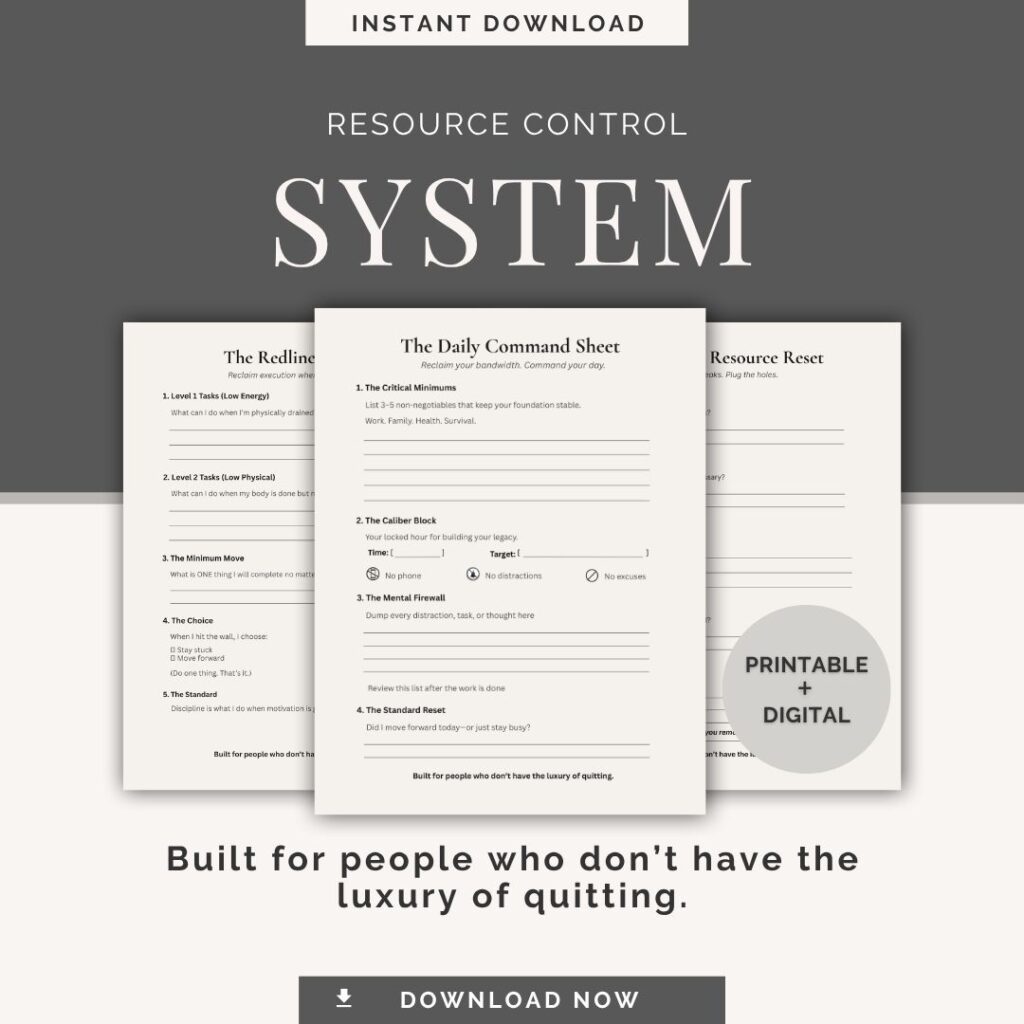
If you want greater control over your time, energy, and resources, the Resource Control System provides a practical framework for tracking what matters most.

If you’re ready to stop guessing and start tracking what actually moves your brand forward, check out the Content Output Tracker.
Stop Looking for Easy
The entrepreneur who solves easy problems competes with everyone.
The entrepreneur who solves difficult problems becomes difficult to replace.
That is where premium pricing lives.
That is where opportunity lives.
That is where freedom lives.
Stop looking for easier work.
Start building the skills required to solve harder problems.
Because the market rarely rewards effort alone.
It rewards people who make difficult things easier for everyone else.
If you are serious about building true self-sufficiency, start by mastering your resources, increasing your visibility, and strengthening your ability to solve meaningful problems.
Because freedom is rarely found in easy work.
Freedom is found in becoming valuable.
If you have not already, read Radical Resource Management for Entrepreneurs and Digital Distribution: Why No One Sees Your Work to complete the first two levels of the Self-Sufficiency Pyramid.
Ready to build a stronger foundation? Visit the shop and explore the tools designed to help entrepreneurs develop discipline, clarity, and long-term self-sufficiency.