Have you ever spent hours staring at a blank screen? You want to build online income without shipping physical packages. You also want to stop trading every single hour for a paycheck. If so, you are in the right place. Maybe you have seen creators selling specialized templates, graphics, or business toolkits. You probably wondered, “What does that actually look like in the real world?” Today, we are pulling back the curtain on niche digital products. You will learn how to turn your existing skills into scalable online assets.
Think of this guide as your grounded, zero-assumption masterclass. You might be an absolute beginner who just learned about digital downloads. Or maybe you listed a few files online and heard crickets. Either way, this guide will give you an “aha!” moment. We will break down why generic products struggle. You will learn how to spot opportunities in micro-niches. Finally, we will cover licensing and how to build a high-value digital store
What Are Niche Digital Products (and Why Do They Beat Generic Ones)?
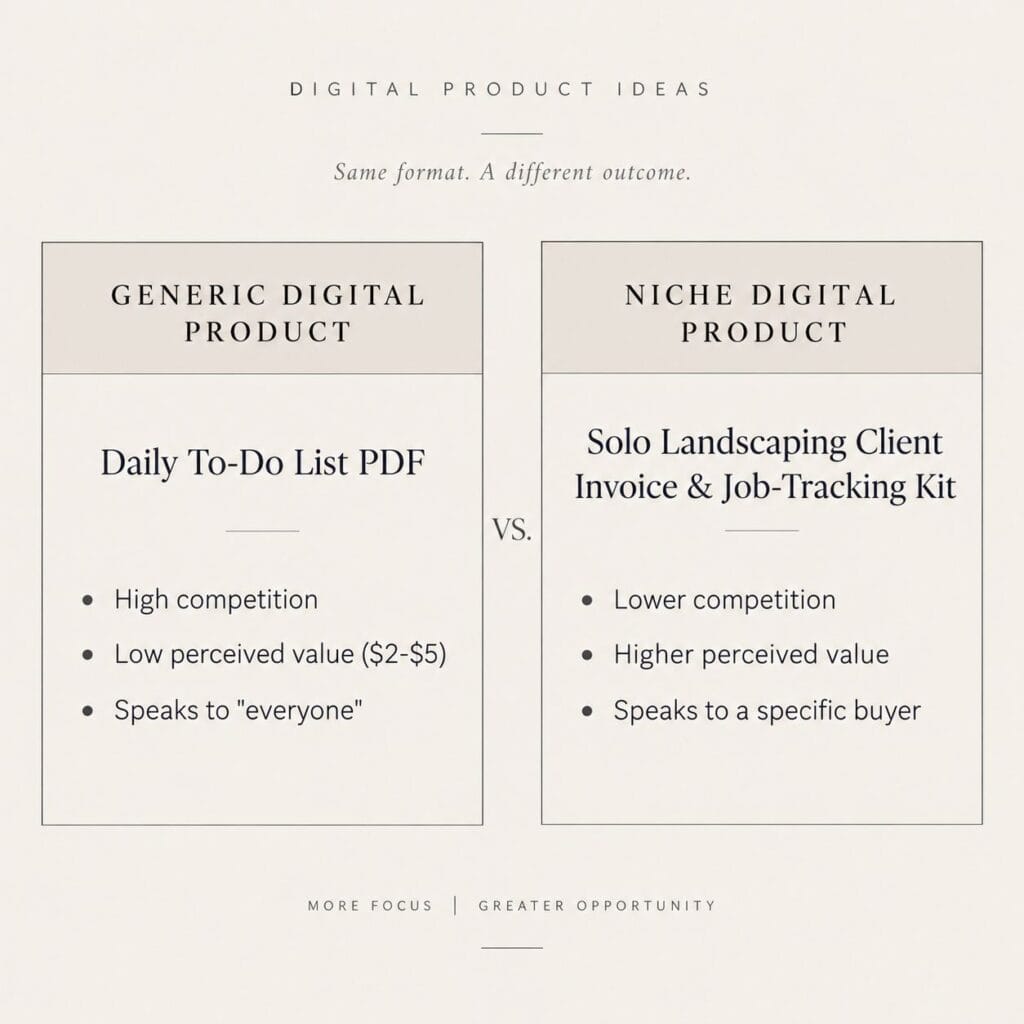
To understand why this business model is so effective, let’s compare two different scenarios. Imagine Person A decides to make a generic “Daily To-Do List PDF” and puts it online for $2. They are immediately competing against two million other identical planners, free downloadable templates, and standard notepad paper. Unless they have a massive social media following or an enormous ad budget, getting consistent visibility is an uphill battle.
Now look at Person B. Instead of making a general planner, Person B creates a “Solo Landscaping Business Job-Tracking & Client Invoice Toolkit.” It includes customized job site checklists, client estimate spreadsheets, and seasonal lawn care schedules. Because it solves a specific problem for a specific group of business owners, Person B may be able to charge $9, $15, or $19 instead of competing with $2 generic planners. That is the fundamental advantage of focusing on specialized digital assets over broad, oversaturated categories.
When you narrow your focus, your marketing suddenly becomes much clearer. It isn’t effortless—you still have to put in the work to get in front of the right audience—but you are no longer shouting into the void. Instead of trying to convince the entire internet to buy your product, you are speaking directly to a tight-knit group of people actively looking for a solution to a specific headache. They do not want a massive, 50-hour video course—they want the exact blueprint, spreadsheet, or workflow that saves them ten hours of manual labor this week.
The Power of B2B: Why Businesses Pay More for Digital Assets
If you want to create higher-value products, it helps to understand B2B. B2B means business-to-business, which simply means one business sells something to another business.
A casual consumer might buy a $3 habit tracker for personal use. However, a freelancer, agency, or small business owner may view a digital asset as a business tool. If that tool saves time, reduces mistakes, or makes work easier, the buyer may be willing to pay more for it.
- Saves High-Value Labor Time: If a template saves a business owner several hours of setup, that time has real value. A useful toolkit can quickly pay for itself.
- Reduces Costly Errors: Standardized intake forms, checklists, and calculation sheets can reduce mistakes. They also make it easier for a business to follow the same process every time.
- Standardizes Operations: Small businesses often struggle to create repeatable systems. A ready-to-use workflow gives them a structure they can use again and again.
When you build digital products around efficiency, consistency, and fewer mistakes, the value becomes easier to understand. That makes the price easier for a business owner to justify.
Understanding Digital Asset Licensing (What You Are Actually Selling)
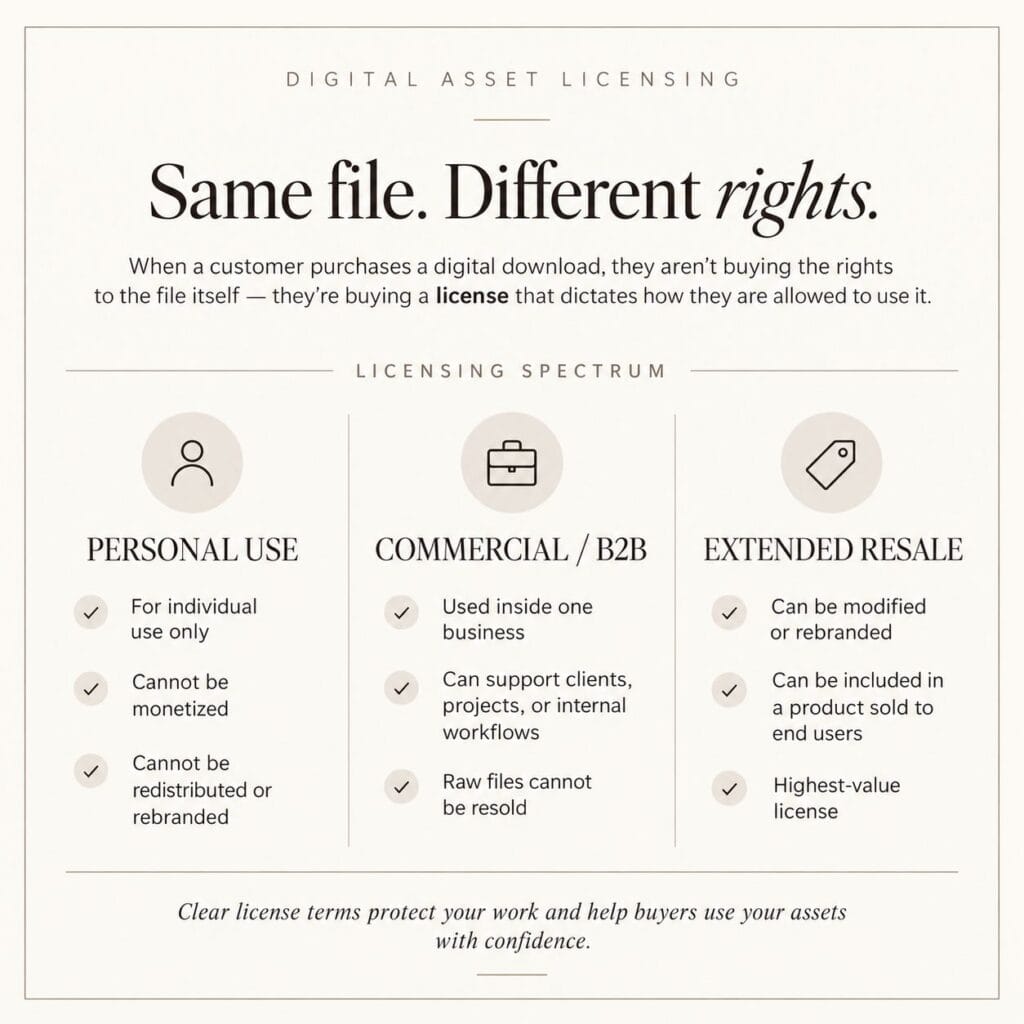
When you sell niche digital products, you rarely give away full ownership of your creation. Instead, you give the buyer permission to use it in specific ways. That permission is called a license.
Think of it like buying software. When someone buys your template, they can use it for their own work. However, that purchase does not allow them to copy it, resell it, or claim they created it. The license sets clear ground rules.
Personal Use
A personal-use license means the buyer can use the product for themselves. For example, someone might buy a daily journal or habit tracker for home use. They cannot sell copies, give the file away, or turn it into a commercial product.
Commercial Use
A commercial-use license allows the buyer to use the product inside their business. For example, a photographer might buy a client onboarding document. They can use it with their own clients. However, they still cannot resell your raw template file to other photographers.
Extended Resale Use
An extended resale license gives the buyer maximum flexibility. Depending on your terms, they can modify, rebrand, or bundle the asset into products they sell to end consumers. Because these rights are broader, extended licenses command higher prices.
Always state your rules clearly on your product pages. Tell buyers what they can do, what they cannot do, and how the license works. Licensing simply means you created the asset, and you decide how others can use it.
3 Core Pillars of Strong Digital Products
A digital product does not need to be complicated to be valuable. However, strong niche digital products usually do three things well:
- It Solves a Specific Problem: People buy digital products to save time, reduce stress, or make tasks easier. The clearer the problem, the easier it is for buyers to see the value.
- It Is Easy to Use: Your customer should open the file and understand what to do within minutes. Clear instructions and clean formatting make the asset much more useful.
- It Feels Complete: A single blank page feels basic. However, a pre-formatted template paired with simple instructions and supporting worksheets feels like a complete solution.
Finding & Validating Your Micro-Niche (The Smart Way)
You do not need to be an industry celebrity to create helpful resources. However, you do need practical experience with the problem you are solving. The best ideas come from your own daily workflows and systems.
1. Identify a Specific Audience & Problem
Start with a group of people whose daily routines you understand. Think about small business owners, freelancers, or busy professionals. What repetitive tasks slow them down every week?
For example, a freelance graphic designer might struggle with client onboarding. A solo landscaper might struggle with tracking job estimates. When you build a template that fixes a specific headache, you create immediate value.
2. Validate Real Demand Before Building
Before spending days building an asset, check if people are actively looking for a solution:
- Google Autocomplete: Type terms like “landscape estimate sheet” or “onboarding checklist” into search engines. Autocomplete suggestions show what people are typing. Keep in mind: search volume shows curiosity, not guaranteed sales.
- Marketplace Feedback: Browse existing listings on Etsy or specialized forums. Read buyer reviews to see what people wish those tools included.
- Direct Questions: Ask business owners in your target niche about their biggest operational headaches.
3. Package & Launch Your Storefront
Once you validate an idea, follow this simple execution framework:
- Build the Product: Create clean, functional templates using tools like Canva, Google Sheets, or web design software.
- Define the License: Include a clear welcome document that outlines whether the purchase is for personal or commercial use.
- Write Outcome-Focused Copy: Explain how the tool saves time, cuts out guesswork, and standardizes daily work.
- Optimize for Search: Use clear titles, clean URL slugs, and target keywords so potential buyers can find your shop organically.

Your Next Steps: Building Assets That Last
Building a digital product business takes consistent effort. It is not an overnight shortcut or an automated cash machine. Driving traffic, refining your offers, and serving your customers requires real work.
However, focusing on high-value, licensed B2B toolkits allows you to build assets that deliver lasting utility. Take an inventory of your current skills and operational templates today. Identify one tested workflow that could save someone else hours of frustration, package it cleanly, and put it to work.
You don’t need to build an entire digital store this week. Start with one useful product that solves one clear problem, make it easy to use, and learn from what happens next.
Disclosure: This post may contain affiliate links. If you purchase through these links, Caliber Motivation Co. may earn a small commission at no extra cost to you.
Further Reading
If you’re serious about starting a digital products business, these two books are worth reading:
- The Lean Startup by Eric Ries — Learn how to test ideas, gather real feedback, and improve a product before investing too much time or money.
- The Entrepreneur’s Guide to Customer Development by Brant Cooper and Patrick Vlaskovits — Learn how to find real customer problems, test your assumptions, and build solutions around actual demand.
Build Your System. Prove Your Mettle.
Turn your ideas into structured, high-value assets with purpose and discipline. Explore the complete collection of tactical digital productivity planners, discipline reflection tools, and habit trackers at Caliber Motivation Co. Shop Get the clean, actionable frameworks you need to organize your workflow and build something that lasts.